
 LV
 EN
 RU
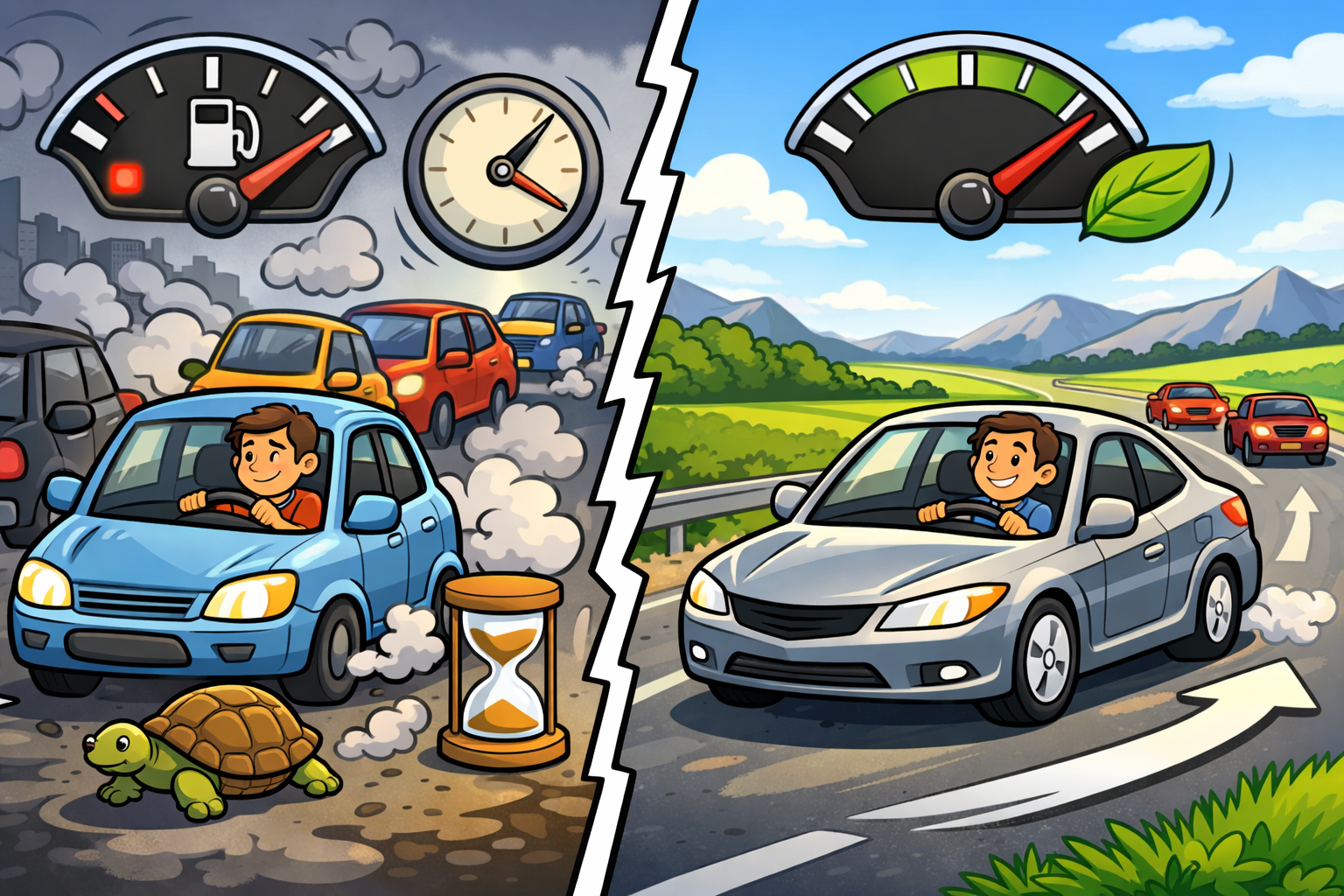
There is one idea that lives in the world of drivers almost like an obvious truth: if you drive slower, you will save fuel. And at first glance, this seems completely logical. Lower speed — lower load — lower consumption. Simple. Clear. But in reality, this story is not that simple, and in some cases it can even become the reason why a person spends more, not less.
This article is not about saying that slow driving is bad. It is about understanding that “slower” and “more economical” are not always the same thing. Because between these two concepts there is a very important factor — efficiency. And in the world of cars, efficiency is often not where people intuitively expect it to be.
That is why we will look deeper. In which situations slower driving actually helps, in which cases it changes nothing, and in which cases it can even make one kilometer more expensive. And, as always — with real examples, driver experiences, and situations that almost every driver in Latvia has encountered at least once.
Slow does not mean efficient — the main mistake in thinking
An engine works best within a certain range. Not too low in revs, not too high. Not under excessive load, but also not “struggling.” This means there is a so-called “efficiency window” where the car operates most economically.
And here comes the interesting part. If you drive too slowly, especially in the wrong gear, the engine may operate inefficiently. That means that to maintain movement, it consumes more fuel than necessary. In other words — you are moving slowly, but not economically.
A very typical situation: a person drives at 50 km/h in fifth gear, thinking it is economical. In reality, the engine is “struggling,” and fuel consumption can be higher than if the same car drove slightly faster but in a more appropriate operating range.
A comment from a driver: “I drove super calmly for a long time thinking I was saving fuel. Then at the service they explained that I was simply driving in the wrong range all the time.”
Driving too slowly increases time — and time also costs fuel
There is another aspect that people often forget. Fuel consumption is not only “liters per 100 km.” It is also fuel per unit of time. If you move very slowly, the engine runs longer to cover the same distance.
This means that a trip that could take 15 minutes suddenly takes 25 minutes. And during that time, the engine keeps running, consuming fuel. As a result, you may travel the same distance but consume more than you would have at a normal pace.
This is especially noticeable in the city. Slow, dragging-type driving without flow often means not only lower speed but also more time with the engine running.
Real situation: “slow” city driving vs steady driving outside the city
Let’s imagine two scenarios. In the first, a person drives in the city — slowly, cautiously, frequently stopping and starting. In the second, a person drives on a highway at a steady 80–90 km/h.
In the first case, the speed is lower. But consumption is often higher. Why? Because the movement is uneven. Every start, every brake, every traffic jam destroys efficiency.
In the second case, the speed is higher, but the movement is stable. And stability is often more important than speed itself when it comes to fuel consumption.
A classic phrase from drivers: “My consumption outside the city is always lower than in the city, even if I drive faster.”
Driving too slowly often leads to more braking and acceleration
This is a very interesting paradox. If you drive too slowly compared to traffic flow, you often end up in situations where you need to brake or accelerate more frequently.
You get overtaken. You adjust. You brake to let someone pass. You accelerate again. And each of these actions costs fuel. As a result, you may be driving slowly, but dynamically — and that is the least efficient combination.
On the other hand, driving in a steady flow, even slightly faster, often means fewer movements, fewer unnecessary actions, and therefore lower consumption.
Driver mistake: confusing “calm driving” with “too slow driving”
This is one of the most important points. Calm driving really does help save fuel. But calm does not mean excessively slow.
Calm driving means:
- steady speed
- less aggressive acceleration
- less braking
- anticipation ahead
Whereas overly slow driving often means:
- wrong gear
- disrupting traffic flow
- extra accelerations
- longer driving time
And these are two completely different scenarios.
When does slower driving actually help?
Of course, there are situations where driving slower really does reduce consumption. For example:
- when driving at very high speeds (above 100–110 km/h)
- when the engine is under excessive load
- when driving becomes aggressive
In these cases, reducing speed helps. But that is not the same as driving too slowly in all situations.
A real driver example from Latvia
One driver shared an interesting experience. He decided to experiment and drive to work “as economically as possible.” The result — he drove slower, avoided acceleration, but the overall consumption barely changed.
When he started driving a bit more “normally,” but more smoothly and with the flow, consumption even decreased slightly.
“I realized the problem wasn’t the speed, but that I was driving unnaturally.”
Conclusion
Driving slower does not always mean saving fuel. Fuel consumption is not only about speed — it is about efficiency. Driving too slowly, in the wrong way, and with interruptions can actually increase costs.
The most economical driving is usually neither the slowest nor the fastest. It is the smoothest. The one where the car operates in its optimal range, where movement is fluid, and where the driver does not fight the road but understands it.
And perhaps this is the most important conclusion: saving fuel does not start with reducing speed. It starts with understanding.