
 LV
 EN
 RU
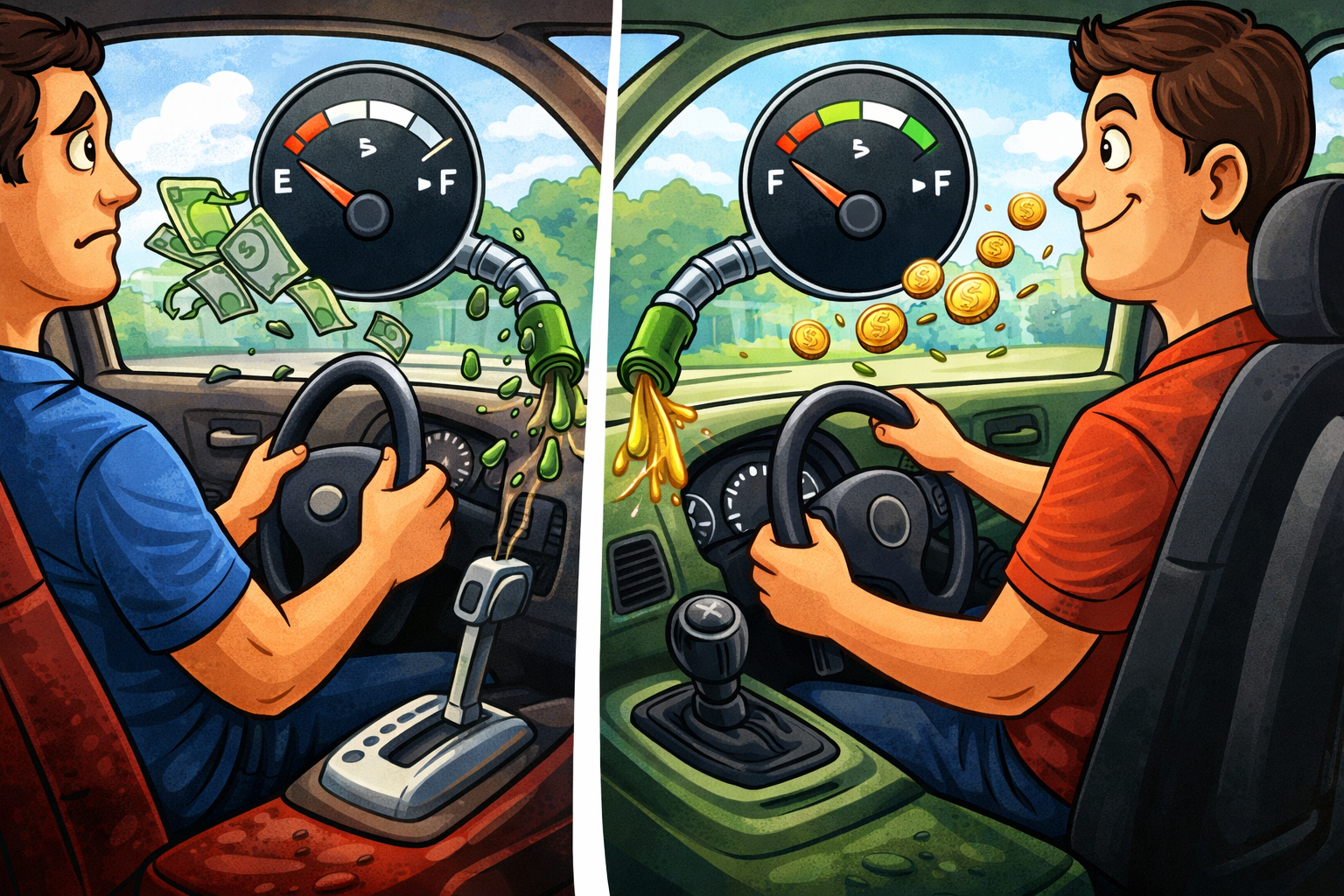
There are questions that have lived in the world of drivers for years and simply refuse to die. One of them is almost legendary: does an automatic transmission consume more fuel than a manual? For many people, the answer seems obvious before the conversation has even started. “Of course an automatic uses more.” Others wave it away just as confidently: “That hasn’t been true for a long time.” And that is exactly where the most interesting part lies — this is not a question that can honestly be answered with one short sentence.
On the one hand, this myth has a very understandable origin. Older automatics really often were thirstier, slower, heavier and less fuel-friendly. People remember that. People tell each other that. And in the car world, old truths live surprisingly long, even when reality has already changed. On the other hand, the modern idea that “an automatic is always just as economical or even better” is not always completely universal either. Because a lot depends on the car itself, the generation, the driving environment and, yes, also the driver.
That is exactly why this article will not be a dry technical argument. It will be about real life. About city traffic jams, morning commutes, highway rhythm, fatigue in traffic, a person’s habits behind the wheel, and the fact that sometimes the fuel difference is hidden not in the gearbox, but in the person themselves. Because very often the question “automatic or manual?” is not only about liters. It is also about everyday convenience, driving culture, the character of the car, and how intelligently we evaluate our costs at all.
And, as tends to happen with good car topics, the truth turns out to be much more interesting than the simple forum phrase “a manual will always be cheaper.” Sometimes — yes. Sometimes — no. And sometimes the difference is so small that completely different factors start playing the biggest role.
Why do people keep believing for so long that an automatic always consumes more?
This assumption has a very understandable history. Many older automatics really were less efficient. They shifted more heavily, thought longer, held higher revs, and often created the feeling that the car was living its own life while fuel disappeared from the tank faster than you would like. And drivers have a good memory for unpleasant things. If, at some point, an automatic really was more expensive to maintain and less pleasant in terms of fuel consumption, that feeling stays alive for a long time after the technology itself has already moved on.
That is exactly why so many people still talk about automatics as if we all lived in the same technical era. But the car world has changed a great deal in this respect. And if someone is comparing a more modern automatic to an old stereotype rather than to real everyday conditions, then they are often arguing not with today, but with yesterday.
Still, the most important thing to understand is one simple point: a stereotype by itself does not mean the question is stupid. It only means it has to be examined more deeply. Because for some cars and in some situations an automatic really can consume more. It is just no longer as universal or as automatic as people like to think.
A very typical thought from driver conversations: “For a long time I thought automatic meant more liters right away, until I started looking not at myths, but at specific cars.”
The first important truth: the gearbox alone says nothing
This is the most important point in the whole topic. People very often try to compare “automatic versus manual” as if it were just one isolated component in a vacuum. But a car does not exist in pieces. It is a whole mechanism in which the gearbox works together with the engine, the car’s weight, the software, the driving environment, and the driver’s habits. And that is exactly why the question “which gearbox consumes more?” is often too simple compared to the way things work in real life.
For example, one car with an automatic transmission may be very well tuned for calm, steady driving, while another car with a manual transmission in real life is driven in an inefficient way simply because the driver is constantly driving it incorrectly. In that situation, the “manual” itself does not save anything. Quite the opposite — it can even lose.
This is very important for people to understand if they expect the transmission type itself to solve the whole fuel story. In reality, car economics is almost never that simple. Sometimes it is much more about how the car is used than about how it is built on paper.
A manual has one big theoretical advantage — but only if the driver knows how to use it
A manual transmission has one very clear logical advantage: the driver chooses when to shift. That means that, in theory, they can keep the car in a very economical operating range, use lower revs, anticipate situations, and control the engine’s work very precisely. And yes — if a person drives intelligently, calmly and with understanding, a manual can offer very good fuel-saving potential.
But this is where a very human problem begins. Not everyone drives like that. Many shift too late. Many hold the revs higher than necessary. Many drive nervously, jerkily, or simply by feel rather than by economy. Others, on the contrary, try to “save” so hard that the car starts living in the wrong operating range, the engine gets strained, and the result once again is not optimal.
That is why the theoretical advantage of a manual does not always materialize in real life. It is like a tool — good only if you use it correctly. And this is the point where an automatic sometimes starts to strike back in a very unexpected way: it may not be theoretically “smarter” than an ideal human, but it is often more consistent than a real human.
A typical thought from driver comments: “You can drive more economically with a manual. The only question is — do you really drive like that every day?”
In the city, an automatic very often wins not in theory, but in life
If there is one environment where an automatic very often starts to recover its reputation, it is the city. Especially traffic jams, stop & go movement, slow flow, standing still every now and then, moving off again, and all that life which feels painfully familiar to drivers. In this environment, a manual demands constant involvement from the driver. Clutch, shifting, repeated movement from a stop, fatigue, inattention — all of this accumulates.
And here a very interesting factor appears: a tired person in a manual very often drives worse than a calm person in an automatic. They jerk the car more, make more mistakes with the gears, hold inefficient revs more often, and overall simply do not drive as smoothly. An automatic, meanwhile, in all of this can turn out to be not only more comfortable, but also more pragmatic in everyday life. Not because it magically saves fuel, but because it reduces human chaos.
That is why in the city, for many drivers, an automatic ultimately turns out to be not only a comfort choice, but also a fairly logical everyday economy choice. Not always by brochure numbers. But by the way those numbers are created behind a real steering wheel in real life.
On the highway, the story becomes different again
The highway is an environment where many things calm down. Less shifting, a steadier rhythm, less stop & go, fewer human mistakes. In that kind of setting, the difference between an automatic and a manual often becomes far less dramatic than people imagine. If movement is steady, then both options can live in a very reasonable operating range.
That is exactly why people who mostly drive longer, steadier routes often do not feel the huge difference that car legends promised them. And here it is very important to understand one nuance — the more even the driving environment, the fewer dramatic advantages appear for either gearbox from the point of view of everyday human mistakes.
In other words, on the highway the actual design of the car and the engine-gearbox pairing start to matter much more than the myth “automatic versus manual” as some absolute truth. And that is a very important bucket of cold water for everyone who wants one universal answer for all roads and all life situations.
Sometimes it is not the gearbox that consumes more, but the driving style around it
This is one of those conclusions people do not like at first, but later find very logical. Very often, when comparing transmissions, people attribute to the gearbox what is actually created by their own driving style. For example, a driver with an automatic gets used to driving more calmly because the car itself removes part of the tension. They jerk less, get less nervous, flow more evenly. Meanwhile, a driver with a manual sometimes drives “more actively,” uses higher revs more often, and does not perceive that as a fuel topic at all.
Or the other way around — a person with an automatic drives more aggressively precisely because the car allows them not to think about gears, and as a result fuel consumption rises not because of the automatic’s essence, but because of the person. For this reason, many conversations about “which gearbox uses more fuel” are actually conversations about how different people behave in different cars.
And that is exactly why such contradictory stories arise so often in this topic. One person says: the automatic uses less for me. Another says: my manual was cheaper. Both may be completely honest. They are simply comparing not only gearboxes, but their entire driving lives together with them.
A good driver comment: “When I switched from a manual to an automatic, I realized that not only the gearbox changed my fuel use, but the fact that I myself started driving more calmly.”
Comfort is not just comfort — it also affects consumption
Many people treat comfort as something separate from economics. As if convenience were one topic and fuel consumption another. But in everyday life, they are much more closely connected than they seem. If a car is more comfortable and easier to drive, then very often the driving rhythm itself also becomes calmer. And a calmer rhythm means less jerkiness, fewer mistakes, and sometimes lower consumption as well.
This is especially clear in the city. A manual may be economical on paper, but if the driver has to go through stress, traffic jams and repeated moving off every day, then in the long run they often do not drive as beautifully as they think. And this is exactly where an automatic begins to provide not only comfort, but something very practical too — consistency.
That is why the smart way to look at this topic is not “comfort versus economy.” The smart way is to understand that in some scenarios comfort itself helps economy, because it reduces human disorder in driving.
The repair and maintenance side is not as black and white as people tend to think either
When people talk about automatic and manual, the conversation almost always moves not only to fuel, but also to maintenance. “The automatic will break and then it’s over.” This phrase has lived an astonishingly long life. And again — it has its historical logic. Some automatics really can be more expensive to repair, and no sensible person will deny that. But here too, the most important thing is to understand that the world is not black and white.
A manual gearbox by itself does not mean life will be cheap. Clutch, dual-mass flywheel, improper use, city driving — all of that creates costs too. In other words, it is not the case that a manual is automatically “cheap,” while an automatic is automatically “expensive.” The real answer, again, is hidden in the specific car model, its technical condition, and how it is used.
And exactly the same applies to the fuel question. If a person chooses between an automatic and a manual based on a single stereotype, they are very often making a far too simple decision about a far too complicated reality.
A real-life situation: two people, two gearboxes, two completely different experiences
Let us imagine two drivers. The first lives in the city, drives to work in traffic jams every day, regularly stops and moves, is tired in the evenings, and for them a car is a daily tool, not a hobby. The second lives outside the city, drives most of the route in a steady flow, likes to drive consciously, and feels good with a manual gearbox. If these two people begin arguing about which gearbox is more economical, both will most likely be convinced that they are right.
And in a way, they both will be. For the first person, an automatic can be not only more logical in terms of comfort, but also economically very understandable as an everyday solution, because in their life environment it simply works more smoothly. For the second, a manual can allow them to use the car’s potential very intelligently and keep consumption under tighter control. Which one of them is wrong? Neither. They simply do not live in the same driving world.
And this is exactly the most important conclusion for those who want to choose their next car wisely. The question is not only “which gearbox is theoretically more economical?” The question is much more personal: which gearbox, in your daily life, will help you drive better, more calmly, and more consistently?
A very accurate comment from a driver: “I spent a long time looking for the right answer on the internet, until I realized I should have been looking for the right answer for my own daily life.”
When is a manual truly a good choice?
A manual can still be a very good choice for people who drive consciously, feel the car well, spend much of their time in a steadier rhythm, and want to control the engine’s behavior themselves. It can also fit very well for people for whom driving itself brings pleasure, rather than serving only as a logistics function. In such hands, a manual can be not only enjoyable, but also economically very sensible.
But it is important to admit the other side too — not every driver can actually make that work so beautifully in everyday life. And that is exactly where the difference begins between the theoretically “best option” and the practically “most suitable option for me.”
When can an automatic be a surprisingly sensible choice?
An automatic very often becomes a very sensible choice in city life, traffic jams, daily work routes, family logistics, and everywhere else where driving is regular, repetitive, and not always emotionally fresh. If the car is a tool for reducing everyday fatigue rather than a platform for driving pleasure, then an automatic can provide exactly that consistent calm which, in the long term, helps you drive more smoothly and sometimes also more economically.
That is why an automatic is very often no longer just a story of “I want it to be more comfortable.” It is a story of “I want my daily life to be more sensible.” And if daily life becomes more sensible, then the fuel story very often becomes far less dramatic than a person had initially imagined.
Conclusion
Does an automatic transmission consume more fuel than a manual? The honest answer is this: sometimes yes, sometimes no, but very often the difference is determined not by the gearbox itself in isolation, but by everything else around it — the car’s generation, the engine, the driving environment, and the person behind the wheel. A manual can be very economical in the right hands. An automatic can be very sensible and even surprisingly efficient in the right daily life.
The most important conclusion is not to look for one eternal winner, but to understand your life model. If a person drives in traffic jams every day, is tired, and wants a more consistent rhythm, an automatic is very often much more logical than old stereotypes allow. If a person drives consciously, calmly, and wants to control the car themselves, a manual can still be a great choice.
And perhaps that is the most sensible thing to take away from this topic: fuel consumption is not only a technical number. It is also a story about a person, their daily life, and how well a specific car fits a specific life. And that is exactly where the real answer is most often hidden.
If you want to compare how different fuel price and consumption scenarios affect your real costs, use the calculator below.