
 LV
 EN
 RU
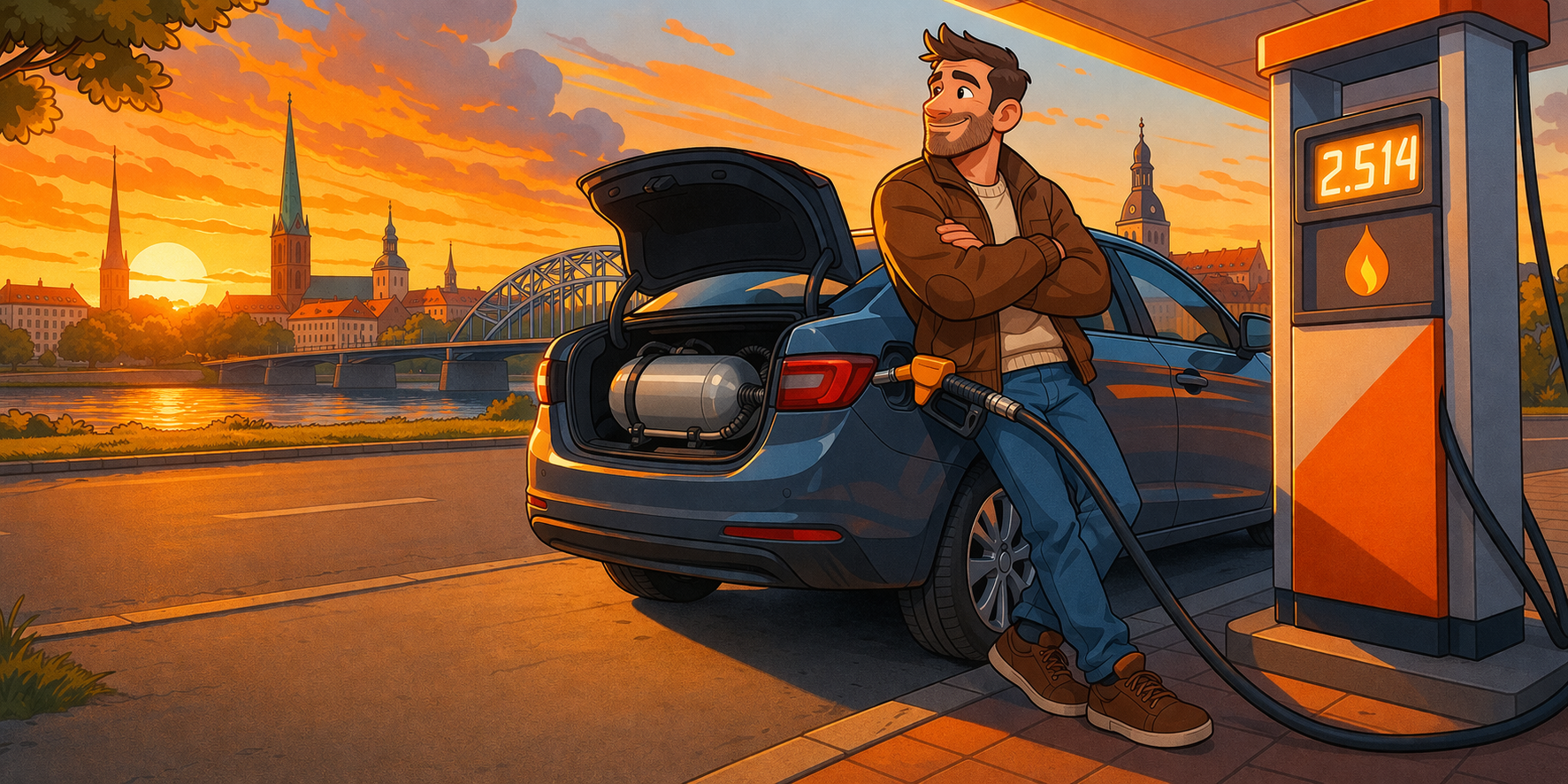
There are certain car-related topics that people approach with a bit of hesitation. Not because they are unimportant — quite the opposite. It is because they touch something very practical: everyday costs. LPG, or autogas, is one of those topics. For some drivers, it still represents a simple idea: if you want to drive cheaper, install gas. For others, it feels outdated, slightly questionable, or at least unnecessarily complicated in a time when everyone is talking about hybrids, electrification, and the future of mobility. That is why the question in 2026 sounds so natural: does it still make sense to even think about an LPG car in Latvia?
What makes this question interesting is that the answer is not a clean “yes” or “no.” The reality sits somewhere less comfortable — and more useful — in between. LPG can be a very smart solution for one driver and almost pointless for another. It can be a strong cost-saving tool if your driving habits, mileage, and expectations match the system. But it can also become a decision where the idea of saving money is more attractive than the actual daily experience.
And that is exactly why this topic remains relevant. Because an LPG car is not just about fuel type. It is a full decision with benefits, compromises, and a certain logic. It is not only about what you pay at the pump. It is also about installation costs, how it affects your trunk space, how easy it is to refuel, how the car behaves in everyday use, and most importantly — whether you will actually drive enough, and long enough, for the whole idea to make financial sense instead of just sounding good on paper.
This article is about understanding that full picture. No hype, no dismissal — just a clear, practical look at when LPG still works, and when it does not.
Why is LPG still even part of the conversation?
Because people still care about one very simple thing: how much it costs to drive. No matter how much the conversation shifts toward electrification and future technologies, a large share of drivers still live with a very practical question: how can I reduce my everyday driving costs without completely changing how I use my car?
That is where LPG keeps its place. Not because it feels modern, but because it promises something very clear — lower fuel costs. However, this is also where the first misunderstanding appears. People are not attracted to LPG itself. They are attracted to the idea of saving money. And in the world of cars, savings are never just one simple number. They depend on how much you drive, how long you keep the car, and how your daily routine actually looks.
So LPG remains relevant not because it is trendy, but because the need it addresses — reducing running costs — is still very real.
The short answer: yes, but only for certain drivers
If we simplify the answer, it looks like this: yes, in 2026 LPG cars can still make sense in Latvia — but not as a universal solution for everyone. They work best for drivers who travel a lot, plan to keep their car for a longer period, want to reduce fuel costs, and are willing to accept a few practical compromises. On the other hand, for drivers with low mileage, short ownership plans, or a desire for maximum simplicity, LPG can quickly lose its appeal.
This is the core idea. LPG is not a bad choice, and it is not automatically a great one either. It is a conditional choice. It only becomes smart when it matches your real usage.
A common forum-style observation: “LPG is great if you actually drive a lot. If you don’t, you end up enjoying the idea more than the real savings.”
Why does LPG still feel attractive?
Because it offers something very concrete and easy to understand. Hybrids often seem more expensive. Electric cars can feel complicated or not suitable for everyone’s lifestyle. Diesel comes with its own set of concerns. LPG, on the surface, looks almost brilliantly simple: take a petrol car, add a gas system, and reduce your fuel costs.
That simplicity is powerful. LPG does not feel like a completely different world. It feels like an upgrade to something familiar. You are not changing your driving life — you are optimizing it. And psychologically, that is very appealing.
But this is also where the risk lies. The simplicity is partly an illusion. LPG is not just “cheaper fuel.” It is a technical system with its own maintenance, limitations, and long-term cost logic. If a driver only looks at the price at the pump, they are only seeing half of the story.
The real question is not “is LPG cheaper?”, but “does it pay off for me?”
This is one of the most important points in this entire topic. Many drivers start with the wrong question: is LPG cheaper to run? The answer is often yes. But that does not automatically mean it is the right choice for a specific person. The smarter question is: will LPG actually pay off in my situation?
Because the answer depends on much more than fuel price. It depends on installation costs, how long you plan to keep the car, how much you drive, whether trunk space matters to you, whether refueling convenience fits your routine, and whether you are comfortable with a slightly more complex vehicle setup.
So the LPG decision does not start at the fuel pump. It starts with a mirror — asking yourself what kind of driver you actually are.
Who benefits the most from LPG?
First, drivers with higher mileage. The more you drive, the faster the fuel savings begin to work in your favor. If your car is used daily and actively, rather than occasionally, LPG becomes much more convincing.
Second, drivers who plan to keep their car longer. If you already know that you will sell the car soon, the payback logic weakens significantly. But if you plan to use the car for several years, the initial investment becomes much easier to justify.
Third, LPG is attractive for drivers who want a traditional internal combustion car experience but with lower running costs. It allows you to keep a familiar driving style while reducing the financial pressure of fuel.
As drivers often say: “If you want to drive a lot and pay less, LPG still makes sense — just don’t expect zero compromises.”
Where do the compromises begin?
This is where things become more interesting. LPG attracts people with the idea of savings, but after the decision, they live with the compromises. One of the most practical ones is space. Depending on the setup, trunk usability can change, and for some drivers that is a minor issue — for others, it matters a lot.
Another compromise is refueling behavior. LPG infrastructure exists in Latvia, but it still requires a slightly different mindset compared to petrol or diesel. Some drivers adapt easily. Others dislike the extra planning.
The third compromise is complexity. The car becomes slightly more complex — not necessarily unreliable, but less simple than a standard petrol car. And for some drivers, that alone is enough to reconsider.
The biggest mistake: focusing only on fuel, not the full ownership cycle
This is a classic trap. A driver sees lower fuel costs and assumes the decision is obvious. But car economics are never about one moment at the pump. They are about the full cycle — installation, maintenance, usage, convenience, resale, and time.
Sometimes a driver makes the “right” decision on paper but drives too little. Sometimes they drive enough but dislike the compromises. And sometimes they choose a system that looks good in theory but does not fit their real usage pattern.
That is why LPG cannot be judged in one dimension. If you only look at fuel cost, disappointment often begins right after the initial excitement fades.
LPG vs petrol: a psychological choice as much as a technical one
In many ways, LPG is not just a technical decision. It is also a psychological one. Petrol cars without LPG feel simpler, cleaner, and easier to manage. Less thinking, fewer compromises. LPG, on the other hand, appeals to those who are willing to accept a bit more complexity in exchange for lower costs.
Neither approach is wrong. But they represent different types of drivers. One values simplicity above all. The other values savings enough to accept small trade-offs. And that is exactly where the answer to the LPG question lies — not just in kilometres, but in mindset.
Used LPG car or installing a system: where do people go wrong?
In reality, drivers usually face one of two scenarios. Either they consider buying a used car that already has LPG installed, or they think about installing the system themselves. And this is where mistakes happen.
In the first case, people often get carried away by the idea that “the gas system is already there,” assuming it automatically adds value. But the real question is how well the system has been maintained and how the car has been used.
In the second case, the mistake is often overestimating the payback. Drivers imagine an ideal scenario without honestly evaluating their real mileage and ownership plans.
The smart approach here is not exciting — it is practical. Less emotion, more honest maths and self-awareness.
A very accurate comment: “LPG isn’t a bad choice. The bad choice is buying into the idea without checking if it actually fits your life.”
So — is LPG still worth considering in Latvia in 2026?
Yes, it is. But only if approached realistically. LPG can still be a very sensible option for drivers with higher mileage, clear usage plans, longer ownership horizons, and a willingness to accept practical compromises. It can allow you to keep a familiar driving experience while reducing fuel costs.
However, for drivers with low mileage, short-term plans, or a desire for maximum simplicity, LPG may not deliver what it promises. In that case, it becomes more of an appealing idea than a truly smart decision.
And that is the real answer: LPG is not about whether it still exists. It is about whether it fits your life. If it does, it can still make a lot of sense in 2026. If it does not, it is better to realise that before the purchase, not after the savings turn into a chain of small compromises.
If you want to compare how different driving scenarios affect your real costs, use the calculator below.