
 LV
 EN
 RU
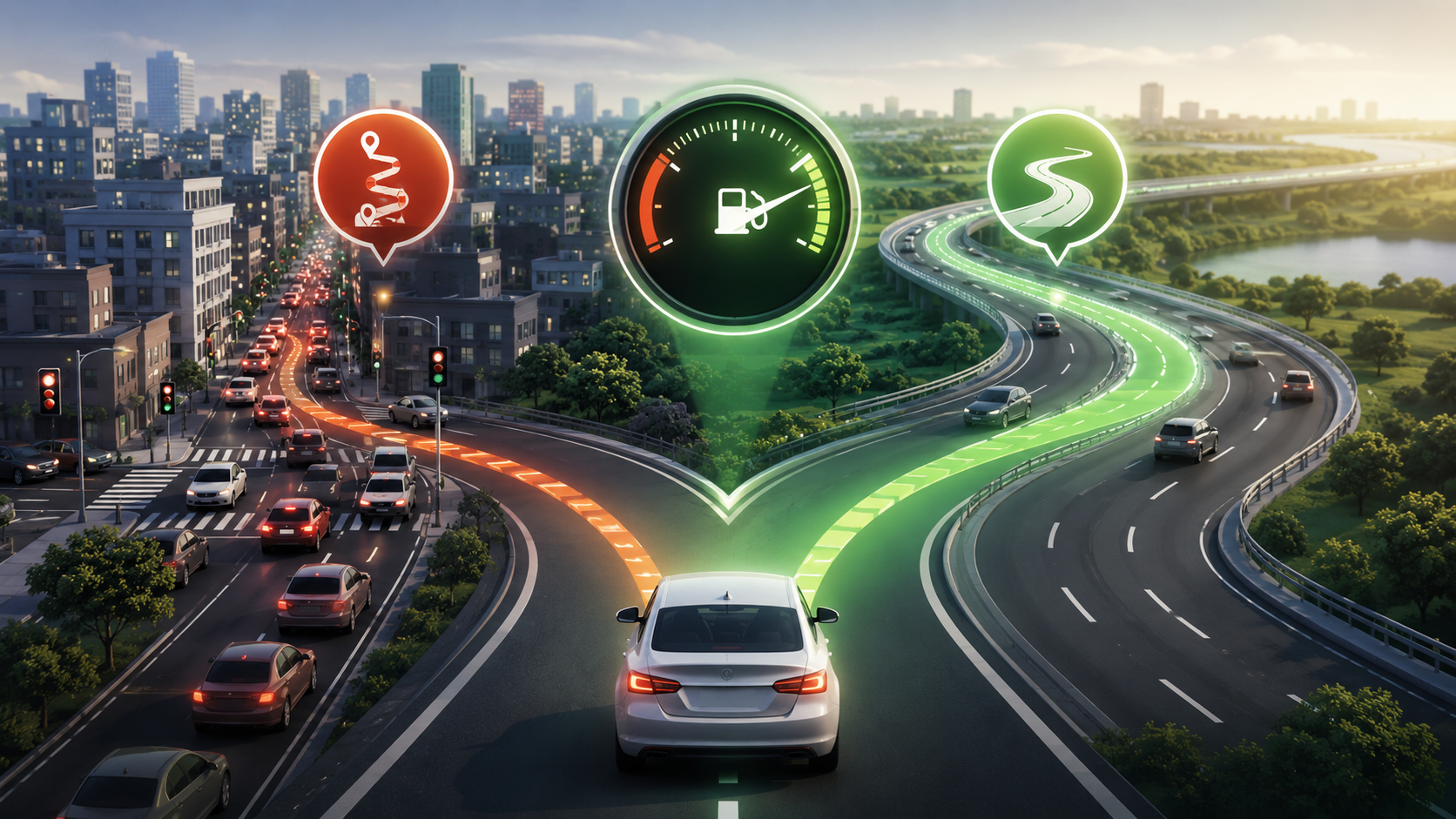
It is a very familiar situation: your navigation app offers two routes. One is a few kilometres shorter, but goes through the city, traffic lights, roundabouts and possible congestion. The other one is longer, but faster, calmer and allows smoother driving. Which one actually saves fuel?
At first, the answer seems logical: fewer kilometres should mean less fuel. But a car’s fuel consumption is not only about distance. Fuel is also used by frequent stopping, hard acceleration, a cold engine, crawling in traffic, driving uphill, gravel roads, poor road surface and excessive speed on the highway.
That is why the shortest route sometimes turns out to be more expensive than a longer but smoother road. And the opposite can also be true — the fastest route is not always the cheapest if it forces you to drive at higher speed, overtake more often or keep the engine in a less efficient operating range.
In this article, we will look at route choice from a practical driver’s point of view. Not in theory, but as it happens in everyday life in Latvia: when driving to work, to the shop, to the countryside, to the seaside, to school, to a service centre or on a longer weekend trip.
The driver’s short takeaway right at the start: the cheapest route is usually not the one with the fewest kilometres, but the one where the car can move smoothly, without unnecessary braking, rushing and standing still.
Quick answer: what should you choose in daily driving?
If you need to decide quickly, use this principle:
Choose the shortest route if it is calm, has few traffic lights and no congestion.
Choose a longer but smoother route if the shortest road means stop-start driving, standing still, hard acceleration and stressful traffic.
On the highway, the fastest option does not always win. If a faster route means driving significantly faster, the fuel benefit may disappear because of air resistance.
Very simply: fuel economy likes flow. The less often the car needs to stop and accelerate again, the better. The less the driver needs to rush, brake, change lanes and overtake, the easier it is to keep consumption at a reasonable level.
Why is the shortest route not always the cheapest?
The shortest route usually looks tempting because the kilometres are immediately visible. If one option is 12 km and the other is 16 km, the first one seems more economical. But those 12 km may go through the city, with ten traffic lights, three roundabouts, pedestrian crossings, a school zone, slow traffic and frequent braking.
Fuel consumption in city driving usually increases because the car constantly loses motion energy. You accelerate, then brake. Then accelerate again, and brake again. Every time the car needs to move off from low speed or a complete stop, the engine works harder than during calm, steady driving.
That is why the shortest road is a good choice only when it is also calm. If the shortest road is stressful, uneven and full of stopping points, fuel consumption per 100 km can become so high that the distance saving no longer helps much.
A typical example: a route that is 4 km shorter through the city centre can turn out to be more expensive than a longer route on a smoother bypass if you spend half the time braking, standing still and moving off again.
Why is the fastest route not always the most economical?
The fastest route does not always mean lower fuel consumption either. It may save time, but in terms of fuel the result depends on how that time is saved. If the route is faster because it avoids congestion and allows steady driving, it is often a good choice. But if it is faster only because you need to drive at a higher speed, fuel consumption may increase.
At higher speeds, air resistance increases. The car needs more energy to maintain speed, especially on the highway. That is why a route where you need to drive fast all the time may not be more economical than a slightly slower but calmer alternative.
This is especially true for larger cars: SUVs, estate cars, vans, cars with roof rails or roof boxes. The larger and less aerodynamic the car, the more speed affects fuel consumption. So sometimes saving 5 minutes on the road can mean noticeably higher fuel use.
Practical thought: if the fastest route saves only 3–5 minutes but makes you drive more nervously, faster or with more overtaking, it is often not the best option for fuel economy.
The key is not kilometres, but driving rhythm
Cars like stability when it comes to fuel consumption. Steady movement at a sensible speed is usually better than a short but jerky drive. This does not mean that you should always choose the longer road. It means that when choosing a route, you should look not only at kilometres but also at the character of the road.
Think about two similar trips. On one route, you drive 10 km but stop 15 times. On the other, you drive 13 km but stop only twice. Which one will use less fuel? Sometimes the first, sometimes the second. But very often the second will be closer to economical driving because the car can move more smoothly.
This is especially important with a cold engine. If the trip is short and the engine does not have time to warm up, fuel consumption can be higher regardless of the route. But if the short route is also full of traffic lights and moving off from a stop, it becomes even less efficient.
Route choice table: when is each option better?
| Situation | Usually more economical option | Why? | Driver’s note |
|---|---|---|---|
| Short city trip with many traffic lights | Not always the shortest one | Frequent stopping and moving off increases consumption | Check whether there is a calmer parallel route |
| Longer road via a bypass | Often more economical | Steady speed helps keep consumption lower | Especially useful if the difference is only a few kilometres |
| Highway route with significantly higher speed | Depends on speed | Excessive speed increases air resistance | The fastest is not always the cheapest |
| Gravel or poor-quality road | A better road surface is often preferable | Poor surface increases rolling resistance and may require slower driving | Tyres, suspension and comfort also matter |
| Risk of congestion | Route with less standing still | The car uses fuel while idling, but distance does not increase | The time estimate in navigation is often more important than kilometres |
Practical example: 12 km versus 16 km
Let’s look at a simple example. Suppose you have two routes to work. The first is shorter — 12 km through the city. The second is longer — 16 km on a calmer road with fewer traffic lights. The fuel price in this example is only a rounded calculation number, not a current market price.
| Route | Distance | Average consumption in this driving mode | Fuel for one trip | Cost at €1.70/l |
|---|---|---|---|---|
| Short city route | 12 km | 9.0 l/100 km | 1.08 l | €1.84 |
| Longer but smoother route | 16 km | 6.5 l/100 km | 1.04 l | €1.77 |
In this example, the longer route costs slightly less because the fuel consumption is significantly lower. The difference for one trip looks small, but if you drive to work every day, it starts to add up. In addition, a smoother route often also means less stress, less brake wear and more pleasant driving.
The simple formula:
Fuel amount in litres = route km × average consumption / 100
Trip cost = fuel litres × fuel price per litre
Example: 16 km × 6.5 / 100 = 1.04 litres. If fuel costs €1.70/l, the trip costs €1.77.
What makes a short route more expensive?
A short route becomes expensive when it contains many situations where the car has to lose speed and then regain it. Fuel is not used only for distance. It is also used for every acceleration.
| Factor | How does it affect consumption? | What should you do? |
|---|---|---|
| Many traffic lights | Increase stopping and moving off | Choose a route with smoother traffic if the distance difference is small |
| Traffic jams | The car uses fuel even when it barely moves | Change departure time or choose a bypass route |
| Hard acceleration between junctions | Short bursts of acceleration create high consumption peaks | Drive more calmly and look further ahead |
| Poor road surface | May increase rolling resistance and reduce smoothness | Do not always choose the shortest gravel or bumpy road |
| Cold engine | Consumption is usually higher during the first kilometres | Combine short trips and avoid unnecessary restarts |
When is the shortest route actually better?
The shortest route is not bad by itself. It is often the best option if traffic is calm, the road is good and there are not many stops. For example, in the evening, on weekends or outside rush hour, the shortest road can be both faster and more economical.
This is especially true for routes where speed is moderate and stable. If you can drive without rushing, without frequent braking and without unnecessary detours, the shortest road can be a very sensible choice.
The shortest route is usually good if:
• it does not have many traffic lights;
• there is no regular congestion;
• the road surface is decent;
• there are not many steep climbs, roundabouts or complicated junctions;
• you can drive calmly, without rushing.
When can a longer route be cheaper?
A longer route can be cheaper when it allows the car to work in a calmer mode. This often happens when the longer road avoids the city centre, a traffic jam, a school zone or a heavily loaded junction.
A longer route can also reduce stress. That is not only about comfort. When the driver is calmer, they usually drive more smoothly: accelerate less aggressively, brake less, change lanes less often and make fewer impulsive decisions. All of this helps fuel consumption.
But it is important not to overdo it. If the longer route adds 15–20 km just to avoid a couple of traffic lights, it is unlikely to be worth it. But if the difference is 2–5 km and the traffic is much smoother, it is worth testing and comparing.
A useful practical filter: if a longer route increases distance by roughly 10–20% but reduces standing still, braking and stressful driving, it may be fuel-efficient. If the distance becomes much longer, the benefit often disappears.
Navigation shows time, but not always cost
Navigation apps usually optimise routes by time, distance or traffic. That is very useful, but they do not always tell you which route will be the most economical for your specific car. The same route choice can give different results for two different cars.
A small petrol hatchback may behave differently in the city than a large diesel SUV. A hybrid can be much more efficient in congestion than an older petrol car. Electric cars are not the main focus of this article, but route choice affects their energy consumption too — especially speed, cold weather and elevation.
That is why navigation is best used together with your own experience. If you know that a certain “fastest” route turns every morning into a stressful game of braking and overtaking, it may not be the economical route. Even if navigation says it saves 4 minutes.
Should you always choose the “eco route” in navigation if one is offered?
It can be a good starting point, but it is not an absolute truth. An eco route may consider road type and speed, but it does not always know your car, driving style, load, tyres, engine condition and real traffic flow at that exact moment.
Does a longer route always mean more tyre and car wear?
Not always. More kilometres do mean more distance, but a jerky city route can put more strain on the brakes, clutch, gearbox and engine. That is why you should look at the full picture, not just the odometer kilometres.
Mini test: which route suits you better?
Answer these questions about your daily route. If most of your answers are “yes”, your shortest road may not actually be the most economical one.
Route economy mini test:
1. Does the shortest route have more than 5–7 frequent stopping points?
2. Does congestion regularly form there?
3. Do you often need to accelerate hard to merge into traffic?
4. Do you feel more tired after this route than after an alternative one?
5. Is the average consumption on this route noticeably higher than outside the city?
If you answered “yes” to at least 3 questions, it is worth testing another route for at least one week.
7-day experiment: how to find your cheapest route?
The best way to understand which route is more cost-effective is not to guess, but to measure. You do not need complicated equipment. Your car’s onboard computer, a fuel receipt or a simple note on your phone is enough.
| Day | What to do? | What to write down? |
|---|---|---|
| Day 1 | Drive your usual shortest route | Km, time, average consumption, traffic feeling |
| Day 2 | Drive the same route at a similar time | Check whether the result repeats |
| Day 3 | Try a longer but smoother road | Km, time, consumption and number of stops |
| Day 4 | Repeat the smoother route | Compare whether consumption is more stable |
| Day 5 | Drive at a time when traffic is slightly different | Does the time of day change the result? |
| Day 6 | Choose the route with the least stress | Note whether driving became smoother |
| Day 7 | Compare all data | Calculate average consumption and cost |
Important: do not compare Monday morning congestion with an empty Sunday evening road. For the experiment to be fair, compare similar times, similar weather and a similar driving style. Otherwise, you are testing traffic randomness, not the route.
Practical tip: write down not only consumption, but also how the drive felt. If one route costs a few cents more but is much calmer and safer, it may be a better compromise for everyday use.
Myths and truth about route choice
| Myth | Truth | What does it mean in practice? |
|---|---|---|
| The shortest route always saves fuel | Not always. Traffic rhythm also matters | Look at the number of stops, not only kilometres |
| The fastest route is always the best | It may save time, but not always fuel | If you need to drive much faster, consumption may rise |
| In congestion, it does not matter which road I choose | It does matter, because standing still with the engine on uses fuel | It is better to avoid stop-start sections |
| Navigation always knows best | Navigation helps, but it does not know everything about your car and style | Check against your own consumption and experience |
Especially important: city, highway and mixed driving
In the city, fuel consumption is strongly affected by moving off and braking. That is why a route with fewer traffic lights can be surprisingly efficient, even if it is slightly longer. On the highway, speed and steadiness become the main factors. Mixed driving is the trickiest because it includes both city stops and highway speed.
If your daily route is mixed — for example, it starts in the city, then moves onto a bypass and ends in the city again — try to find where you lose the most fuel. Often it is not the longest section, but the short part with the most uneven movement.
Can the shortest city route be better for a hybrid?
Often yes, because hybrids can make better use of regeneration and electric assistance in the city. However, even for a hybrid, a very jerky route, cold weather and short trips can increase consumption. A hybrid also prefers predictable and calm driving.
Does a diesel usually prefer a longer steady route?
Diesel cars often feel better in steadier driving, especially on longer sections. Short city trips with frequent stopping can be inefficient for consumption and, in the long term, for some diesel systems as well. That is why route flow is especially important for a diesel.
A simple decision scheme before choosing a route
Before choosing a route, ask yourself:
1. How big is the distance difference?
2. Which route will have fewer stops?
3. Which route will allow smoother driving?
4. Will the fastest road make me drive too fast?
5. Is the shortest road full of congestion?
6. Is the chosen road also safe and calm?
If the shortest route is only a few kilometres shorter but traffic on it is heavy, do not choose it automatically. If the longer route is significantly longer but saves only a few minutes, it is not automatically the best option either. The smart choice is usually somewhere in the middle: short enough, smooth enough and without unnecessary rushing.
Common mistakes that make a route more expensive
Sometimes the problem is not the route itself, but how we drive it. Even a good route can become inefficient if the driver is constantly rushing, accelerating hard, driving too close to the car in front or braking at the last moment.
Watch out for these mistakes:
• choosing the shortest road only because it is the shortest;
• chasing a 3-minute saving with nervous driving;
• ignoring congestion times and school zones;
• driving the same route every day without ever testing alternatives;
• comparing routes based on one random trip.
How much saving can you realistically expect?
Do not expect miracles from changing one route. If you drive very little, the saving may be small. But if you take the same route every working day, even a small difference becomes visible by the end of the month.
For example, if you save only 0.15–0.25 litres in one direction, it does not sound like much. But if you drive there and back 20 times a month, that can already be several litres. And if braking, stress and car wear are also reduced, the benefit becomes wider than just the fuel receipt.
That is why the right question is not only “which route is shorter?”. A better question is: “which route is calmer, more stable and more predictable for my car and my driving style?”. That is usually where the savings are hidden.
Conclusion: the cheapest route is the one where the car works calmly
The shortest route can be the best if it is smooth and does not involve unnecessary stopping. The fastest route can be the best if it saves time without excessive speed and rushing. But if the shortest route means congestion and the fastest one means nervous driving, the most economical choice may be a third option — the calmest one.
Fuel consumption is best reduced not by a magical route, but by a sensible choice: less stop-start driving, less unnecessary acceleration, less stress, reasonable speed and a real calculation. If you are unsure, measure it for a week. Your car will show which road it likes more.
And the next time your navigation app offers a “shortest” and a “fastest” route, look at them as a cost choice, not just lines on a map. Sometimes the cheapest route is not the one that looks best on the screen, but the one after which the fuel gauge drops more slowly.
The driver’s final takeaway: if you want to save fuel, do not look only for the shortest road. Look for the road where the car can move calmly, steadily and without unnecessary fighting with traffic.