
 LV
 EN
 RU
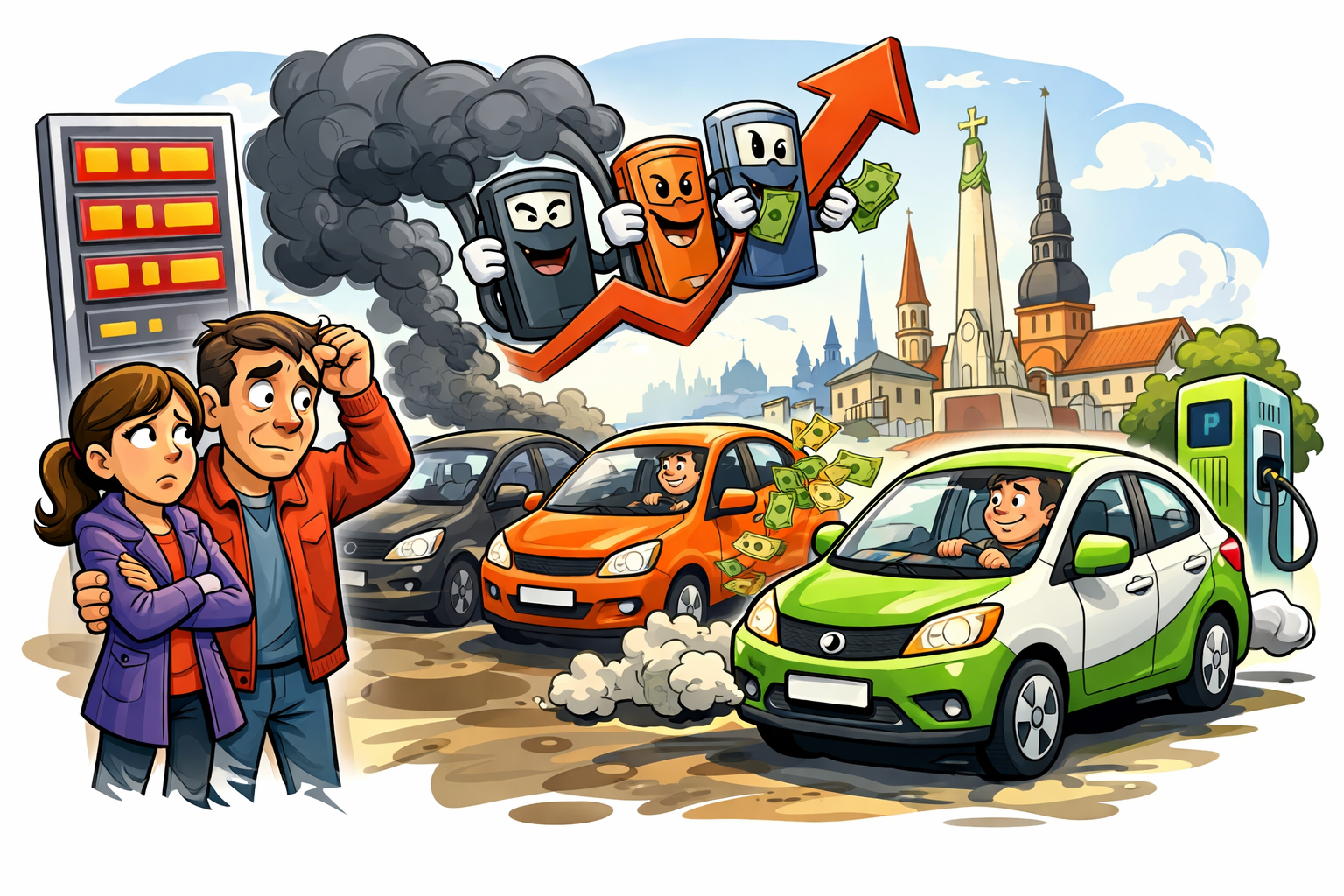
The moment fuel prices start rising and drivers begin looking at station boards with that familiar uncomfortable feeling, many people stop thinking only about how to drive more cheaply today and start asking a bigger question: what kind of car makes sense to own tomorrow? That is exactly where the hybrid question appears. Not as an abstract “green” choice, but as a very practical one: does it actually make sense to buy a hybrid in Latvia right now if fuel keeps getting more expensive?
For some people, the answer sounds obvious — of course it does, because a hybrid uses less fuel. Others are more skeptical and see it as a modern trend that sounds good in advertising but may not always pay off in real life. The truth, as usual in the car world, is less simple than either extreme. A hybrid can be a very smart choice, but not for everyone and not in every scenario. And that is exactly what matters before the purchase, not after it.
In this article, we will look at who in Latvia can benefit most from a hybrid right now, when it can be the smarter choice than diesel or petrol, where it really helps reduce everyday costs, and when a person risks buying a car that looks great on paper but is not actually ideal for their daily life.
Why this question is especially relevant in Latvia
In Latvia, this is not just a theoretical topic. The country’s car fleet is still heavily diesel-oriented, and recent reporting citing 2024 Eurostat data notes that diesel cars make up about 66% of passenger cars in Latvia, one of the highest shares in the EU. That means many drivers do not compare hybrids with some futuristic EV dream; they compare them with a very old and very strong idea — that diesel is the sensible way to save money.
Fuel-price pressure makes that comparison even sharper. When the price per litre becomes uncomfortable, people start counting not in theory, but in real life: how much am I spending per week, per month, per year? And once that happens, interest naturally grows in a car that can use less fuel in the exact kind of stop-start urban driving many Latvians deal with every day.
A hybrid is not magic — but it does have a very clear playing field
One of the most common misunderstandings is the idea that a hybrid is automatically the cheapest option in every situation. It is not. A hybrid’s biggest strength is not that it wins under all conditions. Its biggest strength is more specific: it performs very well in exactly the kind of driving where many other cars become less efficient. That means city traffic, stop-start movement, congestion, repeated braking, slow speeds, and everyday routes where engine load constantly changes.
Toyota’s official hybrid materials explain that a self-charging hybrid automatically shifts between petrol and electric drive and does not need plugging in. Toyota also highlights lower fuel consumption and hybrid-driving coaching designed to help drivers benefit from braking, acceleration, and speed patterns that suit hybrid efficiency. In plain language, that means the car is built to make this mixed driving rhythm work in your favor, especially in urban use.
That is why the real hybrid question in Latvia is not only “is fuel expensive?” but “how do I actually drive?” The more honestly someone understands their own daily routine, the easier it becomes to tell whether a hybrid would be a smart investment or simply an emotional purchase.
If your life mostly happens in the city, a hybrid starts looking very logical
If someone mainly lives in the rhythm of Riga, the suburbs, or any city with traffic lights, queues, and shorter journeys, a hybrid begins to look very convincing. Morning traffic jams. Afternoon stoplights. Small errands. Repeated braking. That is exactly the environment in which a hybrid’s strengths stop being theoretical and start becoming practical.
This is also where many people begin to realize that the old automatic trust in diesel is no longer as obvious as it once was. Diesel can still be very good for long motorway mileage, but in city use a hybrid often feels more natural. That is one of the main reasons hybrids have become such a serious option even for drivers who used to dismiss them. Toyota’s own guidance and fuel-economy materials repeatedly position hybrids as especially effective in urban, slow-moving, and repeatedly interrupted traffic.
“With a C-HR hybrid, only in Riga, in summer I get 4.0 litres, now up to 4.8.”
That kind of forum comment is useful not because it is universal truth for every single driver, but because it brings the question back to real life. The person is not talking about a brochure. They are talking about their actual route and their actual car. And examples like that often persuade people far more than abstract marketing language about “efficiency.”
A hybrid is not only about fuel consumption, but also about how daily driving feels
Many people first look at hybrids only as a way to reduce bills. That is normal, because when fuel prices are high, money is the first thing people notice. But drivers who actually live with hybrids every day often mention something else too — daily driving starts to feel calmer.
That does not mean a hybrid is some kind of miracle machine or perfect under every condition. But in city use it often gives a smoother feeling, less nervous stop-start behavior, and less sense that the car is constantly working against the traffic pattern. This is one of those things that rarely shows up well in tables, but drivers mention it again and again.
“After a diesel, using a hybrid in the city feels calmer. You think less about whether the car is happy sitting in traffic.”
That kind of comment says a lot. Sometimes people choose a car not only because it is cheaper per 100 km, but because it simply irritates them less in daily life.
When a hybrid may not be as impressive as it first sounds
To keep this honest, there is another side too. A hybrid is not an automatic answer for every driver in Latvia. If someone mainly does long motorway distances, spends most of the time at stable speeds, and already owns a good diesel, the hybrid advantage may not feel as dramatic as it does in urban traffic.
The more driving happens in long, steady conditions, the less a hybrid’s city strengths can really shine. That does not mean the hybrid becomes a bad car. It simply means the gap may be smaller, and the buyer has to think more broadly — about purchase price, annual mileage, vehicle age, and long-term plans.
Rising fuel prices make hybrids psychologically more attractive too
There is another important layer here. When fuel prices are high, a person is not only spending more — they are also thinking more about every litre. Fuel stops being only a budget item and starts becoming an emotional one. That is exactly when a car that can use less fuel in city traffic becomes not only mathematically attractive, but psychologically easier to live with.
That is one reason why, during periods of expensive fuel, many people start looking at hybrids much more seriously than before. They are not just looking at another powertrain. They are looking for a way to reduce the feeling that every ordinary journey has become too expensive.
Is this a good time to buy a hybrid in Latvia?
Many people ask the question in exactly this form. And the honest answer still depends on one main thing — does your daily driving pattern match the strengths of a hybrid? If it does, then yes, this can be a very good time to switch. When fuel prices are high, the economic logic becomes easier to feel, and it becomes easier to justify a car that can do city mileage more efficiently.
But if your life is mainly long-distance motorway travel, then rising fuel prices alone do not automatically make a hybrid the perfect answer. In that case, you still have to think not just about litres, but about your whole ownership pattern.
There is also a broader signal in Latvia’s policy environment. State support programs have included electric cars and plug-in hybrids, with additional incentives tied to scrapping older internal combustion cars, which shows that lower-emission vehicle adoption is not a fringe topic in Latvia anymore.
Where people most often get the hybrid question wrong
The first mistake is assuming a hybrid is automatically cheaper in every situation. The second is assuming it is just a marketing gimmick. The third — and probably the most common — is not comparing your actual daily life to the type of car at all, and simply buying by habit.
For years, many drivers lived with the belief that economy simply meant diesel. Then fuel prices rise, the daily routine becomes more urban, traffic gets heavier, trips get shorter — and suddenly the old formula does not feel so safe anymore. That is where smarter car choice really begins: not by repeating an old habit, but by matching the car to the life you actually live.
Conclusion
Yes, in Latvia it often does make sense to buy a hybrid if fuel prices keep rising — but mainly when your daily routine actually matches the conditions where hybrids are strongest. That is especially true for city driving, traffic jams, shorter routes, and drivers who want not only lower fuel use, but also a calmer daily driving experience.
But a hybrid is not an automatic answer for everyone. If your life mostly happens on the motorway, with very long distances and a different usage pattern, then the decision still needs to be made with a cool head. The smartest principle is simple: do not buy a hybrid because it sounds modern. Buy it if it makes sense for your real life.
If you want to compare your daily costs with petrol, diesel, or hybrid, use the calculator below.