
 LV
 EN
 RU
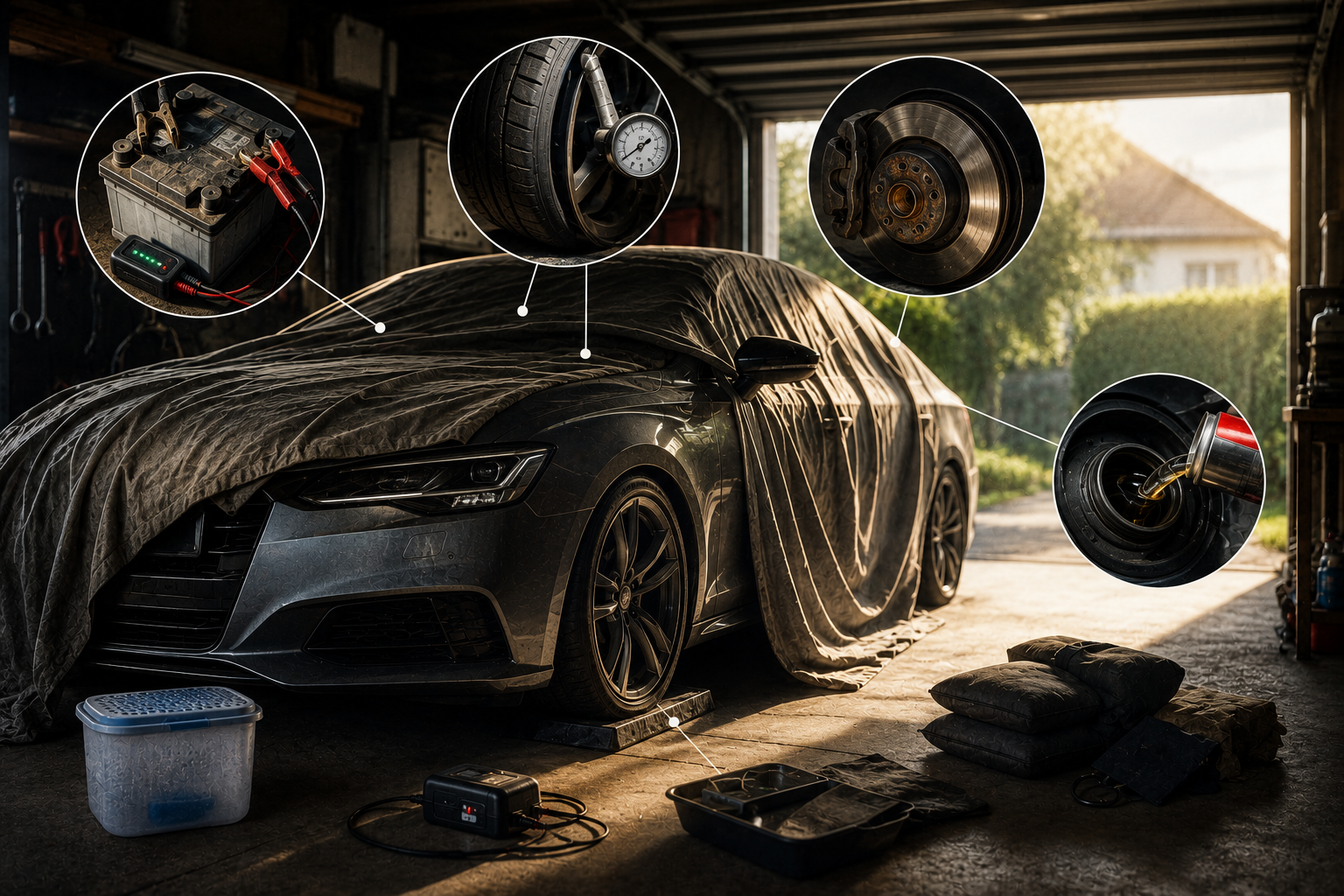
A car is parked outside the house with the expectation that it will remain unused for only a couple of weeks. Business trips are cancelled, the family travels abroad, the driver begins working remotely or the vehicle is waiting to be sold. One month later, it is still standing in exactly the same place. After two months, the central locking no longer responds as confidently, a brown coating is visible on the brake discs and one tyre appears slightly lower than the others.
Then, one morning, the car is needed again. The driver turns the key or presses the start button, hears the starter rotate slowly a few times and then silence. After connecting another battery or a booster, the engine starts, but the first metres feel unpleasant: the brakes scrape, the tyres vibrate, the cabin smells damp and several warning lights appear on the dashboard.
A vehicle can deteriorate even while its odometer remains still. The battery continues to supply electronic systems, the tyres carry the full weight of the car in one position, moisture acts on metal surfaces, fuel remains in contact with air and dust, insects or rodents may enter the ventilation system, cabin or engine compartment.
This does not mean that every car will need repairs after standing for a month. Many vehicles can remain unused for several months without serious consequences if they are prepared properly. The important distinction is between a car that has simply been abandoned and one that has been deliberately prepared for storage.
Long-term parking is not only about whether the engine will start afterwards. The battery, tyres, brakes, fuel system, cabin and safety of the first journey must also be protected.
How long must a car stand before it counts as long-term storage?
There is no single exact threshold. The result depends on the vehicle’s age, battery condition, temperature, humidity, tyre construction, fuel type, parking surface and how much electricity its electronic systems consume while the car is switched off.
Special preparation is normally unnecessary when the vehicle and battery are in good technical condition.
Battery condition, tyre pressure, parking-area humidity and the vehicle’s electrical consumption begin to matter.
The vehicle should be treated as being placed in long-term storage. The battery, tyres, brakes, fuel and cabin should all be prepared.
A systematic storage plan and a thorough inspection before returning the vehicle to the road are necessary.
An older vehicle with a weak battery may fail to start after only ten days. A technically sound car stored in a dry garage with a maintenance charger may remain in very good condition for several months.
What happens to a vehicle while it is not being driven?
Parking stops the mileage from increasing, but it does not stop physical and chemical processes. Temperatures change, metal remains exposed to moisture, rubber continues to age, fluids absorb contaminants and electronic systems consume small amounts of electricity.
The alarm, keyless-entry system, control modules and communication units consume power even when the car is locked.
Air gradually escapes through the rubber and sealing surfaces, while the entire weight of the vehicle rests on one area of each tyre.
Rust forms on the disc surfaces. In damp conditions, brake pads or the parking-brake mechanism may stick.
It remains exposed to oxygen and moisture, and over longer periods its properties and proportion of volatile components may change.
Wet carpets, changing temperatures and insufficient ventilation may lead to unpleasant smells, mould and misted windows.
Rodents may damage wiring, insulation, the air filter or cabin materials, especially in a quiet and warm storage area.
7 days: normally nothing dramatic, but there are exceptions
For a technically sound vehicle, one week is usually not a long period. Problems may still occur if the battery was already weak, an electrical consumer was left switched on, the vehicle was parked in very low temperatures or additional equipment such as an alarm, tracker or dashcam parking mode continues to draw power.
Before leaving for a week, it is normally sufficient to make sure the lights are off, the doors and boot are fully closed, the tyres are not visibly underinflated and no food or wet objects have been left inside.
30 days: battery and moisture issues begin to matter
A healthy battery may still be able to start the engine after one month, but there is no guarantee. A modern vehicle may periodically activate communication, alarm, keyless-entry and other control modules.
If the battery was not fully charged at the beginning of the storage period, cold weather and continuous electrical consumption may lower the voltage to a level at which the central locking still works but insufficient energy remains for the starter.
After a month, light surface rust is often visible on the brake discs. By itself, this does not mean the discs are damaged and it normally disappears after several controlled braking applications. Thick or uneven corrosion, or brake pads sticking to the discs, may cause vibration and uneven braking.
90 days: the vehicle should be treated as stored machinery
Three months is long enough for a careless approach to create unnecessary expenses. The battery may be deeply discharged, the tyres may have lost pressure, brake surfaces may be corroded and signs of moisture or animal activity may be present in the cabin or engine compartment.
For a period of this length, the vehicle should be prepared before it is parked. A dry and secure location should be selected, battery maintenance arranged, tyres checked, a safe method of securing the vehicle chosen without unnecessarily loading the parking brake, and the interior cleaned.
180 days or longer: a complete inspection is required before driving
Over six months, the combination of storage time and storage conditions becomes decisive. Six months in a dry, ventilated garage with a maintenance charger is not the same as six months parked on grass beneath a tree and exposed to moisture, leaves, rodents and sunlight.
After half a year, the engine should not simply be started and the vehicle driven straight onto a motorway. Fluids, tyres, brakes, the engine compartment, wiring, air intake, lighting and battery condition should be inspected first. The initial journey should be short, slow and carried out on a safe route.
The 12-volt battery: usually the first component to give up
Even a fully switched-off vehicle has what is known as a parasitic or quiescent electrical draw. Electricity is used by the alarm, clock, door-control modules, keyless-entry system, telematics and other components.
If the battery is old, has not been fully charged for a long time or the car is normally used only for short journeys, its actual energy reserve may be much lower than expected.
The best solution: a suitable maintenance charger
If the vehicle is stored where mains electricity is available, a high-quality automatic maintenance charger can monitor battery voltage and add energy only when necessary.
The charger must be suitable for the specific battery type. Different charging modes may be required for conventional lead-acid, AGM or EFB batteries.
Can the battery be disconnected?
Disconnecting the battery can be practical on some vehicles, but in a modern car it may erase clock, window, seat, radio and other system settings. Some models require system initialisation or battery registration after reconnection.
The instructions for the particular vehicle should be checked before disconnecting the battery. It is also necessary to confirm that the doors can be opened mechanically and that access to the boot or engine compartment will remain possible after power is removed.
A deeply discharged battery is more than an inconvenience
Repeated deep discharge can permanently reduce battery capacity. A jump start solves the immediate problem but does not necessarily restore the battery’s technical condition.
Hybrids and electric cars also have a 12-volt battery
The large traction battery in an electric car or hybrid does not replace the small 12-volt battery. The 12-volt system often activates control modules, switches, contactors, central locking and safety systems.
An electric vehicle may therefore have a substantial amount of energy stored in its traction battery but still fail to respond because the small auxiliary battery has discharged.
Long-term storage requirements differ significantly between electric-vehicle models. Some vehicles periodically charge the 12-volt battery from the traction battery under certain conditions, while others do so only in a limited way or when connected to a charger.
For long-term storage, the traction battery should generally not be left completely empty or held at maximum charge for an extended period unless the manufacturer specifically recommends it. The correct charge level and connection procedure should be checked in the instructions for the particular model.
Tyres: pressure falls even when the car does not move
A tyre is not completely airtight. Air slowly escapes through the rubber, valve and sealing area between the tyre and wheel. Falling temperature also reduces the measured pressure.
If a vehicle stands for several months on an underinflated tyre, the sidewall and carcass remain more heavily deformed in one area. When driving resumes, vibration caused by a temporary or permanent flat spot may be noticeable.
Is a flat spot always permanent?
Minor vibration after storage may decrease as the tyres warm up and recover their shape. Pronounced, persistent or repeated vibration may indicate permanent deformation, tyre damage or another wheel-related problem.
Should the tyres be inflated more before storage?
They should first be inflated to at least the manufacturer’s specified cold-tyre pressure. For longer storage, some tyre or vehicle manufacturers may allow a slightly higher pressure, but the limits given for the vehicle and tyre must not be exceeded.
Before driving, the pressure must always be returned to the normal everyday value. The vehicle should not be driven with an arbitrarily increased pressure simply because it was stored that way.
Rust on brake discs: what is normal and what is not?
Brake discs are normally unpainted where the pads contact them. In damp weather, rust may appear on the surface after only one night.
A thin and even coating normally disappears after several gentle braking applications. A light scraping sound may be heard during the first few stops.
The problem becomes more serious when corrosion is deep or uneven, or when the outline of a brake pad remains visible on the disc. This may cause pulsation while braking, uneven braking force and reduced effectiveness.
Should the parking brake remain applied during long-term storage?
The parking brake is designed for normal parking and should be used in accordance with the vehicle instructions. During storage lasting several months in damp conditions, however, the mechanism or brake pads may stick.
If the vehicle is stored on private, level and secure ground, a storage plan may sometimes use a selected gear, the automatic transmission’s Park position and suitable wheel chocks instead. This should only be done when it is safe in that particular location and does not contradict the manufacturer’s instructions.
Do not experiment with insufficiently secured parking on a slope or in a public area.
Fuel does not remain completely unchanged
Petrol and diesel are chemical products whose properties change over time. They remain exposed to oxygen, moisture and temperature variation. Some lighter volatile components may evaporate, while oxidation and deposits may develop over longer periods.
Standing for several weeks or a couple of months with good-quality fuel in a closed system normally does not create an immediate problem. Storage lasting six months, one year or longer requires greater attention, especially where temperatures vary widely.
Full tank or half-empty tank?
A larger quantity of fuel reduces the amount of air inside the tank and may reduce the effect of condensation, but the tank should not be filled to the top of the filler neck. The expansion space intended by the manufacturer must remain available, and filling should stop at the nozzle’s first automatic click.
For very long storage, the fuel quantity and possible use of a stabiliser should be considered according to the specific engine, fuel and product instructions. A random additive is not a universal solution.
Diesel fuel and microorganisms
If water remains in a diesel-fuel system for a long time and suitable conditions exist, microorganisms may develop at the boundary between the fuel and water. This is more commonly associated with very long storage, large tanks and machinery than with an ordinary passenger car left unused for a few weeks.
After very long storage, however, an unusual fuel smell, deposits, a blocked filter or uneven engine operation should be taken seriously.
Does engine oil deteriorate while the car is not being driven?
Engine oil ages not only through mileage. It is also affected by time, moisture, fuel dilution, acids and contaminants that entered the oil during previous use.
If the vehicle is parked immediately after many short journeys, the oil may contain more moisture and fuel. An engine that was fully warmed before storage and maintained on time begins the storage period in a better condition.
Standing for a few months does not automatically mean the oil must be replaced. The calendar-based service interval must still be considered. If the oil-change date passes while the car is in storage, the service is still due even though the mileage has not increased.
Coolant and brake fluid also age with time
Coolant contains corrosion inhibitors and other additives whose effectiveness decreases over time. Brake fluid in many systems absorbs moisture, which may lower its boiling point and contribute to corrosion.
Storage does not pause calendar-based replacement intervals. A vehicle covering only a few hundred kilometres per year may still require fluid replacement according to time rather than mileage.
Should the engine simply be started from time to time?
One of the most common recommendations is to start the engine once a week and leave it idling for five or ten minutes. This sounds logical but often creates more problems than benefits.
A short period of idling may not recharge the battery sufficiently because the energy used by the starter is not fully recovered. The engine and exhaust system may also fail to reach full operating temperature, leaving condensation inside them.
For a diesel engine, short periods of idling do not help the DPF, EGR or other emissions systems. They may simply add another cold operating cycle without sufficient load or temperature.
Starting the engine is worthwhile only when the car will actually be driven
If the vehicle is technically and legally ready for the road, a sufficiently long drive that warms the engine, transmission, brakes and exhaust system is more useful than brief idling.
How long should a maintenance drive be?
There is no universal number of kilometres. The journey should be long enough for the engine to reach a stable operating temperature, the battery to receive meaningful charging and the brakes to be used several times under controlled conditions.
In cold weather, urban traffic or with a large diesel engine, this may take longer than with a small petrol car in summer. A five-minute drive around the block is normally not a complete maintenance journey.
There is no point driving merely to “move the car” if its inspection has expired, it is not properly insured, the tyres are unsafe or a fluid leak has been discovered.
The cabin: moisture, smells and mould
The cabin should be dry before long-term storage. Wet rubber mats, snow carried in on shoes, a damp boot liner or a spilled drink may become a source of smells and mould.
Food, rubbish, damp clothing and items that may melt, leak or attract animals should be removed. Particular attention should be paid to storage compartments in the boot and the spare-wheel well, where moisture may remain unnoticed.
Should the windows be left slightly open?
The windows should not be left open outdoors or in a shared parking area. This increases the risk of rain, dust, insects, theft and moisture entering the vehicle.
In a secure, dry and controlled private garage, a very small ventilation gap is sometimes used, but it should be considered together with the humidity, security and pest risk of the particular location.
Moisture absorbers inside the cabin
A moisture absorber may help, but it is not a solution to an active water leak. If water enters through a door seal, sunroof, windscreen or blocked drain, the cause of the leak must be repaired first.
The absorber should be positioned securely so that its contents cannot spill onto the seats or carpet.
Rodents and the engine compartment
A quiet vehicle may become shelter for mice or other small animals. The engine compartment offers protection, while the cabin filter, air-filter housing and sound insulation may provide nesting material.
Rodents can damage wiring insulation, vacuum pipes, washer-fluid hoses and cabin materials. This type of damage may cause not only warning lights but also a short circuit or fire risk.
Before starting the vehicle after long-term storage, check
- whether there are nests, leaves or animal food in the engine compartment;
- whether bite marks are visible on wiring insulation;
- whether the air intake and filter housing are clear;
- whether fresh fluid puddles are visible beneath the car;
- whether the exhaust outlet is unobstructed.
Should the car be washed before storage or left dirty?
It is worth washing the vehicle before long-term storage because salt, mud, bird droppings and plant debris may damage surfaces. Bird droppings and insect remains can be particularly aggressive towards the paintwork.
The vehicle should be allowed to dry completely after washing. A wet car should not be placed inside a closed, poorly ventilated garage or immediately covered with a non-breathable cover.
Wheel arches, lower door edges, drains and areas where leaves collect should also be cleaned. Wax or another body-protection product may help when applied correctly.
Should the car be covered?
Indoors, a suitable clean and breathable cover may protect the car from dust. Outdoors, the situation is more complicated.
A loose cover may move in the wind and rub dust against the paint. Condensation may collect beneath a non-breathable material. An outdoor cover should be designed for exterior use, correctly secured and placed only over a clean body.
Grass, gravel, asphalt or a garage?
Normally the best option when the space is not permanently damp and does not have a pest problem.
A stable and relatively dry surface, although water drainage and prolonged sunlight exposure should be considered.
May be acceptable when the location is dry, stable and does not collect standing water.
Unsuitable for long-term storage because moisture remains beneath the vehicle and the risks of corrosion, mud and pests increase.
30-day preparation plan
- check the battery charge and overall condition;
- inflate the tyres to the manufacturer’s specified pressure;
- remove food, rubbish and damp objects from the cabin;
- check for fluid leaks;
- fill the fuel tank to a sensible level, but not to the top of the filler neck;
- park the vehicle in a dry and secure location;
- switch off unnecessary additional electrical consumers;
- record the storage start date and upcoming service deadlines.
Storage plan for 90 days or longer
- wash and completely dry the body and wheel arches;
- clean and dry the cabin and boot;
- check the oil, coolant and other fluid levels;
- use a suitable battery maintenance charger or follow the manufacturer’s instructions;
- check and record tyre pressures;
- choose a safe method of securing the vehicle;
- close the windows, doors and sunroof and inspect the drains;
- reduce rodent access and inspect the storage area regularly;
- follow the storage instructions for the specific hybrid or electric vehicle;
- prepare a checklist for inspection before the next start.
How should a vehicle be started safely after several months of storage?
A visual inspection should be completed before turning the key or pressing the start button. If a large oil, fuel, coolant or brake-fluid leak is visible beneath the vehicle, the engine should not be started until the cause has been identified.
- Inspect the ground beneath the vehicle and the engine compartment.
- Check for rodent damage and nesting material.
- Check the engine-oil and coolant levels.
- Check tyre pressures and visible damage.
- Confirm that the exhaust outlet and air intake are unobstructed.
- Check the battery voltage or state of charge.
- Switch on the ignition and observe the warning lights.
- Start the engine without immediately increasing the revs.
- Listen for unusual metallic noises.
- Check for new leaks or smoke after the engine starts.
The first metres after storage
Press the brake pedal several times before moving. It should feel firm and predictable. If it sinks, feels unusually soft or brake fluid is visible beneath the vehicle, the car must not be driven.
Begin moving very slowly. Check that the wheels rotate freely and that the parking brake has fully released. A light noise from surface rust may be heard during the first few braking applications.
Test the brakes at low speed in a safe location. If the vehicle pulls to one side, the pedal pulsates, heavy cracking noises are heard or one wheel becomes hot, stop the journey.
Initially avoid high engine speeds, hard acceleration and high road speeds. Check the steering, transmission, tyre vibration and all dashboard warnings.
When should the vehicle be taken to a workshop instead of being started?
- a fuel leak or major oil leak is visible;
- the brake pedal is soft or sinks;
- a tyre has cracks, a bulge or extremely low pressure;
- rodents have significantly damaged the wiring;
- there is nesting material or an obstruction in the engine compartment or exhaust;
- the fluids are heavily contaminated or critically low;
- one or more wheels are locked;
- the oil-pressure warning does not go out after starting;
- heavy metallic knocking can be heard;
- the vehicle has remained unused for several years without maintenance or condition checks.
Illustrative cost example
Assume the car will not be used for four months. The owner can check the battery, inflate the tyres, clean the cabin and use a maintenance charger in advance. In the second scenario, the car is simply left in a damp location with a weak battery and low tyre pressure.
The amounts are illustrative and are not a quotation from a specific workshop. Costs depend on the vehicle, storage conditions and extent of the damage.
What should be checked when buying a car that has stood unused for a long time?
Low mileage does not always mean perfect technical condition. A vehicle that has been used rarely for years may have old tyres, aged fluids, corroded brakes, a discharged battery and deteriorated seals.
- how long the vehicle has stood and under what conditions;
- how old the tyres are, not only how much tread remains;
- when the engine oil, brake fluid and coolant were last changed;
- whether the battery was charged regularly;
- whether the brakes have stuck or corroded heavily;
- whether there is mould or water ingress inside the cabin;
- whether rodents have damaged the engine compartment;
- whether fuel has remained in the system for several years;
- whether the vehicle has already received a professional inspection after storage;
- whether tyre vibration or brake pulsation appears during the test drive.
Driver’s checklist before long-term storage
☐ The vehicle has been washed and dried
☐ The cabin and boot are dry
☐ Food and rubbish have been removed
☐ Tyre pressures have been checked
☐ The battery is fully charged
☐ The correct charging mode has been selected
☐ Fluid levels are correct
☐ No visible leaks are present
☐ The tank has not been filled to the top of the filler neck
☐ The vehicle has been secured safely
☐ The parking area is dry and stable
☐ Rodent risk has been assessed
☐ The windows, doors and sunroof are closed
☐ Service deadlines have been recorded
☐ The key is stored in a secure location
☐ A plan has been prepared for the first inspection
A short self-check
The car will stand for two months. Is it enough to start it for five minutes once a week?
Usually not. Brief idling may fail to recover the energy used by the starter and may leave condensation inside the engine and exhaust. Proper preparation and battery maintenance are normally better.
There is light rust on the brake discs after one month. Must the discs be replaced?
Not necessarily. Light surface rust often disappears after several gentle braking applications. If vibration, uneven braking or deep corrosion marks remain, the brakes should be inspected by a workshop.
The electric car’s traction battery is charged. Does that mean the 12-volt battery can be ignored?
No. The small battery activates many of the vehicle’s systems. Its maintenance procedure should be checked in the instructions for the specific electric vehicle.
The tyres vibrate after three months of storage. Must they be replaced immediately?
First check their pressure and condition. A minor flat spot may decrease after the tyres warm up. If vibration remains or the tyre is visibly deformed, it should be inspected professionally.
Frequently asked questions
How long can a vehicle stand without the engine being started?
It depends on the battery, electronics, temperature and condition of the vehicle. A healthy car may remain unused for several weeks, while a weak battery may discharge much sooner. Storage lasting several months requires deliberate preparation.
Should the engine oil be changed before long-term storage?
If the oil is old, contaminated or approaching its calendar-based replacement date, changing it before storage may be sensible. Several months of storage with recently changed oil does not normally require another immediate change.
Should the tank be filled completely before storage?
A larger fuel quantity may reduce the air space inside the tank, but it should not be filled to the top of the filler neck. Stop at the nozzle’s first automatic click and follow the manufacturer’s instructions.
Can the vehicle be left on jacks to protect the tyres?
A normal emergency jack is not designed to support a vehicle for long periods. Incorrect support points may damage the body or suspension and create a serious injury risk. This type of storage requires suitable professional stands and the correct procedure.
Should the vehicle be moved a few centimetres to change the tyre contact area?
In a safe private location, this may help change the loaded area of the tyres, but the vehicle must be secured again afterwards. Do not do this when the battery, brakes or parking location are unsafe.
Is a heated garage better for storage?
A dry, stable and ventilated environment is more important than a high temperature. A warm but very damp garage may promote corrosion more than a cool, dry one.
Should the car immediately be driven a long distance after storage?
A short test drive in a safe area should come first. A longer route should be planned only after checking the tyres, brakes, steering, fluids and dashboard warnings.
Is long-term storage worse than high mileage?
They are different forms of deterioration. Driving wears moving components, while storage encourages battery discharge, corrosion, tyre deformation, fluid ageing and moisture problems.
A car is better driven properly or stored properly than started briefly from time to time
A vehicle is designed to move, but this does not mean the engine must be started for a few minutes every week. When a complete and safe journey is not possible, proper storage preparation is normally better than repeated cold starts.
For one month of storage, the battery, tyres and moisture deserve the most attention. A three-month period already requires a complete storage plan. After six months or longer, the vehicle should be inspected before returning to the road almost as carefully as a rarely used car before purchase.
A few simple actions before parking can prevent a discharged battery, damaged tyres, stuck brakes, mould inside the cabin and an expensive first drive.
The main takeaway: if the car will stand for more than a few weeks, do not simply leave it to wait. Charge the battery, check the tyres and fluids, dry the cabin, select a dry parking location and prepare a checklist for the first start. After long-term storage, inspect first, then start and drive.