
 LV
 EN
 RU
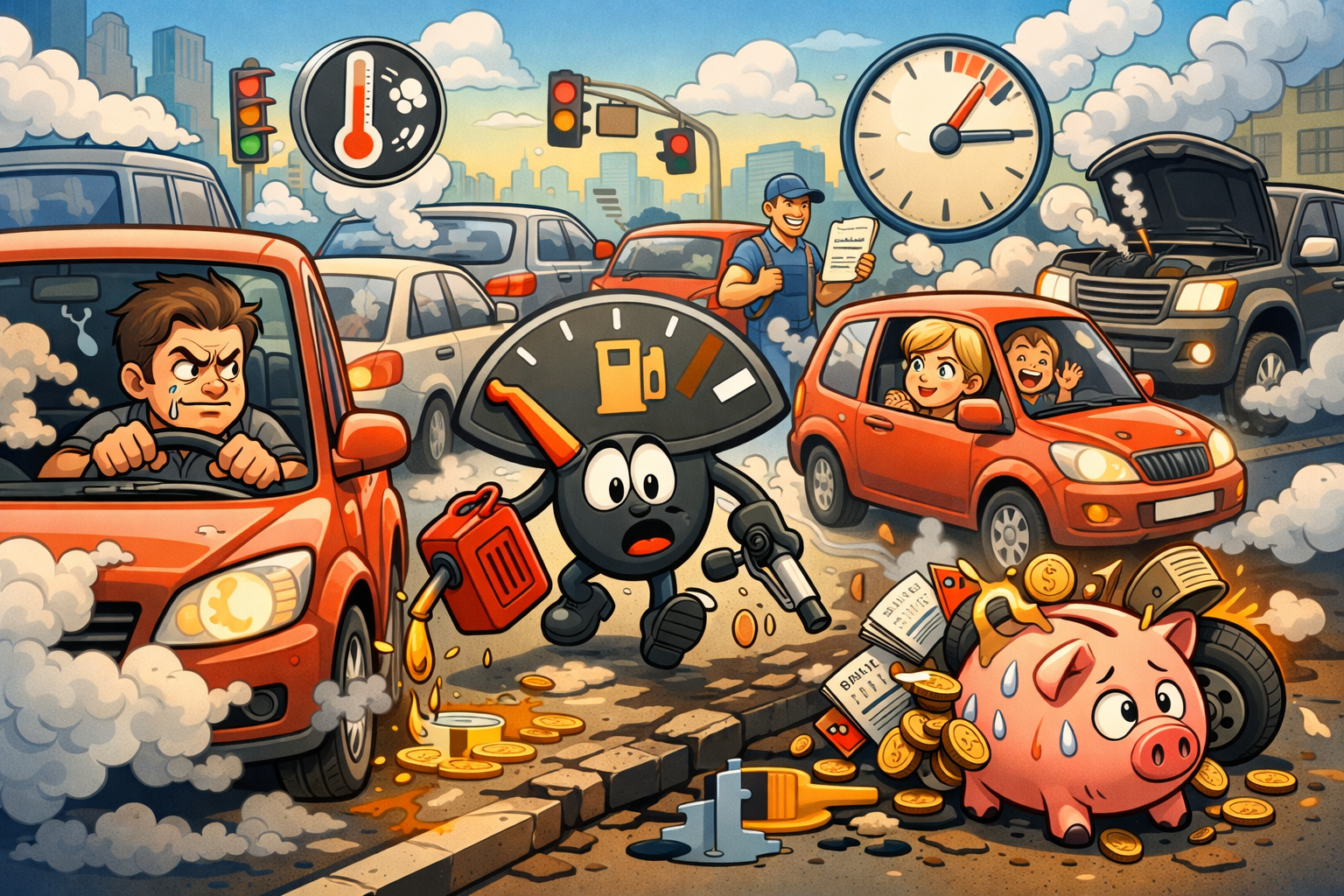
There are feelings that drivers recognize instantly, without long explanations. One of them is this: you haven’t driven anything impressive, you haven’t gone on a long trip, you haven’t crossed half of Latvia, yet somehow the fuel is gone again. And very often the answer lies not in the kilometers, but in what those kilometers actually were like. One thing is to drive smoothly, predictably, and with a steady rhythm. A completely different thing is crawling through the city from one traffic light to another, from braking to acceleration, from hope to the next frustrating stop. This is exactly where one of the most annoying questions in everyday driving is born: how much fuel do traffic jams and so-called stop & go driving actually consume?
From the outside, it all seems so routine that people often don’t even treat it as a separate problem. A traffic jam is just a traffic jam. Annoying, exhausting, but still — part of life. However, in the world of cars, a traffic jam is not just lost time. It is also a multiplier of fuel consumption. And that is what surprises many drivers the most. They look at their daily route and think: I only drove this much. But the car sees a completely different picture: a cold start, slow movement, sudden acceleration, braking, idling, movement again, stopping again. In other words, for the car this is not just driving. It is a constant fight against inefficiency.
That is why this article will not just be about saying “traffic jams are bad.” It will be about something much more interesting: how exactly traffic jams and stop & go driving consume fuel, why this happens so aggressively in cities, what mistakes drivers themselves make that make it worse, and why sometimes a person thinks they have a “short commute” when in reality they are living every day in one of the most expensive driving conditions possible.
And yes — there will be a lot of real life here. Because traffic jams are not just mathematics. They are also nerves, rush, habits, city rhythm, kindergarten logistics, being late for work, unplanned maneuvers, and all those small daily mistakes that together turn into not only fatigue, but also a higher fuel bill. Because in the end, for a driver a traffic jam is not just about moving slowly. It is a situation where moving slowly costs much more than it seems.
The first truth: a traffic jam is not just standing still — it is the most inefficient driving mode
Many people intuitively think that the highest fuel consumption happens when driving fast. And of course, very high speeds do have their cost. But in city traffic there is another, much trickier way fuel gets consumed. It is not a constant heavy load. It is fragmented, continuous inefficiency. The engine is working, the car is consuming resources, but the actual progress in distance is ridiculously small. You are technically driving, but in reality you spend a large part of your time living between standing still and short bursts forward.
This is where the entire fuel logic of traffic jams lies. A car performs best in a steady rhythm without unnecessary interruptions. As soon as constant braking and repeated starts begin, efficiency drops. Because every start from a standstill requires energy. Every braking event partially destroys that previously built movement. And if this repeats dozens of times within one route, the fuel balance becomes much harsher than it appears when looking only at kilometers driven.
Drivers often feel this intuitively, but do not always fully understand it. They know that “the city eats fuel,” but cannot always clearly explain why it does so aggressively. And the answer is simple, even if unpleasant: a traffic jam is a mode where the car consumes a lot while achieving very little.
A very typical thought from driver comments: “It feels like I don’t drive far in the city. But the fuel feels like I’m pulling a trailer uphill every day.”
Stop & go driving consumes fuel not in one big hit, but in hundreds of small losses
One of the reasons people underestimate this problem is psychological. Large expenses are easier to notice than small, repeated losses. That is exactly why city driving is so deceptive. No single moment looks catastrophic. You just stand a bit. Then drive a bit. Then stand again. Then move again. But these small, seemingly harmless cycles together create a very unpleasant result.
Every time a car starts moving from a standstill, it must overcome inertia. Simply put, movement must be built from zero. That always costs more than maintaining an already existing speed. That is why a route where you start from zero 20 times is a completely different world than one where you can drive steadily for 10 minutes. And this is where the absurdity of city fuel consumption is born — the distance seems small, but the car feels like it has done much heavier work.
In this sense, stop & go driving is very similar to hidden expenses in a household budget. You don’t spend one large amount, but something keeps dripping away. And at the end of the month, that “drip” becomes a significant number.
Cold starts make traffic jams even more expensive
If you want to understand the true brutality of city traffic towards fuel consumption, you cannot ignore one factor that often works together with traffic jams: cold starts. A large portion of city trips begin with an engine that has not yet reached optimal operating temperature. This means the car is already operating less efficiently from the very beginning. And if this cold start is immediately followed by traffic congestion, slow movement, stops, and a fragmented pace, fuel consumption becomes particularly unpleasant.
This is one of the reasons why short morning routes in the city often feel surprisingly inefficient. A person drives a relatively short distance, but the car has lived through the exact combination that efficiency dislikes the most: cold engine, short distance, frequent stops, slow flow, and constant restarting of movement.
In colder seasons, this becomes even more pronounced. The cabin needs heating, windows need defrosting, the engine warms up slower, traffic is often even heavier. And then a person quite reasonably asks: how is it possible that I drive so little, but refuel so much? The answer is brutally simple — you are not just driving, you are operating in the most expensive short-distance combination possible.
A typical comment from a daily driver: “Sometimes my 8 km winter morning trip feels more expensive than a 25 km evening drive on a clearer road.”
A traffic jam consumes not only fuel, but also driver patience — and that increases consumption even more
This is where things get even more interesting. Because a traffic jam is not just a mechanical process. It is also a psychological one. A driver stuck in constant stop-and-go flow becomes more nervous, more impatient, sharper. And very often, without realizing it, they start increasing fuel consumption even further. Not intentionally, but because their driving style becomes shorter, more aggressive, and more tense.
A typical situation is very familiar. The flow moves slightly, and the driver immediately presses the gas harder to “use the opportunity.” A few seconds later — braking again. Then another short burst. Then another stop. From the outside, it seems insignificant. But this kind of nervous micro-driving converts very efficiently into extra fuel consumption. Especially in the city, where the actual gain from these short bursts is usually almost zero.
That is why sometimes traffic jams “eat” even more not just by themselves, but together with the driver’s reaction to them. In other words, fuel is consumed not only by traffic. Fuel is also consumed by how we behave in traffic.
Real example: 8 km in the city can be more expensive than 15 km in smoother flow
This is one of those things people initially find hard to believe until they experience it themselves. From a theoretical perspective, a longer route always seems more expensive. But in reality, 8 kilometers through heavy city congestion, with multiple traffic lights, slow flow, stops, waiting, and nervous movement, can be very inefficient compared to 15 kilometers in a much smoother rhythm.
Imagine two people. One lives closer to work and drives through dense traffic every morning. The other lives further away but travels most of the route in a smoother flow without constant stopping. The first person has a shorter distance, but the car operates in a more inefficient mode. The second travels further but moves more smoothly. And at the end of the month, the first person sometimes realizes with surprise that their “short route” was not cheap at all.
This is an uncomfortable conclusion for those who think only in kilometers. But fuel economy does not love the shortest route at all costs. It loves the most efficient route.
A good forum comment: “I used to envy a colleague who lives further away. Then I realized he just drives normally, while I slowly boil every morning in my 7 kilometers.”
Idling seems harmless, but it is not free
Traffic jams are often associated with movement and braking, but we should not forget the other side — standing still with the engine running. Especially in older cars or when start-stop systems are not active, idling means one simple thing: the car consumes fuel without moving. This is a financially harsh fact, even if psychologically idling feels less “expensive” than active driving.
A single half-minute or minute will not ruin anyone. But in city rhythm, idling rarely comes alone. It repeats. At traffic lights. At railway crossings. At blocked intersections. In queues that seem about to move but don’t. And it is exactly this repetition that creates the feeling that the car “eats” fuel even when nothing seems to be happening.
This is another reason why the fuel cost of traffic jams cannot be judged only by movement. Part of the cost comes from standing still. And from a human perspective, this is especially frustrating — paying for not moving forward.
Small daily decisions can make stop & go even more expensive
There is another uncomfortable truth: sometimes drivers themselves make traffic costs worse without even noticing. For example, choosing a route that feels shorter or more familiar, but is actually much more fragmented. Driving at a time when leaving slightly earlier or later could result in significantly smoother traffic. Making multiple short trips during the day when they could have been combined into one. All of this not only increases stress — it directly increases fuel costs.
A very typical family scenario looks like this: in the morning someone takes a child, later another drives to work, in the evening someone else picks up the child, then later there is another short trip to the store. Each of these trips may be short, but all of them exist in the same expensive stop & go environment. And people then say: we don’t drive that much. That may be true in terms of kilometers, but not in terms of efficiency.
That is why saving fuel in the city often starts not with technical tricks, but with organizing daily logistics. Because city traffic is already expensive by itself. There is no point in making it even worse.
Some cars suffer more from stop & go than others
This is also an important point. Not all cars react the same way to traffic jams. Some handle city rhythm relatively well. Others quickly show how much they dislike short, fragmented routes. The larger, heavier, or less city-friendly the car, the more noticeable the impact of stop & go driving becomes on fuel consumption.
That is why people sometimes make the mistake of comparing their own driving habits with others. They say: my friend also drives in the city, and their numbers look better. Yes — but maybe your friend has a car better suited for this type of driving. And here again, an important idea appears: it is not just the traffic that determines the cost, but also what you are driving in that traffic.
A typical driver thought: “Until I changed my car, I didn’t realize how brutally my previous one suffered specifically in city stop & go conditions.”
Traffic jams are not only about fuel, but about total car costs
Here it is very important to remember something people often realize too late: traffic jams increase not only fuel consumption. They also increase overall wear on the car. Brakes work more. The clutch in manual cars lives a harder life. The engine more often operates outside optimal temperature and load conditions. Suspension components endure constant uneven stress. In other words, a traffic jam costs the driver not only at the fuel pump. It also leaves its mark on the entire lifecycle of the car.
This means that heavy city use is more expensive not only in refueling terms. It is more expensive because the entire operation of the car becomes more demanding. And this is something many people only start to fully understand when multiple cost lines begin to stack together — fuel, maintenance, tires, brakes, and everything else that city driving gradually but persistently adds.
What can a driver do to reduce the cost of traffic jams?
The first and most important step is to stop telling yourself that a short city route is automatically cheap. Until you understand this, you cannot realistically evaluate your true costs. The second step is to observe your route not only in kilometers, but in rhythm. Is it possible to leave slightly earlier or later? Is it possible to combine several small trips into one? Is there a route that is slightly longer but smoother? Sometimes the answer to fuel consumption lies not in the car, but in the schedule.
Third, it is worth honestly evaluating your driving style in traffic jams. Am I turning every small movement into an unnecessary sprint? Am I paying extra for my own impatience? These questions are not theoretical — they directly affect how expensive the same route becomes.
And finally — if stop & go city driving is your daily reality, then the suitability of your car for this environment matters. Because sometimes people live for years with a route where their car is not particularly suitable, yet they treat it as normal. It is not normal. It is an expensive habit.
Conclusion
Traffic jams and stop & go driving consume far more fuel than people like to believe, because in this mode the car constantly lives between building motion and destroying it. Every restart costs fuel, every braking event wastes part of the previous effort, idling consumes fuel without progress, cold starts make everything worse, and the driver’s own nervous driving often amplifies the situation even further.
That is why city traffic so often creates the unpleasant feeling that fuel disappears disproportionately fast. And that feeling is usually not an illusion. It is a very logical reaction to a highly inefficient driving environment. For a driver, a traffic jam is not just an annoying waste of time. It is also a financial penalty for being forced to operate a car in a mode where it works hard but moves very little.
And perhaps this is the most important takeaway: stop & go driving rarely looks dramatic in a single moment. Its cost lies in repetition. A little here, a little there, every day again and again. And that is why the true cost of city traffic so often reveals itself not in one receipt, but at the end of the month, when the driver honestly admits — I didn’t drive far, but I paid as if I did much more.
If you want to compare how different fuel price and consumption scenarios affect your real costs, use the calculator below.