
 LV
 EN
 RU
A driver is travelling calmly through the city. The engine is warm and nothing suggests a problem. While stopping at a traffic light, a red oil-can warning light briefly flashes on the instrument panel. When the engine speed is increased, it goes out. At the next junction, the light appears again, but this time remains on for several seconds.
The driver assumes that the oil level is probably only slightly below normal and that home is just a few kilometres away. The engine is still running, the temperature appears normal and there is no visible smoke from the engine bay. The journey continues.
A short time later, the engine begins to tick quietly. The sound then becomes deeper, additional warning lights appear and the engine stops. What could initially have been a sensor, oil-level, filter or pump diagnosis has now turned into a crankshaft-bearing, turbocharger or complete engine repair.
The red oil-pressure warning light is one of those warnings that must never be judged by the principle that “the engine is still running, so it must be safe to drive”. An engine can continue rotating while important components are already receiving insufficient lubrication.
The main principle: if the red oil-pressure warning light comes on while the engine is running, stop safely and switch off the engine as soon as possible. Do not assume that it automatically means only a low oil level.
What does the oil-can symbol actually mean?
In most vehicles, the red oil-can warning light primarily indicates insufficient oil pressure rather than accurately measuring the amount of oil in the sump. Some vehicles also have a separate yellow oil-level warning, electronic level measurement or a text message.
Oil level and oil pressure are related, but they are not the same thing. The sump may contain the correct quantity of oil, while a failed pump or blocked pickup prevents the required pressure from developing. Conversely, a low level may allow the pump to draw in air during cornering or braking, causing a temporary loss of pressure.
Usually requires the engine to be stopped immediately because lubrication may have been lost and rapid engine damage is possible.
May indicate a low level, measurement error or required maintenance. The instructions for the specific vehicle must still be followed.
Reminds the driver about the service interval and does not normally mean that oil pressure has been lost immediately.
When is it normal for the light to come on?
When the ignition is switched on while the engine is not yet running, the oil-pressure light should usually illuminate. The pump is not rotating at that moment and pressure has not yet developed. This brief illumination also acts as a warning-light self-test.
After the engine starts, the warning should go out within the time specified by the manufacturer. A very brief delay under certain cold-start conditions may be normal for a particular model, but a repeated delay of several seconds, ticking noise or flashing warning should not be ignored.
An important distinction
The warning light with the ignition on and the engine off is usually normal. The same light while the engine is running must be treated as a possible lubrication-system emergency.
What should you do in the first few seconds?
- Release the accelerator and do not raise the engine speed to “check” whether the light goes out.
- Switch on the hazard warning lights if the situation requires it.
- Choose the nearest safe place to stop.
- Stop without creating additional danger to yourself or other road users.
- Switch off the engine as soon as possible.
- Do not restart it merely to see whether the warning appears again.
- After stopping safely, check the oil level and look for visible leaks.
If stopping immediately would create a greater danger, for example because the vehicle is in an active traffic lane with no safe stopping area, human safety takes priority. Move the vehicle only as far as necessary to reach a safer position rather than continuing all the way home or to a workshop.
Why should you not simply increase the engine speed?
If the light flickers at idle, it may go out when the accelerator is pressed because the oil pump turns faster and temporarily raises pressure. This does not prove that the system is healthy.
On the contrary, this behaviour may indicate that pressure at low engine speed is already below the permitted limit. The cause may be a very low level, excessively thin or fuel-diluted oil, the pump, pressure-control valve, bearing wear or a faulty sender.
Higher engine speed also increases the load on components that may already be receiving insufficient lubrication. Revving the engine for diagnostic purposes may therefore accelerate the damage.
How should the oil level be checked correctly?
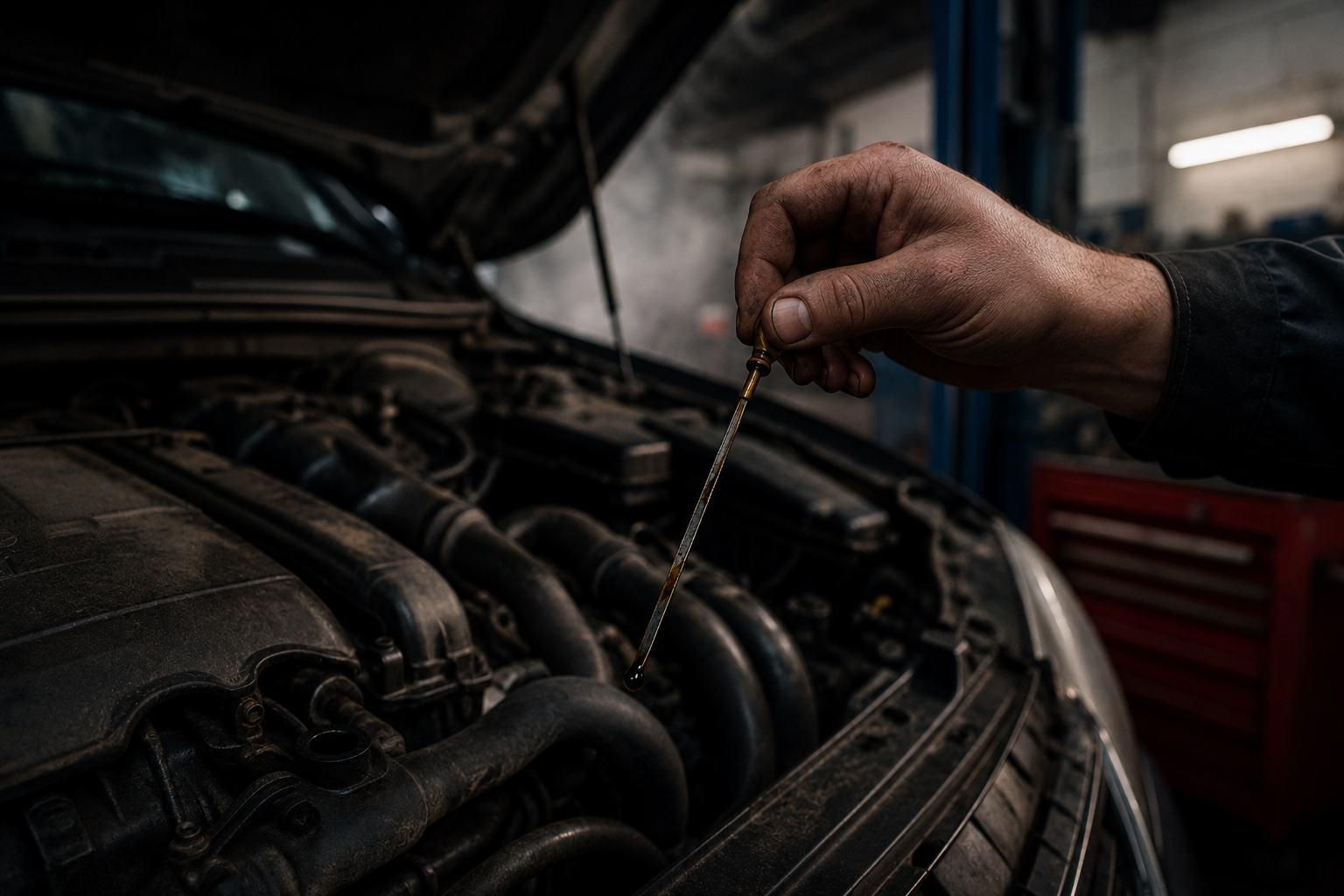
The correct method depends on the vehicle. Some engines have a conventional dipstick, while others use an electronic system that operates only under certain conditions. The manufacturer’s instructions should always be followed.
General dipstick-check procedure
- Park the vehicle on as level a surface as possible.
- Switch off the engine.
- Wait for the period specified in the owner’s manual so that the oil drains back into the sump.
- Remove the dipstick and wipe it with clean, lint-free material.
- Insert the dipstick fully again.
- Remove it once more and read the level.
- Also inspect the appearance, smell and any unusual foam, but do not use colour alone as an oil-quality test.
If the level is below the minimum mark or no oil is visible on the dipstick at all, the engine should not be restarted until it is understood how much oil is missing and why it has disappeared.
Is topping up the oil enough?
If the level is only slightly below the minimum mark, adding oil of the correct specification may restore the required quantity. Oil should be added in small amounts, checking the level again after each addition.
Topping up alone, however, does not answer the most important questions: why the level dropped, how long the engine operated with insufficient lubrication and whether the pressure warning was actually caused by the oil level.
If the warning remained on for more than a brief moment, mechanical noises were heard, a significant leak is visible or the level was extremely low, the safest option is not to restart the engine and to have the vehicle transported to a workshop.
Do not restart the engine after topping up if
- a large oil puddle has formed beneath the vehicle;
- oil is leaking from the filter, filter housing, sump or drain plug;
- the engine knocked, rattled or ticked loudly before being switched off;
- the dipstick was completely dry at first;
- the warning appeared immediately after a repair or oil change;
- the correct oil specification is unknown;
- there is suspicion of sump, filter or oil-cooler damage.
Too much oil is not safe either
While trying to rescue the situation, the engine must not be filled significantly above the maximum mark. An excessive level may allow the crankshaft to strike the oil, whipping it into foam and filling it with air bubbles.
The oil pump may be unable to pressurise a foamy mixture consistently. Overfilling may also increase crankcase pressure, encourage leaks and push oil into the intake system.
If the level is above the maximum mark, determine whether too much oil was simply added or whether fuel or coolant is raising the level. Such an engine should not remain in service without inspection.
Why does a low oil level cause pressure loss?
The oil pump normally draws oil from the sump through a pickup. If the oil quantity becomes too low, the pickup may no longer remain fully submerged under certain conditions.
During hard braking, acceleration, a long corner or a steep incline, the oil moves around inside the sump. If the level is critically low, the pump may briefly draw in air and pressure disappears.
Typical signs of a low level
- the warning flickers during a sharp turn;
- the light appears while braking or accelerating;
- the oil level is below the minimum mark;
- the engine has already shown increased oil consumption;
- leaks are visible beneath the vehicle or on the engine;
- a long distance has been covered since the oil was last checked.
A warning that flickers only during cornering is not “less serious”. It may be the final sign before pressure begins to disappear while driving straight as well.
Where can the oil disappear?
Oil may escape from the filter, sump, seals, cam cover, oil cooler, pipes or turbocharger lubrication connections.
Worn piston rings, cylinders, valve-stem seals or a crankcase-ventilation problem may increase oil consumption.
Oil may enter the intake or exhaust, causing smoke, increased consumption and a risk of turbocharger damage.
Too little oil may have been added, the filter may be fitted incorrectly or the drain plug may not have been tightened sufficiently.
Why must you not drive even when the oil level is normal?
A normal level proves only that a certain quantity of oil is probably present in the sump. It does not prove that the oil is being drawn in, pressurised and delivered to every required component.
If the light remains on with the correct level, possible causes include a failed pressure sender, wiring fault, oil-pump failure, blocked pickup, stuck pressure-control valve, incorrect filter, excessively thin oil or large internal clearances in a worn engine.
If the level is normal but the red warning light does not go out while the engine is running, do not restart the engine. A normal level is not permission to continue driving in this situation.
Faulty oil-pressure sensor or wiring
A pressure sender or switch may begin transmitting an incorrect signal because of internal wear, oil entering the connector, corrosion, damaged wiring or a poor electrical contact.
A faulty sender is a relatively simple defect, but it must not be assumed without measurement. If the mechanical pressure is genuinely low, replacing the sender or disconnecting the wire merely hides the warning.
Signs that may suggest a sender fault
- the warning comes on and goes out after driving over an uneven road;
- oil or connector damage is visible around the sender;
- diagnostics records an electrical-circuit fault for the pressure sensor;
- the engine operates without mechanical noise, but the warning is intermittent;
- an independent pressure gauge confirms that the pressure meets the manufacturer’s specification.
The final point is decisive. Without measuring the actual pressure, it is not safe to conclude that only the sender is faulty.
Blocked oil pickup
The oil pickup is normally located in the sump and uses a mesh screen at the pump inlet to stop larger debris. If sludge, sealant fragments or pieces of damaged components have accumulated in the engine, the screen may become partially blocked.
The pump can no longer draw in enough oil, especially during a cold start, under heavier load or at a particular temperature. Sometimes the problem is not the mesh itself but a seal on the pickup pipe that allows the pump to draw in air.
What encourages blockage?
- oil-change intervals that are too long;
- unsuitable oil;
- engine overheating;
- heavy sludge deposits;
- excessive use of sealant during repair;
- breakdown of timing-guide or wet-belt material;
- internal engine-component damage.
Oil-pump and pressure-control-valve failure
The oil pump creates flow, while pressure develops because of the resistance to that flow in the lubrication passages and bearing clearances. The pump may wear out, suffer mechanical damage or lose its drive.
The pressure-control valve helps prevent excessive pressure. If it sticks open, a large amount of oil may circulate through the bypass and insufficient pressure develops in the system.
Some engines use variable-output pumps, electronically controlled valves or several pressure modes. In such a system, the fault may be mechanical, electrical or related to software control.
Worn crankshaft and connecting-rod bearings
Pressurised oil flows between the crankshaft and bearing surfaces, forming a thin protective film. As an engine wears, the clearances may increase and oil escapes through them more quickly.
Cold, thicker oil may still maintain adequate pressure. Once the engine and oil are fully hot, viscosity decreases and pressure at idle may fall below the warning threshold.
A typical wear pattern
- the warning does not appear when the engine is cold;
- after a longer drive, it flickers at hot idle;
- the light goes out when engine speed is increased;
- a deep knocking or metallic sound can be heard;
- metal particles are found in the oil filter or sump;
- measured pressure does not meet the manufacturer’s specification with the engine hot.
Using thicker oil may temporarily raise the pressure, but it does not repair worn bearings. Incorrect viscosity may create other lubrication and cold-start problems.
Incorrect or diluted engine oil
Oil viscosity and specification must match the requirements of the particular engine. Oil that is too thin, unsuitable or heavily degraded may be unable to maintain the necessary pressure when the engine is hot.
Fuel may dilute the oil after unsuccessful DPF regenerations, injector faults, repeated very short journeys or other fuel-system problems. The oil level may even rise, while its lubricating properties deteriorate.
Coolant entering the oil also changes its properties and may form an emulsion. A failed head gasket, oil cooler or another component then needs to be investigated.
Incorrect or damaged oil filter
An oil filter is not simply a metal container filled with filter material. Depending on its design, it may contain anti-drainback and bypass valves that affect pressure build-up and oil delivery after starting.
A filter of the wrong size, poor quality, damaged or internally collapsed may restrict flow or allow oil to drain from the passages after the engine is switched off. A cartridge filter may be installed incorrectly, have a missing seal or use a damaged housing valve.
If the problem began immediately after an oil change, check
- whether the correct oil specification and quantity were used;
- whether the correct filter was installed;
- whether the old filter seal remained stuck to the engine;
- whether filter-housing seals were fitted in the correct positions;
- whether the filter or drain plug is leaking;
- whether the filter housing is damaged;
- whether pressure was checked after the repair rather than merely clearing a fault code.
A double filter seal can empty the engine very quickly
When a spin-on oil filter is replaced, the old rubber sealing ring may remain stuck to the engine. If the new filter is screwed on over it, a gap may open between the two seals under pressure.
After the engine starts, oil may escape extremely quickly. The driver notices the red warning light in the cabin, while a puddle forms beneath the vehicle within seconds.
In this situation, the engine must be switched off immediately. Topping up is not enough — the filter must be fitted correctly and the engine must be assessed for operation without pressure.
Damaged or crushed oil sump
An impact with a stone, kerb, ice or road obstacle may puncture or deform the oil sump. Plastic, aluminium and thin-steel sumps react differently to impact.
Even when the sump is not leaking, deformation may push its base against the oil pickup and restrict flow. No leak may be visible externally, but the pump is still unable to receive enough oil.
After an impact beneath the vehicle
If the oil-pressure warning appears, an oil smell develops or fluid is visible beneath the vehicle, switch off the engine and do not continue driving.
What sounds may accompany loss of lubrication?
Loss of oil pressure does not always produce noise immediately, so silence does not mean that the engine is safe. Certain sounds do, however, increase the likelihood of serious damage.
Hydraulic tappets, camshafts or other upper-engine components may not be receiving enough oil.
May indicate connecting-rod or crankshaft-bearing damage. The engine must not continue running.
A hydraulic chain tensioner may be receiving insufficient pressure, also creating a risk that the timing mechanism will jump.
The turbocharger bearings may have lost lubrication or already suffered mechanical damage.
The turbocharger may be damaged first
A turbocharger shaft rotates at extremely high speed and depends on a continuous oil supply. Loss of pressure, a blocked feed pipe or contaminated oil may damage its bearings very quickly.
Oil may then enter the intake or exhaust side, causing bluish smoke, rapid oil consumption, power loss and, in some diesel engines, even a risk of uncontrolled engine operation.
If the pressure warning is accompanied by turbocharger noise or smoke, the engine must not be restarted.
Why does the light flicker only when the engine is hot?
Oil becomes more fluid as it warms. In a technically healthy engine, the system must still maintain the pressure specified by the manufacturer with hot oil.
If the warning appears only after a long journey or at hot idle, possible causes include incorrect viscosity, fuel dilution, pump wear, a pressure-control valve fault, increased bearing clearances or a sender whose signal changes with temperature.
This is not a normal “old-engine habit”. Even if the light goes out at 1,000–1,500 rpm, the cause must be found before the vehicle is used again.
Why does the warning remain on after a cold start?
After the vehicle has been parked for a long time, some oil drains back into the sump. Anti-drainback valves in the filter and the design of the lubrication system should help retain oil in important passages.
If the filter drains empty, the pump loses its prime, the pickup seal draws in air or the oil is unsuitable for low temperatures, pressure may take too long to develop after starting.
Inspection is required if
- the light remains on longer after every cold start than it used to;
- the chain or valve gear rattles during the first few seconds;
- the problem began after a different filter or oil was installed;
- the symptom becomes considerably worse in cold weather;
- the time required to build pressure is gradually increasing.
Does OBD diagnostics show the real oil pressure?
It depends on the vehicle. A simple system may use only a switch that reports whether pressure is above or below a particular threshold. Diagnostics can then see only the switch state or an electrical-circuit fault.
A more modern engine may have an analogue pressure sensor, allowing calculated or measured pressure to be viewed in the control unit. A faulty sensor may still transmit a believable but incorrect value.
The absence of a fault code does not prove that mechanical pressure is correct. An independent test with a suitable gauge or manufacturer-approved equipment may be decisive.
How does a workshop test oil pressure?
- checking the oil level, smell and condition;
- checking for leaks at the top and bottom of the engine and beneath protective covers;
- confirming the oil and filter specification;
- visually inspecting the sender, wiring and connector;
- reading control-unit faults and live data;
- connecting a mechanical gauge in place of the sender or at the specified test port;
- measuring pressure at the oil temperature specified by the manufacturer;
- taking readings at idle and at specified engine speeds;
- comparing the results with the technical requirements for the particular engine;
- inspecting and, where necessary, cutting open the oil filter;
- looking for metal particles and sludge;
- inspecting the sump, pickup and pump;
- checking the pressure-control valve;
- assessing bearing clearances and engine wear;
- repeating the pressure test after repair.
Why is there no single universal “correct pressure” value?
Acceptable pressure depends on engine design, oil temperature, viscosity, engine speed, pump-control mode and the measuring location.
The same reading may mean completely different things in two different engines. A modern variable-output pump may intentionally maintain lower pressure under certain conditions than an older engine.
A workshop should therefore not judge the result using only a general rule found online. Technical information for the specific engine and the correct test temperature are required.
Can you replace only the sensor and see what happens?
If the sender is inexpensive and easy to access, it may be tempting to replace it without measuring pressure. In some cases, the sender will indeed be the problem, but this approach is risky.
If the light goes out after the sender is replaced but actual pressure remains too low, the new sender may have a different threshold or the warning may simply not appear during that particular test.
The safe sequence is to confirm mechanical pressure first and then decide whether the sender, wiring, pump or internal engine components require repair.
What must not be done?
A few kilometres without sufficient pressure may turn a small defect into a complete engine repair.
The light going out at higher rpm does not prove that lubrication is safe.
This may hide the symptom, but it does not repair the pump, pickup or worn bearings.
Overfilling may foam the oil and create additional problems.
Hiding the warning does not restore oil pressure and prevents future damage from being noticed.
Every restart without pressure creates another period of dry friction.
What happens if you continue driving?
Without an adequate oil film, metal surfaces begin making direct contact. Friction and temperature rise, bearing material wears or melts and metal particles circulate through the entire lubrication system.
Crankshaft bearings, connecting-rod bearings, camshafts, the turbocharger, pistons, cylinders, hydraulic tappets and timing-chain tensioners may all be damaged.
Even if the engine appears quiet again after oil is added, early damage may already have occurred. Metal particles may remain in the filter, oil and sump and continue damaging the system.
Illustrative cost example
Assume that the warning light appears after an oil change. In the first scenario, the driver switches off the engine immediately and the workshop finds an incorrectly installed filter seal. In the second scenario, the driver covers another ten kilometres, the oil escapes and the crankshaft bearings and turbocharger are damaged.
The amounts are illustrative and are not a quotation from a particular workshop. Costs depend on the vehicle, engine design, extent of damage, parts availability and repair method.
The oil warning light in start-stop, hybrid and electric vehicles
Start-stop vehicle
When the start-stop system intentionally switches off the engine, the vehicle should not display an emergency oil-pressure warning as if a fault had occurred. The control system knows that the engine was stopped deliberately.
If the warning does not go out after the automatic restart or appears while driving, respond in the same way as in any other vehicle — stop safely and switch off the engine.
Hybrid
A hybrid’s petrol engine may stop frequently while the vehicle remains ready to drive. The control system must distinguish normal engine shutdown from a genuine pressure fault.
If the dashboard displays an oil-pressure warning or an instruction to switch off the hybrid system, follow the instructions for the particular vehicle and stop the journey.
Electric vehicle
A fully electric vehicle does not have an internal-combustion engine oil-pressure system. It may contain reduction-gear oil and other fluids, but a traditional red engine-oil-can warning generally does not apply to the traction motor in the same way.
What should be checked when buying a used vehicle?
A seller may warm up the engine, use thicker oil or clear fault codes. Both a cold start and a fully warmed-up engine therefore need to be assessed.
- whether the light comes on when the ignition is switched on;
- how quickly it goes out after a cold start;
- whether chain or valve-gear noise is heard during the first few seconds;
- whether the warning appears after the engine is fully warm;
- whether deep knocking is heard at idle;
- whether leaks are visible around the filter, sump and turbocharger;
- whether the oil level is too low or too high;
- whether the oil has a strong smell of fuel;
- whether visible sludge is present beneath the oil-filler cap;
- which oil and filter were used at the last service;
- whether regular maintenance is documented;
- an independent mechanical-pressure test if there is even the slightest concern.
Driver’s checklist
☐ I recognise the red oil-pressure symbol
☐ I know that it is not merely an oil-level reminder
☐ I do not increase engine speed when the warning appears
☐ I stop safely and switch off the engine
☐ I check the level on a level surface
☐ I use oil of the correct specification
☐ I do not fill above the maximum mark
☐ I check for fresh leaks beneath the vehicle
☐ I inspect the filter and sump area
☐ I do not restart the engine merely because the level is normal
☐ I do not assume the sender is faulty without measurement
☐ I request a mechanical pressure test at the workshop
☐ I tell the workshop whether the warning appeared with the engine cold or hot
☐ I report any impact to the sump or recent maintenance
☐ I report ticking, knocking or turbocharger noise
☐ Pressure was retested after repair
A short self-check
The red oil warning light came on, but the engine sounds normal. Can I drive three kilometres to a workshop?
No. Stop safely and switch off the engine. If pressure has genuinely been lost, even a short drive may cause extremely expensive damage.
The oil level is at maximum. Does that prove only the sender is faulty?
No. The level may be normal with a failed pump, blocked pickup, incorrect filter or worn bearings. A pressure test is required.
The light flickers only during sharp turns. Is it an electrical fault?
Possibly, but check the oil level first. With a critically low level, the pump may briefly draw in air during a turn.
The warning does not go out after an oil change. Should I wait for the filter to fill?
Switch off the engine. Waiting for a long time with the engine running is not safe. The oil quantity, filter, seals, leaks and actual pressure must be checked.
Frequently asked questions
How long can an engine run without oil pressure?
There is no safe period. The speed of damage depends on load, engine speed, remaining oil and engine design. The correct response is to switch off the engine immediately.
Can the oil warning light come on because the engine speed is too low?
If the engine is close to stalling, pump speed falls and the light may illuminate. However, if the engine is running steadily at its specified idle speed, the warning must not be considered normal.
Can a weak battery cause the oil warning light?
Low system voltage may create various incorrect signals, especially during starting, but a stable oil-pressure warning with the engine running must not be blamed on the battery without testing the pressure.
Can oil that is too old cause the warning?
Yes. Degraded, contaminated or fuel-diluted oil may lose the required properties, but pump, pickup and engine-wear problems must also be ruled out.
Will thicker oil stop the warning flickering when the engine is hot?
It may temporarily change the symptom, but it does not repair mechanical wear or a failed pump. The manufacturer-approved specification should be used and the real cause must be found.
Why does the oil warning light come on while braking?
With a critically low level, oil moves inside the sump and the pickup may briefly become uncovered. An electrical contact fault is also possible, but the level should be checked first.
Is the engine definitely damaged after the light comes on briefly?
Not necessarily. If the engine was switched off quickly, damage may not have occurred. The cause must still be found, pressure tested and the oil and filter assessed.
Can the vehicle be towed to a workshop with a rope?
This depends on the transmission, drivetrain and manufacturer’s requirements. Towing many automatic, hybrid and all-wheel-drive vehicles with their wheels on the road is restricted. A recovery vehicle is often the safest option.
Is clearing the oil-pressure-sensor fault code enough?
No. Clearing the code does not change mechanical pressure. The sender circuit and actual pressure must be tested according to the requirements of the particular engine.
A few seconds of correct action can save the entire engine
The oil-pressure warning light is not a diagnosis. It does not tell you whether the cause is the level, sender, filter, pump, blocked pickup or engine wear. It warns that the lubrication system may not have the pressure required for safe operation.
The driver’s task is not to dismantle the engine at the roadside. The most important step is to switch off the engine as soon as possible, check the level and visible leaks and not continue the journey until the problem has been assessed.
A normal level is not reassuring in this situation. It makes a mechanical pressure test especially important. Replacing the sender based on guesswork may be inexpensive, but incorrectly assuming that the sender is responsible can cost the entire engine.
The main takeaway: a red oil-pressure warning light while the engine is running means you should stop safely and switch off the engine. Check the oil level and visible leaks, but do not restart the engine merely because the quantity appears normal. The real cause is identified by measuring pressure, inspecting the oil and filter and diagnosing the lubrication system.