
 LV
 EN
 RU
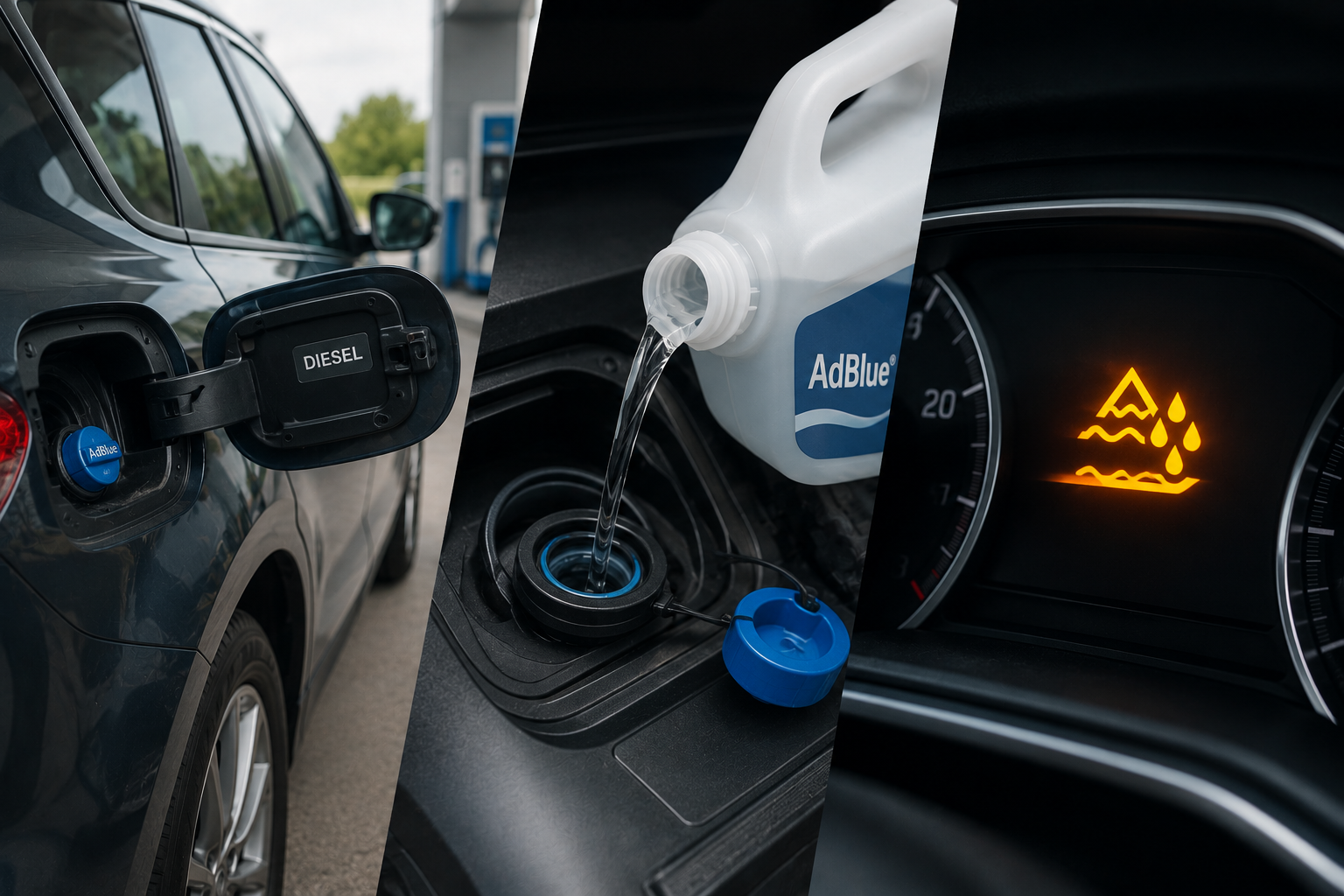
A modern diesel car is no longer just an engine, a fuel tank and an exhaust pipe. It has many systems designed to reduce emissions, improve efficiency and meet emissions requirements. One of the systems that many drivers only start thinking about when a dashboard warning appears is AdBlue.
At first, AdBlue can seem strange. It is not fuel. It is not engine oil. It is not windscreen washer fluid. It is also not an additive that should be mixed with diesel. However, without it, many modern diesel cars cannot operate properly in their intended emissions mode. In some cars, if AdBlue runs out or the system has a serious fault, the engine will not restart after a certain distance.
That is why AdBlue is an important topic for anyone who drives a modern diesel car. Not because it should be feared, but because it should be understood. If you know what AdBlue is, where to top it up, how to respond correctly to warnings and what not to do, this system is usually not a problem. If you ignore it, pour it into the wrong place or leave faults until the last moment, it can become an expensive and frustrating experience.

Quick answer for the reader:
AdBlue is a special fluid used in modern diesel cars with an SCR system. It is not poured into the fuel tank and it is not used to lubricate the engine. The car injects it into the exhaust system to reduce nitrogen oxide, or NOx, emissions.
A typical driver thought: “I filled up with diesel, the oil is fine, everything works. Then suddenly an AdBlue warning appears on the dashboard saying the car will not restart after 1000 km. That is when you realise AdBlue is not just a small detail.”
What exactly is AdBlue?
AdBlue is a special fluid used in diesel cars with an SCR, or selective catalytic reduction, system. In simple terms, it is part of an emissions reduction system designed to help reduce harmful nitrogen oxide emissions. These emissions are one of the challenges diesel engines must deal with under modern emissions standards.
AdBlue consists of a urea solution and demineralised water. It is not a fuel-type liquid, it is not oil and it is not intended to burn inside the engine. The car stores it in a separate tank and injects it into the exhaust system, where together with the SCR catalyst it helps convert NOx emissions into less harmful substances.
The most important thing to remember is this: AdBlue must never be poured into the diesel fuel tank. It has its own separate filling point. In some cars, it is located next to the fuel filler cap; in others, it may be in the boot or under the bonnet. If you are not sure where the filling point is, it is better to check the owner’s manual than to guess based only on the colour of a cap.
What does AdBlue do in the exhaust system?
The purpose of AdBlue is not to give the engine more power or directly reduce fuel consumption. Its main job is to help the SCR system reduce NOx emissions. The car doses it into the exhaust flow, where at high temperature a chemical process helps neutralise harmful substances.
This means AdBlue is part of the emissions control system. If this system does not work, the car may record faults, show warnings and, in some cases, restrict further engine restarts. To the driver this may feel excessive, but the manufacturer designed this system as an essential part of emissions control, not optional equipment.
Simply put: fuel powers the engine, engine oil protects the engine, and AdBlue helps the exhaust system make diesel emissions cleaner. These are three completely different things.
| Fluid | Where does it go? | What is it for? |
|---|---|---|
| Diesel fuel | Fuel tank | Powering the engine. |
| Engine oil | Engine | Lubrication and engine protection. |
| AdBlue | Separate AdBlue tank | SCR system for reducing NOx emissions. |
| Washer fluid | Windscreen washer tank | Cleaning the windscreen. |
How can you tell if your car uses AdBlue?
Not all diesel cars use AdBlue. It is most common in newer diesel vehicles, especially those that meet newer emissions standards. However, the production year alone is not enough to be certain, because different manufacturers and models introduced these systems in different ways.
The easiest way is to inspect the car. If there is a second cap, often blue, marked AdBlue next to the fuel filler, the system is clearly visible. In some cars, the filling point is in the boot, under the floor or near the spare wheel. In others, it may be under the bonnet. The information is usually also found in the owner’s manual and in the onboard computer menu.
Another sign is a dashboard or menu warning. If the onboard computer shows AdBlue level, remaining distance until refill or an SCR system message, then the car uses this fluid.
Quick check:
- Open the fuel filler area and check whether there is a blue AdBlue cap next to the diesel filler.
- Check the owner’s manual under emissions system or fluids.
- Look at the onboard computer menu — does it show AdBlue level or remaining range?
- If you are unsure, ask a workshop to check by VIN instead of guessing.
Where do you pour AdBlue?
AdBlue must only be poured into the tank designed for it. Often the cap is blue and located next to the fuel filler, but not always. This “not always” part is important, because filling the wrong place can lead to very unpleasant consequences.
If AdBlue is accidentally poured into the fuel tank, do not start the engine. In this situation, the correct action is to stop and contact a workshop or roadside assistance. The sooner the mistake is noticed, the better the chance of avoiding more serious damage.
The opposite mistake — putting diesel into the AdBlue tank — is also serious. The AdBlue system is not designed for fuel. So before filling, always make sure you are holding the correct pump nozzle or container and pouring into the correct place.
Important:
Never pour AdBlue into the fuel tank. If the mistake has already happened, do not start the engine. The sooner the car reaches a workshop, the better the chance of reducing damage risk.
How often does AdBlue need to be topped up?
AdBlue consumption is not the same in every car. It depends on the engine, vehicle size, driving style, load, temperature, route and manufacturer system. One car may need AdBlue only rarely, another more often. Heavier vehicles, towing, higher loads and more intensive driving can increase consumption.
Many drivers do not think about AdBlue until a warning appears. That is not ideal, but it is also not a disaster if you react in time. The car usually gives several warnings and shows an approximate remaining range. The problem begins when the driver ignores these warnings until the very end.
A good habit is to check the AdBlue level before a longer journey. Especially if you are travelling abroad, driving at night, travelling with family, towing a trailer or going somewhere where you do not want to search for the right filling option at the last moment.
| Situation | What should you do with AdBlue? | Why does it matter? |
|---|---|---|
| Everyday city driving | Check the level in the onboard computer from time to time. | So the warning does not surprise you at the last moment. |
| Long trip abroad | Top up before the trip if the level is not sufficient. | Less stress on the road and less risk of searching in a hurry. |
| Low-level warning appears | Do not postpone topping up until the last day. | Many cars can block the next restart if AdBlue runs out. |
| “System fault” appears | Run diagnostics, do not only add fluid. | It may be a system fault, not just a low level. |
Why can the car display “No restart”?
One of the most unpleasant AdBlue warnings is a message saying the car will not restart after a certain distance. This does not mean the engine will switch off while driving. Usually it means that after the remaining distance has been driven and the engine is switched off, the car will not allow it to restart until the problem is fixed.

This warning can appear because of a low AdBlue level or because of a system fault. These are two different scenarios. If the fluid is simply low, topping it up usually solves the problem. If there is a fault in the pump, injector, sensor, heater, NOx sensor or SCR system itself, topping up alone will not be enough.
That is why it is important to read the exact message. “Refill AdBlue” and “AdBlue system fault” are not the same thing. The first more often means a low level. The second means diagnostics are needed.
Quick logic:
- “Refill AdBlue” — most likely, the fluid needs topping up.
- “No restart in...” — do not postpone it, because the car may block the next restart.
- “AdBlue system fault” — diagnostics are needed because the problem may not be only fluid level.
- The warning does not disappear after topping up — the system should be checked at a workshop.
What should you do if an AdBlue warning appears?
The first step is to calmly read the message. Many drivers see only the word “AdBlue” and immediately assume fluid must be added. Often that is true, but not always. The warning text helps you understand whether it is about low level or a system fault.
If the car asks you to refill AdBlue and shows remaining kilometres, top up the fluid as soon as reasonably possible. Do not wait until the last 50 kilometres. If using a container, pour carefully, do not use a dirty funnel and do not let dirt fall into the filler opening. The SCR system is not a place for contamination.
If the car shows a system fault, diagnostics are needed. Sometimes the fault may be related to a sensor, dosing injector, pump, crystallisation, wiring, heater or control unit. In this case, simply pouring in another container may not solve anything.
Action plan:
- Read the exact warning message on the dashboard.
- If refill is requested, top up the correct AdBlue tank.
- After filling, give the car time to recognise the added fluid.
- If the warning does not disappear, do not drive for months — run diagnostics.
- If you see “system fault” or “no restart”, do not postpone a workshop visit.
Why does the warning not disappear immediately after topping up AdBlue?
In some cars, after topping up AdBlue, the warning disappears immediately. In others, it disappears after a few minutes, after a short drive or after a system check. This can be normal. However, if the warning does not disappear at all, do not automatically keep adding more and more fluid.
It is possible that too little fluid was added, the system has not yet read the level, or a specific ignition procedure is needed. But it is also possible that there is a system fault. That is why after an unsuccessful refill it is important to check the owner’s manual and, if necessary, perform diagnostics.
Be especially careful if the message is not just “low AdBlue”, but “AdBlue fault” or “emissions fault”. These messages often mean the issue is technical, not just an empty tank.
Does AdBlue affect fuel consumption?
AdBlue is not directly a fuel economy product. It is not designed to make the engine use less diesel. Its purpose is emissions control. However, indirectly, the overall operation of the car can be affected by whether the SCR system works correctly.
If the AdBlue system has a fault, the car may show warnings, restrict operation or register emissions faults. In some cases, the driver may notice the car no longer behaves as usual. But if the question is “will adding AdBlue reduce consumption by one litre?”, the answer is no. It is not a fuel-saving additive.
If a diesel car consumes too much fuel, you should look at tyre pressure, driving style, short trips, DPF regeneration, thermostat, air filter, fuel system, brakes, sensors and other factors. AdBlue belongs to a different part of the story.
Short explanation: “AdBlue is not a fuel-saving fluid. It is an emissions system fluid. If the car uses too much fuel, the cause of consumption must be found — do not expect a miracle from AdBlue.”
AdBlue in winter: what should you know?
In winter, the AdBlue system has its own characteristics. AdBlue can freeze at low temperatures, so many cars have heaters in the system to help thaw it and keep it suitable for operation. This does not mean you cannot drive an AdBlue-equipped car in winter. It means the system must be in working order.
Problems can begin if the heater, sensor or another part of the system does not work. Then winter may bring faults, warnings and restrictions. The driver may think “the AdBlue froze”, but the real reason may be a faulty heater or sensor.
Another winter risk is poor-quality or contaminated fluid. AdBlue should be stored cleanly and correctly. If dirt, water or foreign substances get into the container, they can cause problems for the sensitive dosing system.
Winter mini tips:
- Use good-quality AdBlue from a trusted source.
- Do not store an opened container for a long time in a dirty or extremely hot/cold place.
- If an AdBlue fault appears in winter, check the system — do not only top up the fluid.
- Do not ignore a “no restart” warning, because finding help in cold weather will be even more unpleasant.
Why can AdBlue system faults be expensive?
The AdBlue system is not just a tank with fluid. It can include a pump, dosing injector, sensors, heaters, pipes, control unit, NOx sensors and SCR catalyst. If any of these parts start working incorrectly, faults appear.
It becomes expensive not only because the parts can cost a lot. It also becomes expensive because the problem is not always easy to guess by feel. In one car, the fault may be a NOx sensor; in another, the pump; in a third, a crystallised injector; in a fourth, wiring or software. That is why replacing parts at random can be very inefficient.
The smartest solution is diagnostics. Not “let’s pour in another container”, not “let’s disable the system”, but understanding what the car actually sees and which component is causing the fault. This can save both money and time.
Can you switch off or deactivate the AdBlue system?
Technically, you can find different offers online to disable the AdBlue system. But that does not mean it is a smart or safe solution. The AdBlue system is part of the vehicle’s emissions control. If it is disabled, the car no longer operates as the manufacturer intended.
Such a solution can create legal, technical and resale-value risks. It can also be a major disadvantage for the next buyer, because restoring the system later may cost a lot. In addition, disabling the emissions system does not solve the original cause of the problem — it only tries to hide the consequences.
If the AdBlue system shows faults, it is better to find the defect and repair the system. It may not be the most pleasant option, but in the long term it is usually safer and more sensible than disabling the emissions system.
Mini test: are you handling AdBlue correctly?
Answer honestly — this mini test helps you understand whether you take the AdBlue system seriously enough in everyday use.
Tick what applies to you:
- I know where the AdBlue filling point is in my car.
- I know that AdBlue must not be poured into the fuel tank.
- I do not postpone refilling until the last kilometres.
- I can tell the difference between a “low level” warning and a “system fault”.
- If the warning does not disappear after topping up, I plan diagnostics.
If 4–5 points apply to you, you are treating the AdBlue system quite correctly. If only 0–2 apply, it is worth reading the owner’s manual and learning the basics before the next warning appears.
Common mistakes with AdBlue
Most AdBlue problems are not caused by the system being “bad by nature”. Often, problems come from ignoring warnings, filling incorrectly or trying to save money in the wrong place.
- AdBlue is confused with a fuel additive. It must not be poured into the fuel tank.
- The warning is ignored until the last moment. As a result, the car may refuse to restart.
- Poor-quality or dirty fluid is used. This can harm the dosing system.
- After a fault, another container is poured in without diagnostics. If the problem is a sensor or pump, it will not help.
- The AdBlue system is disabled as a “quick fix”. This can create long-term risks.
- Cleanliness is ignored during refilling. Dirt in the AdBlue system can lead to very unpleasant consequences.
AdBlue refill at home or at a station — which is better?
AdBlue can be topped up from a container or at a fuel station if there is a suitable AdBlue filling option for passenger cars. Both options have advantages and disadvantages. A container is convenient if you need to top up at home or on the road. A station can be more convenient if you want to refill more precisely and avoid spilling.
If you use a container, cleanliness is very important. Do not use a dirty funnel, do not let sand fall into the filler opening and wipe up spilled fluid. AdBlue can crystallise, and white deposits around the cap are not unusual, but it is better not to leave them unattended.
If you use a filling station, make sure the nozzle is suitable for your car. In some places, AdBlue nozzles were originally intended more for commercial vehicles, and with a passenger car you need to be careful with flow rate and filler opening size.
| Filling method | Pros | Cons |
|---|---|---|
| Container | Convenient at home, easy to carry, available in many shops. | Higher risk of spilling, overfilling or using a dirty funnel. |
| Fuel station | Convenient for filling a larger amount, less packaging. | You must make sure the nozzle and flow rate suit a passenger car. |
| Workshop | Safe if you are unsure or if there is also a system fault. | Usually more expensive than topping up yourself. |
Is all AdBlue the same for every car?
AdBlue is not a fluid that should be chosen only by the nicest label. It must meet the quality requirements intended for SCR systems. Cheaper fluid of unknown origin may seem like a good deal, but if it is contaminated or unsuitable, the consequences can cost more than the saving.
When buying AdBlue, choose a trusted seller and make sure the package is sealed and has not been stored for a long time in unsuitable conditions. If a container is old, dirty, opened or stored in the sun for years, it is not the best choice for a modern SCR system.
This is not exaggerated caution. AdBlue system components can be sensitive. It is better to pour in quality fluid than later deal with faults and try to find out why a sensor or injector is not working correctly.
Small reader challenge: 10-minute AdBlue check
If you have a diesel car with AdBlue, today you can do a small check that may save stress later.
10-minute check:
- Find exactly where AdBlue is filled in your car.
- Check whether the onboard computer shows remaining AdBlue range.
- Look around the filler cap for large crystallised deposits.
- Check whether any AdBlue container at home is opened, dirty or very old.
- Make a note: how many kilometres before a longer trip will you check AdBlue level?
Common myths about AdBlue
Myth No. 1: “AdBlue is a fuel additive.”
No. AdBlue is not poured into the fuel tank. It is stored in a separate tank and used in the SCR exhaust system.
Myth No. 2: “If AdBlue runs out, the car will just keep driving.”
Many cars, after ignored warnings, may block the next engine restart until the fluid is topped up or the fault is fixed.
Myth No. 3: “AdBlue reduces fuel consumption.”
Not directly. It is an emissions system fluid, not a fuel economy product.
Myth No. 4: “All AdBlue faults are solved by adding fluid.”
No. If the problem is a sensor, pump, injector, heater or SCR system fault, diagnostics are needed.
Myth No. 5: “It is better to disable the AdBlue system to avoid problems.”
This can create legal, technical and resale-value risks. It is better to find the defect and repair the system.
Conclusion: AdBlue is not scary if you understand the system
AdBlue is not mysterious and it is not a reason to fear a modern diesel car. It is part of the emissions reduction system that helps SCR technology reduce NOx emissions. If the system is in good condition and the fluid is topped up in time, in everyday life it is usually a simple maintenance matter.
Problems begin when AdBlue is ignored, confused with a fuel additive, poured into the wrong place, topped up with poor-quality fluid or system faults are left until the last moment. Then a simple refill issue can become a workshop visit, a “no restart” warning and an unpleasant bill.
So the best advice is simple: know where AdBlue is filled in your car, check the level before longer trips, do not ignore warnings and distinguish low level from a system fault. If you see “AdBlue system fault”, do not start by guessing — start with diagnostics.
A modern diesel requires a little more attention than an old simple engine, but that does not mean it is bad. It means the driver needs to know a few new things. AdBlue is one of them.
Short driver conclusion: “AdBlue is not the problem. The problem begins when the driver does not know what it is, where to pour it and why the warning should not be ignored.”