
 LV
 EN
 RU
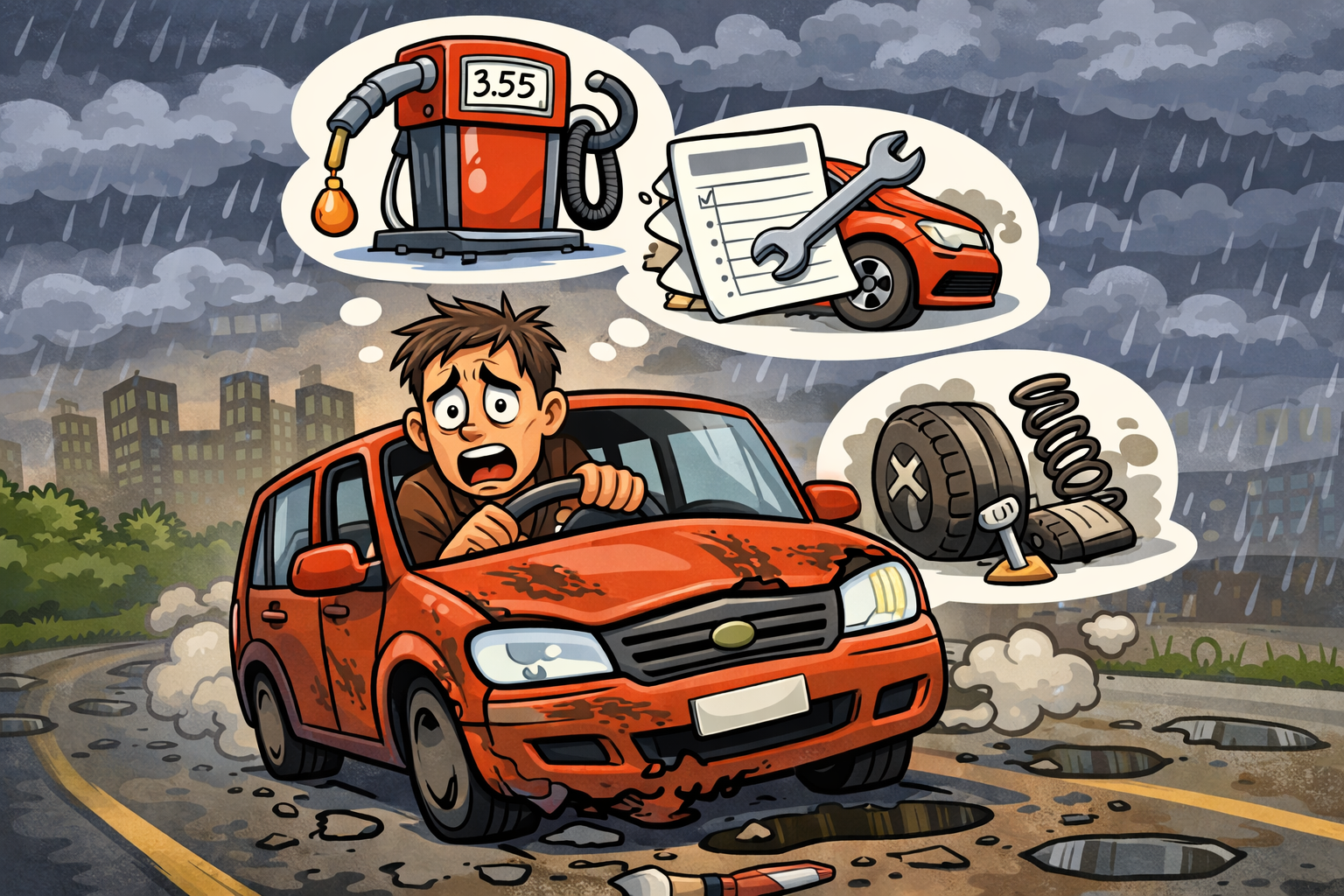
There are questions about car costs that people live with for years based on a vague feeling rather than a clear answer. One of them is very simple in form and very uncomfortable in substance: how much does 1 kilometer cost when driving a car? At first glance, it seems like there is nothing complicated. Take the fuel price, take consumption, divide it, and that’s it. But this is exactly where the big illusion begins. Because a car kilometer is almost never just a fuel kilometer. A car kilometer is also a depreciation kilometer, a tire kilometer, an oil kilometer, a maintenance kilometer, a brake kilometer, and sometimes even a kilometer of your nervous system.
That is why people very often live with a dangerously incomplete understanding of their car’s cost. They know how much it costs to fill the tank. They roughly know how often oil needs to be changed. They remember that tires were expensive. But they very rarely try to connect all of this into one honest question: how much does one driven kilometer actually cost me? And this is where unpleasant discoveries often begin. Because the cost of one kilometer on paper may look almost harmless, but over a year it can turn into a number that starts to look like a very serious part of a household budget.
This article is exactly about that. Without fairy tales. Without self-deception. Without comforting phrases like “a car just has to be maintained somehow.” We will look at what one kilometer really consists of, why people so often underestimate it, what the most common misconceptions are, how dramatically a cheap kilometer differs from an expensive one, and why sometimes a car owner thinks they control their costs, while in reality they only see a small part of the full picture.
And there is one very human point here. This article is not meant to scare people away from cars. It is about clarity. Because in car costs, the most painful thing is usually not that they exist. The most painful thing is that they exist in fog for a long time. And fog in finances is almost always more expensive than clarity.
The first big mistake: thinking that 1 km cost is determined only by fuel
This is the most common mistake of all. A person says: my car consumes, for example, 7 liters per 100 kilometers. Fuel costs, for example, 1.75 euros per liter. So 100 kilometers cost 12.25 euros. That means one kilometer costs about 12 cents. That’s it. Clear. Calculation done. From a mathematical perspective, everything is correct. From a real-life perspective — very incomplete.
Because a car does not end at the fuel tank. Every kilometer driven also means slightly less tire tread. Slightly closer to the next oil change. Slightly closer to brake replacement. Slightly closer to the next suspension repair. Slightly less of the car’s overall market value. In other words, every kilometer not only burns fuel. It also slowly consumes the car itself.
This is where people most often deceive themselves — not maliciously, but psychologically. Fuel is visible every week. Wear and tear is not felt every day. That is why fuel seems like the “real cost,” while everything else feels like separate inconveniences. In reality, they are not separate. They are different faces of the same kilometer.
A very typical thought in driver forums: “I thought my kilometer was cheap for a long time until I started counting not just the tank, but everything that comes with driving.”
The simple fuel formula — a good start, but not the final answer
However, fuel calculation is an important starting point because it gives a baseline feeling. If a car consumes 6 liters per 100 kilometers and fuel costs 1.75 euros per liter, then fuel alone costs 10.50 euros per 100 kilometers. That means one kilometer costs about 10.5 cents in fuel. If a car consumes 8 liters, then it is already 14 euros per 100 kilometers or 14 cents per kilometer. These numbers are real, understandable, and useful.
But they become dangerous at the moment when a person starts thinking that these 10, 12, or 14 cents are the full cost of one kilometer. They are not. They are only the fuel part. And very often this fuel part is psychologically so loud that it hides everything else. That is why a person can be completely convinced that their car costs “around this many cents per kilometer,” while in reality the true cost is noticeably higher.
That is why the smarter way of thinking is this: fuel cost is the foundation of a kilometer, not the entire building. And if you want to see the full picture, you have to look beyond the fuel pump.
Tires: one of the quietest but most honest costs per kilometer
Tires are a perfect example of how car costs live more quietly than fuel but are no less real. You do not buy tires every week, so psychologically they do not feel like a daily expense. But tires wear down every day. They do it quietly, invisibly, without dramatic sound — but they do. And that means every kilometer consumes a small part of them.
For example, if a set of tires costs several hundred euros and lasts a certain number of kilometers, that cost can be simply divided across those kilometers. And suddenly it turns out that every kilometer carries not only fuel, but also a portion of tire wear. Maybe it is not a huge amount per kilometer, but over time it becomes very real. And this is exactly how car economics works — large sums turn into small but constantly repeating cents.
This is often where people have their first interesting realization. A car is not expensive only when it “breaks down” or when “something big needs replacing.” A car is also expensive when it quietly and steadily consumes its regular resources every single day.
Oil, filters and maintenance: every kilometer moves you closer to the next service
People like to think of maintenance as a periodic event. Something that simply happens at a certain time. But if we look honestly, maintenance is also part of the cost per kilometer. Every kilometer you drive brings you one small step closer to the next oil change, filter replacement, and everything else that is part of normal operation.
This means that even if you do not pay anything at the service today, today’s kilometer already carries a part of that future bill. And this is a very important psychological shift. Because a person usually only feels the day when maintenance must actually be paid. But in reality, they have been paying for that day gradually, kilometer by kilometer.
This way of thinking helps to look at car costs much more calmly and honestly. Not as random disasters, but as a system. And in that system, every kilometer has its share of oil, filters, and maintenance life.
A good comment from drivers: “When I stopped seeing maintenance as a sudden hit and started seeing it as a cost I had accumulated through kilometers, the car became much easier to understand.”
Brakes, suspension and running gear: a kilometer becomes more expensive if it is a heavy kilometer
Here we reach a very important nuance. Not all kilometers are equal. One kilometer on a smooth highway at a steady pace is not the same as one kilometer in the city, in traffic, over potholes, with constant braking and repeated acceleration. Why does this matter? Because a heavier kilometer consumes the car’s mechanical life much more aggressively.
Brakes work much more in city driving. Suspension components take more impacts. The clutch in manual cars lives a harder life. The running gear is simply not used the same way in all scenarios. This means that the cost of one kilometer cannot be completely universal if we ignore how that kilometer is driven.
That is why two car owners can drive a similar distance per year, yet one will have significantly higher maintenance costs than the other. Not only because of the car, but also because of the route. And this leads to one of the most important conclusions: a kilometer is not just a unit of distance. It is also a unit of load.
Depreciation: the most uncomfortable cost per kilometer because you don’t feel it immediately
If there is one cost category people especially dislike including, it is depreciation. The reason is simple: depreciation is not the same as an immediate receipt. It is not as tangible as fuel or service. But it is very real. Every kilometer makes the car slightly less valuable on the market. Every kilometer brings you closer to the moment when a buyer will look at your car with a very different price than when it had lower mileage.
This is a very uncomfortable but very mature idea. When you drive, you are not only consuming fuel and parts. You are also moving the car along its value curve downward. Of course, not all cars depreciate the same way. Some lose value faster, others slower. But almost no kilometer is completely innocent when it comes to a car’s value.
Many people ignore this because it feels too “theoretical.” Until the day comes to sell the car. Then suddenly theory becomes very practical. And that is when people realize that their kilometers have quietly carried a reduction in market value for years.
A very accurate driver thought: “Until I sold my car, depreciation felt like a finance theory. On the day of sale, it became a very real number.”
Real scenarios: a cheap kilometer and an expensive kilometer are not just theory
To make this more human, let’s imagine two drivers. The first has a relatively economical car, drives mostly in smoother conditions, maintains the car properly, and covers most distance at a steady pace. The second has a heavier, more fuel-hungry car, more city stop & go driving, short trips, delayed maintenance, and overall a more demanding usage pattern. Both say: I drive a car. But their cost per kilometer can differ significantly.
For the first driver, fuel costs look reasonable and other expenses are spread more smoothly. For the second, the kilometer becomes expensive not only because of fuel, but also because each trip is harder on the car. And this is where many people feel something they do not always articulate: sometimes a car is not expensive just because it is a car. It is expensive because of the life you put it into.
That is also why there is no single universal number that fits everyone. But there is a very clear principle — the more honestly you include all cost layers, the closer you get to the real cost per kilometer.
Why do people want their kilometer to be cheaper than it actually is?
This is where human psychology comes into play. For many people, a car is not just a means of transport. It is a habit, comfort, independence, and sometimes even a part of identity and lifestyle. And the more emotionally important the car is, the more people tend to want to see it as financially reasonable.
That is why people reduce the cost per kilometer to fuel. That is why they avoid counting depreciation. That is why they do not want to divide tires, maintenance, brakes and all other “small things” across kilometers. Because as soon as they do it honestly, the car becomes a little less romantic and a little more what it actually is — an expensive, but often necessary mobility system.
And that is not a bad thing. On the contrary. Because the fewer illusions, the better decisions. About routes, about the next car, and about whether your current lifestyle is truly as cost-effective as you tell yourself it is.
When does the cost per kilometer become critically important?
When you drive a lot. When work is far away. When daily routes are long and repetitive. When the car is a central tool in your daily life. The greater the total mileage, the more important every cent in the cost per kilometer becomes. The difference between, for example, 0.14 and 0.22 euros per kilometer may seem abstract at first. But across thousands of kilometers per year, it becomes very real.
This is where one cent is no longer nothing. It becomes the character of your budget. And this is where many people realize for the first time how important it is not just to ask “how much fuel does my car consume?” but “how much does my car cost per kilometer overall?” Because this question is much closer to real life than fuel consumption alone.
What should you do if you want to understand your cost per kilometer more honestly?
The first thing is to stop looking for one magical number that fits everyone. It is smarter to look at your own car and your own usage. How much do you spend on fuel? How often is maintenance needed? How much do tires cost? What is your driving environment — highway, city, traffic, short trips? What is your annual mileage? Does depreciation matter in your case? These questions are not bureaucracy. They are a way out of the fog.
The second thing is to accept that an approximate but honest calculation is far more valuable than a beautiful illusion. You do not need perfect accounting. But it is very useful to understand that your kilometer is not just fuel. As soon as you understand this, all other decisions become smarter.
And the third thing — if the cost per kilometer in your life starts to feel too heavy, it is not a signal to feel ashamed. It is a signal to think. Maybe routes need to change. Maybe habits need to change. Maybe it is time to consider a different type of car. Or maybe it is simply time to finally admit how much your current car lifestyle actually costs.
Conclusion
One kilometer driven in Latvia is almost never just a fuel cost. It is a combination of many small costs, including fuel, tires, maintenance, oil, filters, brakes, running gear, depreciation and everything else that may seem “separate,” but in reality travels with you every day. The more honestly a person sees this, the closer they get to the real answer.
The most important conclusion is not that a car is expensive. Many people already suspect that. The most important conclusion is more practical: a car becomes easier to understand when you stop measuring it only by the fuel tank. Because in reality, one kilometer is always more than just a trip from point A to point B. It is also a resource you take from your car and your budget.
And perhaps this is the main value of this article. Not in one perfect formula, but in more honest thinking. Once a person understands the true cost of their kilometer, they live much less in illusion and much more in clarity. And clarity in car ownership is almost always cheaper than self-deception.
If you want to compare how different fuel price and consumption scenarios affect your real costs, use the calculator below.