
 LV
 EN
 RU
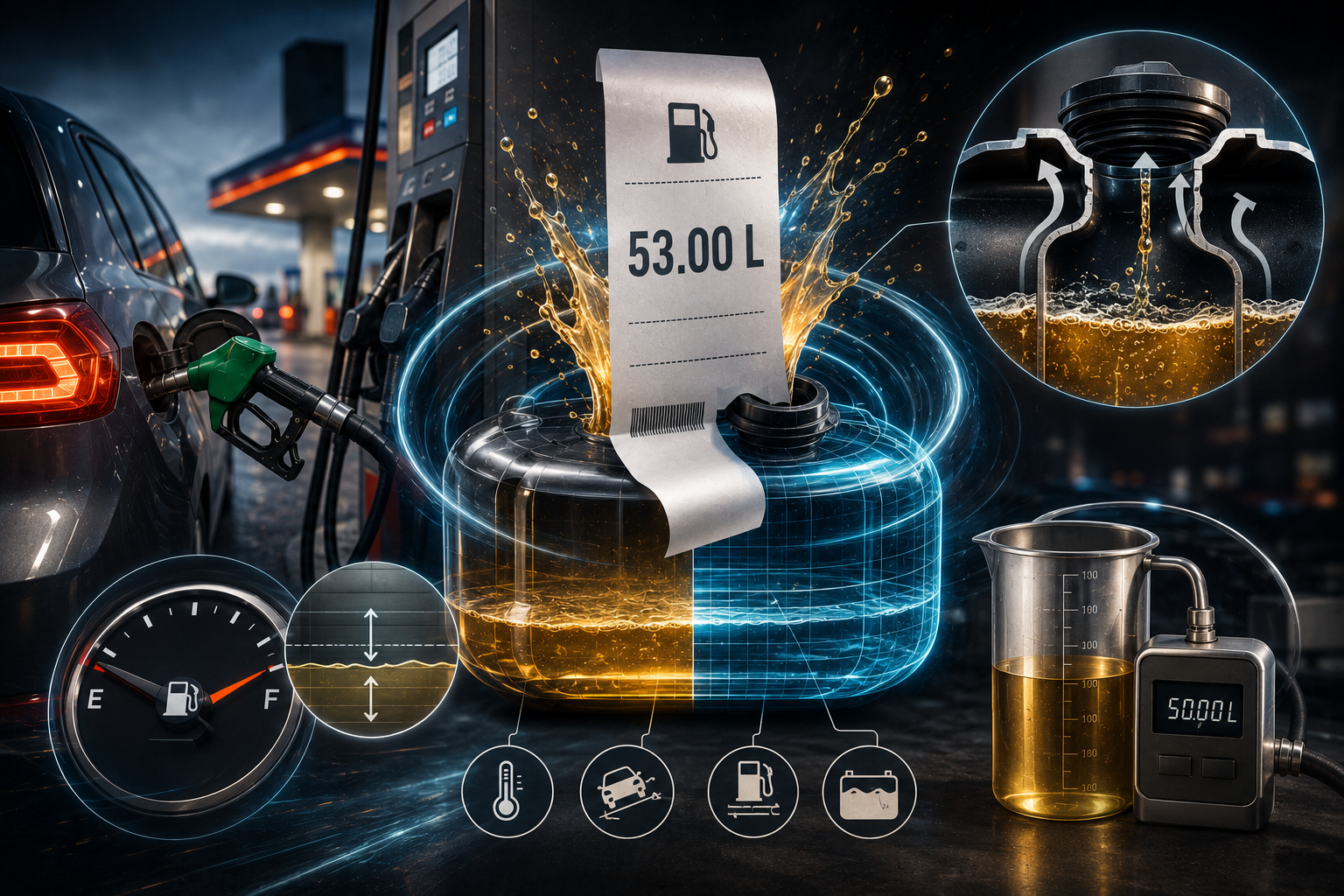
You arrive at a fuel station with an almost empty tank. The warning light has been on for some time, the remaining-range display shows only a few dozen kilometres, and the vehicle’s technical specifications clearly state: fuel-tank capacity — 50 litres.
You insert the nozzle, squeeze the handle and watch the display approach 50 litres. The filling process does not stop. The screen shows 50.6 litres, then 51.4, 52.2 and finally 53.1 litres. The nozzle clicks off, you take the receipt and are left with a perfectly reasonable question: how could more than 53 litres fit into a 50-litre tank?
For many drivers, the first conclusion is immediate and uncomfortable — the fuel station is cheating. A second explanation is that the manufacturer published an incorrect tank capacity. Others blame fuel temperature, the nozzle, air inside the tank or a mysterious “reserve tank” supposedly hidden somewhere beneath the vehicle.
In reality, one unusual fill-up does not prove either deliberate fraud or a vehicle fault. The number of litres shown on the receipt may be affected by the difference between nominal and physical tank capacity, the filler neck, expansion space, vehicle angle, fuel foaming, nozzle position, the amount of fuel previously remaining and whether the driver continued filling after the first automatic click.
The opposite extreme is not correct either. It should not automatically be assumed that any quantity is normal simply because the tank has a filler neck. If the difference is substantial, repeatedly appears during several fill-ups and remains present when the same filling method is used, the situation should be investigated systematically.
The main principle: the fuel-tank capacity listed in the owner’s manual, the position of the fuel gauge and the nozzle’s first automatic click are three different values. They should not be treated as one perfectly precise measurement.
What does the stated fuel-tank capacity actually mean?
The fuel-tank capacity shown in a vehicle’s technical specifications is normally a nominal value. It describes the fuel system of that particular model, but it should not always be interpreted as an absolute laboratory-measured boundary beyond which not even one additional millilitre can enter the system.
A fuel tank is not a simple rectangular box. It must fit around the body structure, rear axle, exhaust system, drivetrain components and other parts of the vehicle. The tank may therefore have a complicated shape, multiple recesses, connected chambers and different heights in different areas.
The fuel system also includes the filler neck, ventilation passages, fuel-pump housing, pipes and the space required for fuel expansion and vapour control. Not all of this geometric volume is intended to be filled with liquid fuel during normal use.
The tank requires space for ventilation and fuel expansion. Additional fuel may also enter the filler neck and other parts of the system, particularly when the driver continues filling after the nozzle’s first automatic click.
Is the fuel reserve a separate tank?
One of the most common myths is that the main fuel tank and the reserve are two separate capacities. A driver may believe, for example, that the car has a 50-litre tank plus an additional five-litre reserve.
That is normally not the case. The reserve is part of the tank’s total nominal capacity. The warning light comes on when the fuel level reaches a threshold selected by the manufacturer, while a certain quantity of fuel still remains in the tank.
If the specifications list 50 litres and the warning light comes on with several litres remaining, the total capacity does not suddenly become 55 litres. The reserve is already included within the same 50 litres.
The warning-light threshold may not be identical every time. It can be influenced by fuel movement inside the tank, the vehicle’s angle, float movement, sensor characteristics and electronic filtering used to stabilise the reading.
Why is the fuel gauge not a precision measuring instrument?
A vehicle’s fuel gauge is not a laboratory instrument. Its purpose is to give the driver an understandable indication of the remaining fuel, not to display the quantity with an accuracy of a few hundred millilitres.
In many vehicles, the fuel level is measured by a float that moves with the surface of the fuel. In an irregularly shaped tank, a one-centimetre change in level near the top may represent a completely different number of litres from the same change near the bottom.
The fuel-gauge scale is therefore often non-linear. After a full fill-up, the needle may remain near the full mark for a long time and then begin to move more quickly. In another vehicle, the final quarter may disappear much faster than the first quarter.
The manufacturer may also deliberately smooth the reading. Otherwise, the needle would move during every corner, acceleration and braking event because the fuel is constantly moving inside the tank.
Why does the gauge show empty when fuel is still present?
The gauge must warn the driver early enough. If the empty mark represented a completely dry fuel system, many cars would stop on the road before their drivers reached a filling station.
Fuel may therefore still remain even when the gauge is extremely low. This remaining quantity should not be relied upon. On a steep slope or during a sharp turn, the fuel pump may temporarily be unable to draw fuel even though some remains elsewhere in the tank.
The remaining-range display is not a direct fuel measurement
A display showing “60 km remaining” does not mean the computer knows the exact amount of fuel down to the last fraction of a litre. It is an estimate based on an assessed fuel level and recent or average fuel consumption.
If the vehicle was previously driven gently on a motorway, the computer may calculate a longer remaining range. After entering urban traffic, towing a trailer or driving into a headwind, the estimated range may fall much faster than the actual distance travelled.
Some vehicles stop showing a specific distance at a very low fuel level and display dashes instead. This is a deliberate warning that the remaining range can no longer be predicted with sufficient confidence.
How does the nozzle’s automatic shut-off work?
The fuel nozzle does not measure the vehicle’s total tank capacity and does not receive information from the car. It does not know whether the vehicle has a 40-, 50- or 80-litre tank.
A small sensing opening is located near the end of the nozzle. While air can flow through the mechanism, filling continues. When liquid fuel or foam covers the opening and changes the airflow inside the nozzle, the handle automatically releases.
The click therefore does not mean that one universal and mathematically exact level has been reached. It means that fuel or foam has reached the nozzle’s sensing area at that particular moment.
What affects the moment at which the nozzle clicks?
A nozzle inserted or rotated at a slightly different angle may receive fuel splashes and shut off earlier.
Very fast filling may create more turbulence and foam, causing the nozzle to click off sooner.
Diesel fuel in particular may create foam that temporarily reaches the nozzle opening even though free space remains below it.
If air cannot leave the tank freely enough, fuel may rise inside the filler neck and cause an early click.
Parking on a slope can change the fuel level in relation to the filler neck and ventilation passages.
Vehicles differ in filler-neck shape, length, ventilation design and the arrangement of tank chambers.
The first click and filling to the brim are not the same thing
When filling is stopped at the first automatic click, the result is normally reasonably repeatable. It will not be perfectly identical every time, but it is consistent enough for everyday fuel-consumption records.
If the driver waits after the first click, squeezes the handle again, waits once more and continues until fuel becomes visible in the filler neck, several additional litres may enter the fuel system.
This is often how the story of a 50-litre tank and a 53-litre receipt begins. The driver compares the nominal tank capacity with a quantity that was not only placed in the tank but also in the filler neck and space that would normally have remained empty.
Additional litres after the first click do not increase the safely usable tank capacity
They may fill the filler neck and reduce the space available for fuel expansion. This is not the same as having a larger manufacturer-approved everyday driving reserve.
Why is continuing after the click not recommended?
Fuel needs expansion space
Liquid fuel changes volume with temperature. If cool fuel is filled all the way into the filler neck and the vehicle is then left in direct sunlight, the fuel may warm up and expand.
The fuel system is designed to provide space for these changes. Filling the area intended for vapour and expansion increases the risk of fuel entering parts of the system where liquid fuel should not be present.
Petrol-vapour control system
In petrol vehicles, fuel vapours are controlled through a ventilation system and activated-charcoal canister. This system is designed for vapour, not for repeated exposure to liquid petrol.
Regularly filling to the brim may allow liquid fuel to enter the vapour-control system. Possible consequences include a fuel smell, difficult starting after refuelling, uneven engine operation, evaporative-emissions faults or damage to the charcoal canister.
Fuel spillage
When the filler neck is already full, fuel may spill onto the bodywork, the ground or the driver’s hands as the nozzle is removed. This creates fire-safety, health and environmental risks.
The safest everyday rule is therefore simple: stop filling at the first automatic click unless the vehicle manufacturer specifically instructs otherwise.
Why does diesel filling sometimes stop too early?
Diesel fuel may foam noticeably during filling. The foam rises inside the filler neck, reaches the nozzle’s sensing opening and triggers the automatic shut-off even though free space remains below it.
After a few seconds, the foam settles and more fuel can be added. This does not mean the first click was caused by a defective nozzle. The mechanism operated as intended because foam had reached the sensing opening.
Using a slower filling setting may reduce foaming and premature shut-offs in some vehicles. Diesel fuel should still not be routinely filled until liquid is visible at the top of the filler neck.
Can fuel temperature explain several “extra” litres?
Fuel volume changes with temperature. It expands as it warms and contracts as it cools. This is a real physical effect, but its importance is often exaggerated in everyday discussions.
The temperature inside a fuel station’s underground storage tanks normally changes more slowly than the outside air temperature. Filling in the morning rather than the afternoon is therefore not a magic technique that provides several free additional litres during a 50-litre fill-up.
Temperature can affect volume, but a large one-off discrepancy is more likely to involve an unknown amount of fuel already remaining, filling after the click, nominal tank capacity, nozzle operation or differences in the measurement method.
How can a 50-litre system produce a receipt for 52 or 53 litres?
There is no single universal explanation. Several factors often work together.
- The 50-litre figure in the technical specifications is a nominal and rounded value.
- The tank was emptier before filling than the driver’s estimate suggested.
- The fuel gauge and remaining-range calculation were not exact.
- The vehicle was parked at a different angle from previous fill-ups.
- The nozzle shut off later on this occasion or was inserted at a different angle.
- The driver continued filling after the first click.
- Additional fuel entered the filler neck and reduced the expansion space.
If several of these factors occur together, the amount shown on the receipt may exceed the nominal tank capacity. This does not automatically prove that the fuel station’s measurement was incorrect.
Illustrative example: where do the apparently missing litres come from?
Assume the owner’s manual lists a 50-litre tank. The warning light comes on when the driver believes approximately six litres remain. After the warning light appears, the car travels another 75 kilometres at an average consumption of 7.2 l/100 km.
The apparent discrepancy may exist because the warning light did not come on at exactly six litres, consumption was not precisely 7.2 l/100 km, nominal capacity is not an absolute physical limit and some fuel entered the filler neck after repeated filling. This example is illustrative and does not prove that a 52.4-litre fill-up is normal for every vehicle with a stated 50-litre tank.
When is a higher litre figure a genuine reason to investigate?
Suspicion becomes more reasonable not because of one surprising receipt, but when the discrepancy can be repeated under controlled and consistent conditions.
- a significantly higher quantity appears during several fill-ups;
- filling is always stopped at the first automatic click;
- the vehicle was not empty enough to explain the amount added;
- one particular pump regularly produces a different result from others;
- the litres purchased and actual distance travelled repeatedly produce an implausible consumption figure;
- the nozzle repeatedly clicks, the flow is irregular or the display behaves unusually;
- receipts and records have been retained so that the discrepancy can be documented.
A feeling that “the amount seems too high” is difficult to prove. Records from several fill-ups using the same method are far more useful.
Can a fuel-pump meter be inaccurate?
Any measuring instrument can theoretically be damaged, incorrectly adjusted or operating outside its permitted accuracy. One receipt alone, however, does not prove that a particular station is deliberately displaying an incorrect quantity.
A fuel pump cannot be tested fairly by filling a few litres into a random container and comparing the result with an approximate mark on a plastic wall. A household container is not a certified measuring instrument, its markings may be approximate and transferring fuel creates a fire-safety risk.
An official test requires a suitable calibrated measure, an established procedure and a competent authority. The driver’s role is to retain evidence and describe the circumstances accurately, not to perform a dangerous experiment in the station car park.
What should you do if you suspect an inaccurate fill-up?
- Keep the fuel receipt.
- Record the station address, date, time and pump number.
- Record the vehicle’s odometer and trip-meter readings.
- Note whether filling stopped at the first click or continued afterwards.
- If practical, photograph the pump display without obstructing other customers.
- Contact the station operator and ask for the situation to be investigated.
- If the explanation is insufficient, submit the documented information to the relevant consumer-protection or metrology authority.
- Avoid making public accusations before the equipment and circumstances have been properly investigated.
The full-tank method: the best way to calculate real fuel consumption
The consumption figure shown by the onboard computer is useful, but it may differ from the amount of fuel actually purchased. The most practical way to check long-term fuel consumption and notice repeated filling discrepancies is the full-tank method.
- Park the vehicle on ground that is as level as possible.
- Fill until the nozzle’s first automatic click.
- Do not continue until fuel becomes visible in the filler neck.
- Reset the trip meter or record the odometer reading.
- Drive a meaningful distance, preferably several hundred kilometres.
- Fill again to the first click under similar conditions.
- Divide the litres added by the kilometres travelled and multiply by 100.
- Repeat the calculation over several fill-ups and assess the average result.
Fuel consumption = litres added ÷ kilometres travelled × 100
Example: 42.6 litres ÷ 615 km × 100 = 6.93 l/100 km.
The result from one fill-up may be affected by the nozzle click and the vehicle’s angle. An average calculated over several complete cycles significantly reduces these differences.
How can two fuel stations be compared fairly?
One fill-up at station A and one at station B do not provide a reliable comparison. The vehicle may be parked at a different angle, the nozzles may shut off at different moments and the initial quantity remaining in the tank is not known precisely.
A better experiment is to record several fill-ups. Use the same rule at each station: stop at the first click, do not fill the filler neck, keep the receipts and record the distance travelled.
Do not compare only how many litres fitted into the tank during one visit. Compare how far the vehicle travelled using the fuel purchased over several fill-ups on similar routes and under similar conditions.
Even this comparison will not be a laboratory test because temperature, traffic, wind, tyre condition and driving style change. It is nevertheless far more reliable than a conclusion based on one surprising receipt.
Common mistakes when comparing tank capacity with the receipt
The warning threshold and sensor reading are not exact litre measurements.
The reserve is normally already part of the total nominal capacity.
Fuel added after the first click may fill the neck and expansion space.
Fuel consumption and remaining range are calculations, not direct measurements of the fuel received.
A one-off result may be influenced by too many changing factors.
A household container is not sufficiently accurate, and transferring fuel can be dangerous.
Can a fuel leak explain unusual calculations?
If the vehicle regularly uses much more fuel than expected, a technical problem should also be considered. An external leak, however, normally produces additional signs such as a fuel smell, wetness beneath the vehicle, stains on the tank or pipes and a falling level while the vehicle is parked.
A petrol leak is a serious fire hazard. If there is a strong fuel smell or visible liquid, the vehicle should not continue to be operated until the cause has been found.
Higher fuel consumption may also be caused by incorrect tyre pressure, dragging brakes, short journeys, cold weather, roof luggage, engine-management faults and heavier traffic. Litres and kilometres should therefore be assessed together with the vehicle’s mechanical condition.
What if the nozzle repeatedly clicks in a half-empty tank?
If the nozzle repeatedly shuts off after only a few litres even though the tank is not full, the cause may be the nozzle angle or the flow rate of that particular pump.
Insert the nozzle fully, but do not hold it in an unsafe position. A slower filling setting may help. If the problem occurs at different stations, the filler neck and tank-ventilation system should be inspected.
A blocked ventilation passage or faulty valve may prevent air from leaving the tank quickly enough. Fuel then rises inside the filler neck and causes premature shut-off.
A ventilation fault may also be indicated by strong pressure when the fuel cap is opened, fuel smell, difficult filling or deformation of the fuel tank. The system should be inspected by a workshop rather than forcing the filling process to continue.
Checklist after a suspicious fill-up
☐ The fuel receipt has been retained
☐ The pump number has been recorded
☐ The date and time have been recorded
☐ The odometer reading has been recorded
☐ The stated technical tank capacity is known
☐ It is known whether the reserve is included in that capacity
☐ The fuel-gauge reading before filling has been recorded
☐ It is known whether filling stopped at the first click
☐ Fuel was not added to the top of the filler neck
☐ Several fill-ups have been compared
☐ Real consumption has been calculated from distance travelled
☐ Any complaint is supported by documented facts
A short self-check
The car has a 50-litre tank, but 52.5 litres were added after several clicks. Does this prove fraud?
No. Some fuel may have entered the filler neck and expansion space, while nominal capacity may not be the absolute geometric limit of the system. Compare future fill-ups by stopping at the first click every time.
The nozzle clicked at 44 litres, but another four litres fitted after waiting. Why?
Foam, splashing or fuel rising in the filler neck may have caused the first click. The foam settled while you waited. This does not mean repeatedly filling to the brim is recommended.
The warning light came on, I drove 30 kilometres and then added almost the complete nominal capacity. Is the gauge faulty?
Not necessarily. The warning-light threshold, remaining consumption and nominal tank capacity are not exact. If the readings are repeatedly illogical, the level sensor should be checked and several fill-ups should be recorded.
Is morning fuel so much denser that it creates meaningful savings?
Temperature affects fuel volume, but underground storage-tank temperature normally changes slowly. Fuel price, driving style and a consistent filling method matter much more to the average driver.
Frequently asked questions
Is the capacity listed in the owner’s manual always accurate to the last tenth of a litre?
It is normally a nominal technical value. The actual fill-up can be influenced by tank design, the filler neck, remaining fuel, vehicle angle and the moment at which the nozzle clicks.
Should the reserve be added to the stated tank capacity?
Normally not. The reserve is the part of the total tank capacity that remains after the warning light comes on.
Is it safe to fill until the second click?
The safest and most repeatable method is to stop at the first click. Repeated filling may reduce expansion space and fill the filler neck.
Why does the nozzle click more frequently at some stations?
Nozzle design, flow rate and position in the filler neck may differ. If the problem occurs everywhere, the vehicle’s ventilation system should be checked.
Can a full tank damage the vehicle?
Normal filling until the nozzle automatically shuts off does not damage the vehicle. Problems may be encouraged by repeatedly filling to the top of the neck after several additional clicks.
Does the onboard computer always show correct fuel consumption?
No. It calculates consumption using engine-management data. For a more reliable long-term comparison, use the full-tank method over several fill-ups.
Can the fuel-level sensor give an incorrect reading?
Yes. The float may stick, the sensor track may wear, a connection may corrode or the tank’s shape may produce a non-linear reading. Repeatedly illogical readings should be inspected by a workshop.
Can the fuel quantity be tested with a five-litre can?
Household fuel-can markings are not designed for verifying a precise commercial measurement. Transferring fuel also creates fire-safety and environmental risks. An official inspection requires an appropriate measuring procedure.
Is one suspicious fill-up enough to make a complaint?
You may inform the station after one fill-up, particularly if the discrepancy appears substantial. A receipt, pump number, time and a clear description of the filling method will make the investigation much more useful.
One receipt raises a question, but several consistent measurements provide an answer
A situation in which 53 litres apparently fit into a 50-litre tank is a good example of how easily an everyday observation can be mistaken for a precise measurement. The driver knows the capacity listed in the specifications, sees the gauge near empty and assumes the amount remaining is known. None of these values, however, is perfectly exact.
Nominal capacity does not necessarily include every part of the system’s geometric volume. The reserve is not a separate tank. The nozzle click is affected by foam, splashing, angle and ventilation. Filling after the first click may also fill the neck and space intended to remain empty.
This does not mean fuel-pump measurements can never be inaccurate. It means that suspicion should be investigated using a repeatable method, retained receipts and documented facts rather than one surprising number.
The main takeaway: stop normal filling at the nozzle’s first automatic click, assess fuel consumption over several complete tank cycles and keep your receipts. If the nominal capacity is exceeded by a large amount, the result repeats with the same filling method and cannot be explained by an almost empty tank or fuel in the filler neck, document the situation and request a professional inspection.