
 LV
 EN
 RU
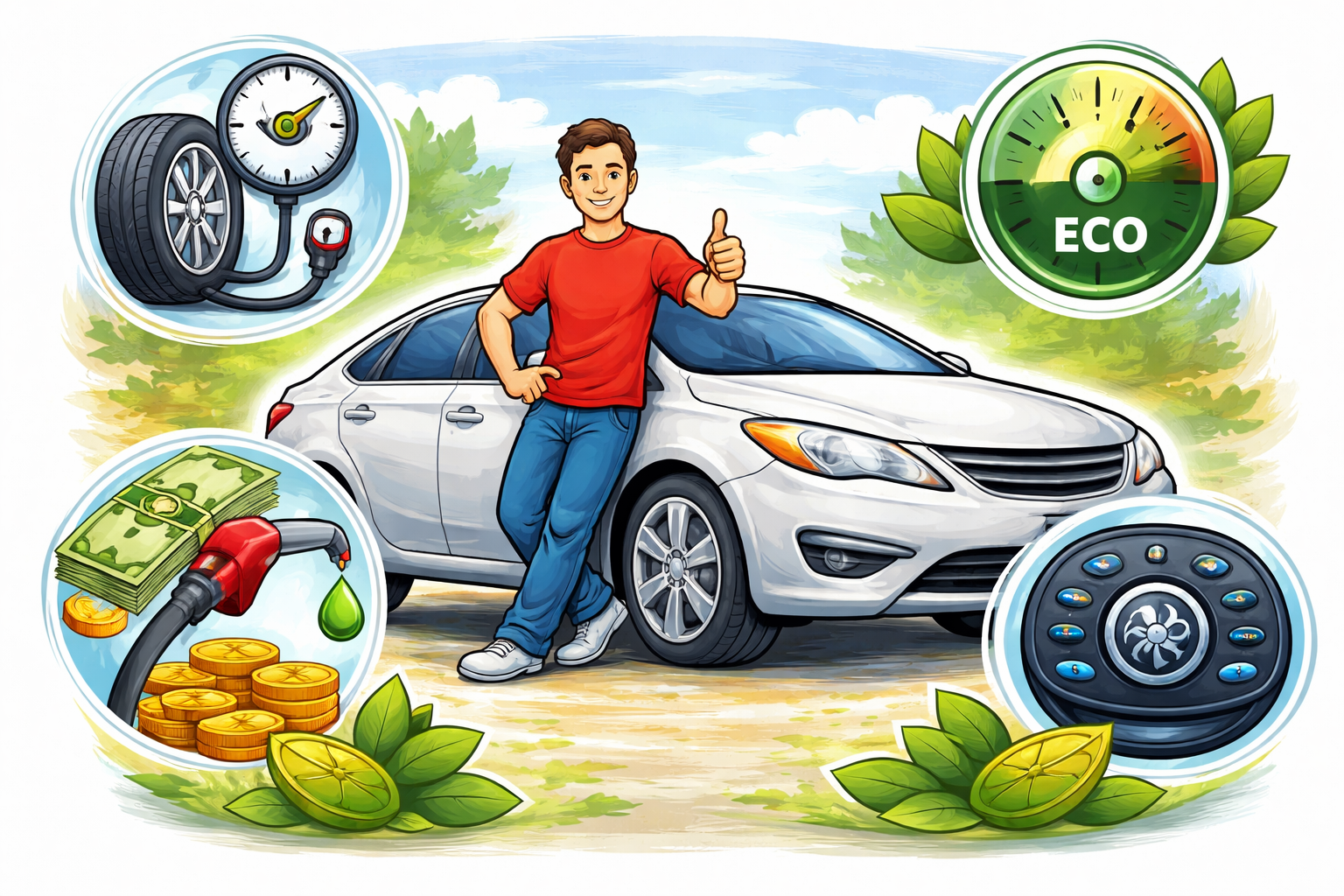
There is one very frustrating moment that many drivers have been experiencing lately. You pull into a filling station, put the nozzle into the tank, glance at the numbers, and suddenly you are annoyed not only by the price, but by your car, your route, your driving style, and sometimes even the whole logic of your daily life. At that moment, two thoughts usually appear. The first is, “I need to change my car.” The second is, “Surely there must be a way to reduce fuel use without making such a big decision.” And in reality, that second thought is often the smarter one.
People too often assume that fuel consumption is almost entirely built into the car itself. As if the only things that matter are engine size, fuel type, or the number printed in the manufacturer’s brochure. But in real life, consumption is strongly shaped by how the car is used. That means before taking a big step and thinking about replacing the vehicle, it is often worth improving the things that are already under your own control.
And here is the good news — in many cases, this is not about one magical trick. It is about the sum of several small, intelligent adjustments. On their own, each one may seem minor. Together, they can produce a surprisingly noticeable result. Sometimes not 1% or 2%, but enough that a driver begins to feel, for the first time in a while, that part of their fuel bill is back under their control.
This article is about how to do exactly that. Not in theory, but in a way that is practical, honest, and grounded in real daily life. No fairy tale about how “just driving slower” solves everything. No empty advice that sounds clever but changes nothing. And no assumption that the only solution is buying another car. Because very often, the first serious saving begins not in a showroom, but in the way you live with the car you already have.
Fuel consumption starts in the mind, not in the tank
This is the most important principle in the whole discussion. Fuel consumption is not only a technical number. It is also a behavioural result. Two people with the same car, in the same city, on very similar routes, can end up with completely different consumption figures. One will constantly complain that the car “drinks too much.” The other will quietly feel that the same car is actually fairly reasonable. Very often, the difference is not in the engine. It is in the rhythm.
It is the rhythm of how the journey begins. The rhythm of how the driver accelerates. The rhythm of how they approach traffic lights. The rhythm of how they react to traffic. The rhythm of how they plan trips. And also the rhythm of how they maintain the car. That is why saving fuel is not one mechanical trick. It is a shift in thinking. The moment you stop seeing the car as something that “just consumes” and start seeing fuel use as a process that can be influenced, the whole topic becomes much less hopeless.
“For a long time I thought my car was simply thirsty. Once I started paying attention to my routes and driving style, I realised a big part of the problem was me, not the car.”
That is not an embarrassing realisation. It is actually a very freeing one. Because if part of the problem is on your side, then part of the solution is there too.
The first big mistake: driving as if everything is urgent
One of the biggest fuel killers is the kind of driving style where the person is constantly chasing something. They accelerate harder, brake later, change lanes more nervously, try to get “just a little ahead,” and in reality often gain only the feeling of being more active, not any meaningful time advantage. This is exactly the kind of daily habit that quietly burns far more fuel than most people realise.
Many drivers do not fully understand how expensive jerky driving really is. Every sharp launch, every unnecessary sprint toward the next red light, every situation where the car is pushed forward only to be slowed down again immediately, is not only a stress issue — it is a fuel issue. Cars use the most energy in those moments when a driver tries to force movement more aggressively than the situation actually requires.
This is not about driving timidly or unbearably slowly. It is about smoothness. Cars respond much better to flow than to repeated bursts of effort. The more even your driving becomes, the less fuel is spent repeatedly fighting physics for one short, unnecessary jump forward.
Speed costs more than people like to admit
There are things drivers understand in theory but do not want to accept in practice. One of them is that higher speed often means much higher fuel consumption, not just slightly higher. People like to believe that the difference between “driving normally” and “driving a bit faster” cannot be that important financially. But over longer distances, that difference becomes surprisingly visible.
This happens because, at higher speeds, the car has to fight much more air resistance. The faster you go, the more energy is required to keep that pace. That is why a faster journey is not just a time question. It is also a decision to burn more fuel in exchange for a few minutes that may not even turn into any real advantage in daily life.
What is especially interesting is that many drivers only really see this once they consciously choose, for a week or two, to drive more calmly. Then they discover that the time difference to the destination is often smaller than expected, while the difference in fuel use is not small at all. This is one of those moments when fuel saving stops sounding theoretical and starts feeling very real.
“I thought driving a bit faster was saving time. When I actually compared it, the time hardly changed — but the fuel bill definitely did.”
Tire pressure is boring — until you realise how much it costs
Some things get ignored not because they are difficult, but because they seem too ordinary to matter. Tire pressure is one of them. Many people remember it only when a warning light comes on or when a tire already looks suspiciously soft. But underinflated tires are not just a comfort or safety issue. They are also a direct fuel-consumption issue.
When pressure is too low, the car has to work harder to move. That means more rolling resistance, a heavier feeling on the road, and a greater appetite for fuel. The worst part is that this loss is often quiet. Drivers do not always feel a dramatic difference immediately. They simply start living with a car that consumes more than it should.
That is exactly why checking tire pressure is one of the simplest and most rewarding actions on the whole fuel-saving list. It does not require a new car. It does not require an expensive repair bill. It does not require a major life change. It requires only a bit of discipline and basic attention to the car.
The trunk is often a small secret fuel tax
Some drivers are effectively carrying half their apartment around every day. Old tools, spare bags, seasonal items, children’s things, sports gear, “just in case” boxes, random purchases, and a few objects they have probably forgotten are still even there. All of that creates a very simple result — the car is constantly carrying extra weight for no real reason.
Extra weight may not feel like a dramatic evil on its own. But in fuel terms, it acts like a slow, stubborn drain. The heavier the car, the more energy is needed to move it and keep it moving. This is especially noticeable in city driving, where movement constantly depends on repeated acceleration and braking rather than smooth cruising.
And here is the strange part: people are often willing to spend a lot of time worrying about the price of fuel, yet not willing to remove 40 or 60 kilograms of unnecessary objects from the trunk. That invisible inertia is exactly the kind of thing that creates the feeling that the car is somehow using “too much” for no clear reason. In reality, part of the reason may be sitting right behind them.
A roof box or roof rack may look harmless, but it can be expensive
This is one of those things people underestimate until they spend some time on the motorway and start wondering why consumption has become unpleasant. A roof box, roof bars, or any external equipment on top of the car creates extra aerodynamic drag. That means the car has to work harder against the air, especially at speed.
There is also an important psychological detail here. If someone notices that fuel seems to disappear more quickly, they often blame the engine, the weather, or the fuel quality. But sometimes the reason is much simpler — the car is carrying equipment that makes every drive more expensive. This is especially true if the roof box or bars are left on long after they are actually needed.
This is one of the clearest examples of comfort and economy pulling in different directions. If you need it, use it. If you do not, remove it. A surprising number of drivers could improve fuel use with that one habit alone.
Route chaos costs more than people think
Many drivers connect fuel consumption only with the car itself and the driving style, but do not think enough about route quality. And that is remarkable, because the route often determines whether the car spends the day moving in a smooth pattern or in a constant cycle of stopping, crawling, and wasting energy. Several short unplanned trips, pointless detours, repeated back-and-forth driving, ignoring congestion patterns, and failing to combine errands all create fuel chaos.
Sometimes people are willing to search for the “right” fuel brand, the “right” oil, or some miracle additive, but they are not willing to honestly look at how inefficiently they organise their daily movement. If one supermarket visit, one pharmacy stop, one school pickup, and one other small errand can be combined more intelligently, that can produce more savings than many exotic fuel-saving tricks found online.
This becomes especially important in colder weather, when the engine is not yet fully warmed up and several short trips can be noticeably less efficient than one organised journey. This is one of the clearest signs of a more mature driver: they stop thinking only about how to drive, and begin thinking about whether they should be driving in exactly the same way they always have.
The car’s condition is not only about reliability — it is also about consumption
Some people desperately want lower fuel use while delaying basic maintenance for months or years. Filters, spark plugs, oil, brake service, wheel alignment, suspension checks — all of this gets postponed, and then they live with the feeling that the car has somehow become much thirstier. Sometimes that is age. But often it is simply the effect of neglected maintenance.
A car that breathes badly, rolls badly, brakes heavily, or constantly fights mechanical resistance cannot be economical, even if it is a supposedly efficient model on paper. And this is important to understand: fuel consumption is not only about the fuel itself. It is about the efficiency of the whole system. If the car is tired, it will consume more. And sometimes people search for the answer everywhere except the place where the real problem is.
That is why one of the smartest questions is not “what car should I buy next?” but “is my current car working as well as it actually should?” Sometimes the answer leads to uncomfortable but very useful conclusions.
Idling feels harmless, but creates quiet waste
There are many situations in which people simply let the engine keep running. “I’ll only be a minute.” “I’m waiting.” “I’ll be moving again in a moment.” “Let it warm up.” From the outside, this feels like such a small detail that it hardly seems worth discussing. But idling is one of those daily habits that quietly collects a very ugly total over time.
This is not about rare technical exceptions or special circumstances. It is about ordinary daily life, where the engine is simply running with no real movement benefit. It is especially common among people who live in a state of constant hurry and always want the car to be “ready to go.” These little moments add up quickly. Not always in a way you feel on day one, but certainly enough to create meaningful fuel loss over time.
A smart driver begins to think here not just as a driver, but as someone who understands the value of money. If the car is not moving and there is no strong reason for the engine to stay on, then very often that is not convenience — it is simply fuel being burned without purpose.
The biggest secret: 10 - 20% often comes not from one trick, but from the total
This is a very important point because it helps avoid disappointment. Many people look for one miracle trick. One action that will suddenly slash fuel use. Real life does not work that way. Big improvements very often come from the combined effect of several smaller changes. A smoother driving rhythm. Better tire pressure. Less unnecessary weight. Less idling. A removed roof box. Smarter routes. Better maintenance. Each of these things on its own may sound almost too minor to matter. Together, they can produce a result that is far from minor.
And this approach is much more mature than chasing one dramatic answer. It is less exciting than changing cars or finding some “secret” trick, but it is far more reliable. This is exactly how people regain influence over their fuel costs. Not perfectly. Not completely. But enough to make the difference genuinely visible.
Conclusion
Reducing fuel consumption without changing your car is possible much more often than people first assume. But it requires not belief in one miracle solution, but a willingness to look honestly at your own habits, the car’s condition, and the logic of your daily life. Fuel consumption is not only an engine question. It is also a human question.
The smartest driver does not wait for the perfect moment or the perfect product. They begin with what can be influenced today. And very often, that is exactly where the first serious saving appears — not in a showroom with another car, but in the way the current one is driven, maintained, loaded, and used.
If you want to understand what each trip really costs you and how small reductions in consumption affect your budget, use the calculator below.