
 LV
 EN
 RU
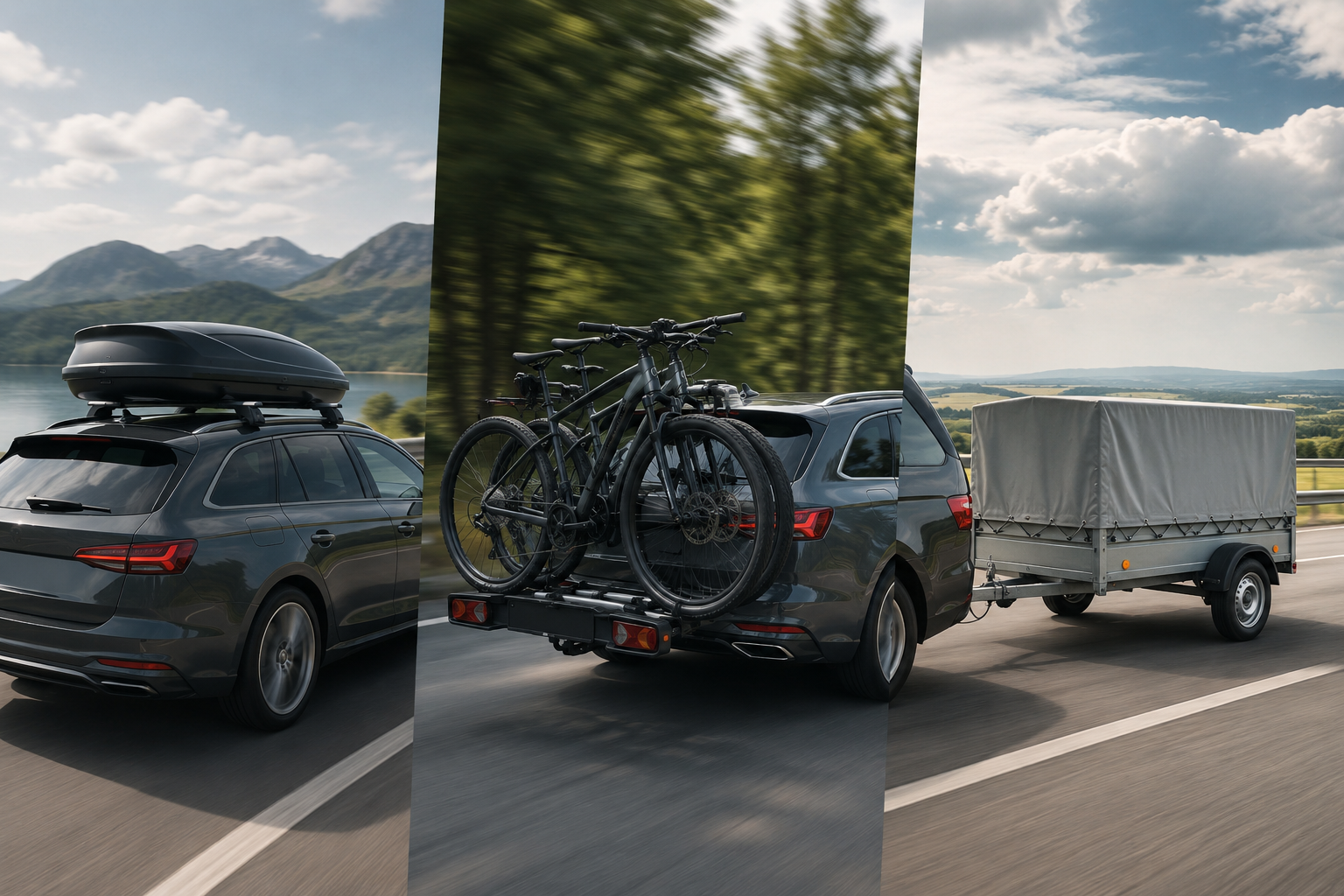
There are trips where the normal boot simply is not enough. A family holiday, a skiing trip, a weekend by the lake, a cycling trip with friends, moving house, building materials, children’s pushchairs, tents, bags, fishing gear, SUP boards, bicycles, tools. At some point, the car starts to feel too small, and then very practical solutions appear: a roof box, a bike rack or a trailer.
From a convenience point of view, they are excellent helpers. A roof box lets you take more luggage without turning the cabin into a storage room. A bike rack allows you to take bicycles to the place where the real adventure begins. A trailer lets you carry things that would never fit properly inside the car. But there is one thing people often think about only after the trip, when they look at the fuel consumption: why did the car suddenly start using so much more?
The answer is simple and at the same time very interesting: everything we attach outside the car or behind the car changes how the car moves through the air and how much work the engine has to do. A roof box is not just a plastic box on the roof. It is an additional obstacle in the airflow. A bike rack is not just a metal frame. Very often it is a complicated aerodynamic disturbance made of wheels, frames, pedals and handlebars sitting directly in the airflow. A trailer is not just “two more wheels behind the car”. It is extra weight, extra rolling resistance, extra aerodynamic drag and a completely different driving dynamic.
That is why this article will not simply say that “a roof box increases fuel consumption”. That would be too shallow. We will look at the whole picture: why speed becomes especially important with a roof box, how the position of a bike rack changes consumption, how a trailer affects the engine and brakes, how weight differs from aerodynamics, how to calculate the extra cost and how to prepare for a trip wisely so that convenience does not turn into an unnecessarily expensive fuel bill.
A typical driver thought after a holiday: “With the roof box, the car drove normally, but the fuel consumption on the highway was completely different. Same route, same car, but the fuel gauge seemed to drop much faster.”
The main thing many drivers underestimate: aerodynamic drag
When people talk about extra equipment on a car, they usually think about weight first. If you put 40 kilograms of luggage into a roof box, the car becomes heavier. If you mount four bicycles, that is extra weight too. If you load boards, tools or furniture into a trailer, the weight becomes even more noticeable. All of that is true, but when it comes to fuel consumption, aerodynamic drag is often even more important.
Car manufacturers spend a lot of time trying to make the body as aerodynamic as possible. Air flows over the bonnet, along the windscreen, over the roof, along the sides and behind the car. The smoother this airflow is, the less energy the car needs to move forward. But as soon as a box appears on the roof or bicycles appear behind the car, that airflow is disturbed.
This is why two seemingly similar trips can be very different. A car without a roof box may drive calmly and efficiently at 90 km/h. The same car with a roof box at 110 km/h may already use noticeably more fuel, because the engine is no longer fighting only the road — it is also fighting increased air resistance. And this resistance rises very quickly as speed increases.
Simply put: at lower speeds, weight is more noticeable; at higher speeds, aerodynamic drag becomes one of the main fuel consumption factors. That is why a roof box in the city and a roof box on the highway are not the same story.
Why does speed change the result so much?
Speed is at the centre of this topic. Many drivers think: “Fine, I mounted a roof box, but I will drive as usual.” This is where the biggest mistake appears. With extra equipment, “as usual” no longer always means “just as economical”. The faster you drive, the more air the car has to push out of the way.
If a car is travelling at 50 km/h, the aerodynamic effect of a roof box is not yet very dramatic. But at 90, 100 or 110 km/h, it becomes much more serious. At those speeds, every uneven shape, every protruding element and every non-smooth surface starts costing fuel. A roof box, bike rack or trailer becomes something the car is physically pulling through the air at a real energy cost.
That is why a driver may experience a very interesting situation. They mount a roof box, drive around the city and barely notice anything. Fuel consumption may rise slightly, but not dramatically. Then they enter the highway, hold 110 km/h and suddenly see that the average consumption is no longer what it used to be. Not because the engine suddenly got worse. Simply because the car is no longer as aerodynamic as before.
A good driver comment: “With a clean roof, my car is quite economical on the highway. With a roof box at the same speed, it feels as if the car is constantly driving into a light headwind.”
Roof box: convenient, but aerodynamically expensive
A roof box is one of the most popular solutions for families and travellers. It allows you to carry skis, bags, children’s items, sports equipment and everything that no longer fits in the boot. The convenience is obvious. The cabin stays clearer, passengers do not sit between bags, and the boot does not need to be forced shut. But in terms of fuel consumption, a roof box almost always costs something.
Even an empty roof box can increase fuel consumption because it changes the car’s aerodynamics by itself. When the box is loaded, weight is added too. But on the highway, shape and position are often more important than the weight itself. A large, tall, wide or poorly positioned box can create more drag than a compact and aerodynamically designed one.
It is also very important whether the roof box stays on the car when it is no longer needed. Many people do not remove it immediately after a trip. It remains on the roof for another week, a month or even the whole season. From a convenience point of view, that is understandable — removing and reinstalling it is not the most enjoyable job. But in fuel terms, it means the car is carrying unnecessary aerodynamic drag every single day.
If you use a roof box only a few times per year, the smartest economical solution is to install it when you need it and remove it after the trip. Driving daily with an empty roof box is one of those habits that seems harmless, but over time it can mean extra fuel with no real benefit.
Does an empty roof box also increase consumption?
Yes, an empty roof box can also increase fuel consumption. This is an important point because many drivers think consumption rises only when the box is full of luggage. But if we are talking about highway speed, even an empty box already disturbs airflow.
The weight of an empty box is not huge compared with the car’s mass, but the aerodynamic effect remains. The car becomes taller, the airflow over the roof is disturbed and the engine works harder. In that sense, an empty roof box on a car is a bit like constantly wearing a backpack that has almost nothing inside but still catches the wind and makes movement harder.
Of course, in city driving the effect may not be very noticeable. But if a person drives every day on a bypass road, highway or faster route, an empty box becomes a real fuel consumption factor. So the question is not only “is the roof box full?”, but also “do I actually need it today?”.
Practical conclusion:
If the roof box is not needed, remove it. Even an empty box on the highway can mean extra fuel consumption simply because the car becomes less aerodynamic.
Roof bars are not completely innocent either
Sometimes a driver removes the roof box but leaves the crossbars on the car. It seems like a small thing. They are only two bars on the roof. However, they can also affect airflow, especially if they are older, square-shaped or not aerodynamically designed.
Crossbars can create additional noise, whistling and a small amount of drag. If they are used regularly, that is normal. But if they remain on the car all year simply because they are inconvenient to remove, they also become a small but constant contributor to higher fuel consumption.
The difference between aerodynamic bars and basic square bars can be felt not only in fuel use, but also in noise. Good equipment often costs more, but in the long run it can make driving more pleasant. Especially for those who often carry a roof box, skis, boats or other objects.
A common comment after removing roof bars: “I thought the noise was coming from the tyres. I removed the crossbars, and the car suddenly became quieter.”
Bike rack on the roof: one of the least economical options at speed
Carrying bicycles on the roof is popular because it keeps access to the boot free and often does not require a tow bar. But in terms of fuel consumption, bikes on the roof can be a rather unpleasant solution, especially at highway speed.
The reason is very simple: a bicycle is not an aerodynamic object. It has a frame, wheels, spokes, handlebars, pedals, saddle and fork. When it is mounted on the roof, it sits directly in the airflow. Even one bicycle can create noticeable drag, while two, three or four bikes on the roof increase the effect even more.
Compared with a roof box, which is usually closed and at least somewhat aerodynamically shaped, bicycles on the roof are a much “messier” shape for the air. That is why the increase in fuel consumption can be surprisingly high, especially on longer highway journeys.
There are also practical inconveniences. The car becomes taller. You need to be careful with underground car parks, low branches, canopies and garages. Bicycles have to be lifted high. In strong wind, driving can become louder and less pleasant. None of this means that a roof bike rack is bad, but it is rarely the most economical solution in terms of fuel.
Tow bar bike rack: often more economical and easier to use
A bike rack mounted on the tow bar is often more economical than carrying bikes on the roof. Why? Because the bikes sit behind the car rather than directly above the roof in the main airflow. Of course, they still affect aerodynamics, but often less than bikes mounted on top of the car.
There is also a convenience benefit. The bikes do not need to be lifted high. They are easier to load and unload. The car’s height does not increase, so there is less risk of forgetting about the bikes and driving into a low space. Many modern platforms also allow access to the boot by tilting the rack.
However, this solution is not without disadvantages either. It requires a tow bar, a good rack costs money, number plate and lights must remain visible, and the car becomes longer. When manoeuvring in car parks, this must be remembered. But in terms of fuel consumption on longer journeys, it is often more sensible than the roof option.
A cyclist’s comment: “When I switched from roof-mounted bike racks to a tow bar platform, the biggest difference was not only fuel consumption, but also silence. The car no longer howled in the wind.”
Rear hatch bike rack: a compromise, but not always ideal
There are also bike racks that attach to the boot lid or tailgate. They can be cheaper and do not require a tow bar. For some cars, they are a practical solution for occasional use when one or two bicycles need to be transported. But they also change the car’s aerodynamics and can create other risks.
Correct installation is extremely important with this type of rack. If it is not secured properly, it can move, damage paint or create a safety risk. You also need to check whether the bicycles cover the number plate or lights. In some cases, this solution is enough, but for frequent use and longer journeys, a tow bar platform is often more convenient and more stable.
In terms of fuel consumption, this option is usually somewhere in the middle. It can be better than bikes on the roof because the car’s height does not increase, but it may be less stable and less convenient than a tow bar platform. The key is to understand your real need: are the bikes transported a couple of times a year or every weekend?
Trailer: a completely different level of fuel consumption
A trailer is a special case. If a roof box and bike rack mainly affect aerodynamics, a trailer adds several factors at once. It adds weight, rolling resistance, aerodynamic drag, length, inertia and the need to drive more calmly. With a trailer, the car is no longer the same car with a few extra items. It becomes a different combination altogether.
Even an empty trailer can increase fuel consumption because it has its own wheels, bearings, tyres and shape. With a loaded trailer, the effect becomes much greater. The engine has to move more mass, maintain speed with a higher total load, work harder uphill and often use more fuel in city driving as well, where there is a lot of starting and stopping.
Driving style becomes especially important with a trailer. Hard acceleration, high speed, nervous braking and poor load distribution can quickly increase consumption. And this is not only an economy issue. With a trailer, bad habits can also become dangerous.
That is why a trailer should be treated seriously. Before driving, tyre pressure, load distribution, coupling, lights, documents, permitted weight and the car manufacturer’s limits should all be checked. If everything is correct, the journey will be safer and often more economical too.
Weight versus aerodynamics: which increases consumption more?
A very good question is: what increases consumption more — weight or air resistance? The answer depends on the driving situation. In the city, where the car often starts and stops, weight is very important. The heavier the car and load, the more energy is needed for every start. On the highway, where speed is stable, aerodynamic drag often becomes more important.
That is why a heavy trailer in the city can be very inefficient, because every start from traffic lights requires a lot of energy. Meanwhile, an empty but large and poorly shaped roof box on the highway can increase consumption more than the driver expects, even though it does not weigh much.
Simply put: at low speeds, think more about weight; at high speeds, think more about aerodynamics. In real life, both factors often work together. A roof box has both shape and luggage. A trailer has both weight and shape. Bicycles have both weight and very poor aerodynamics.
The short formula:
In the city, weight hurts more. On the highway, air resistance hurts more. On a long journey with a roof box, bicycles or trailer, both factors can work against your wallet at the same time.
How much can fuel consumption increase?
It is impossible to name one exact number for every car because the result depends on the car model, engine, speed, wind, load, equipment shape, tyre pressure, road profile and driving style. However, in practical terms, a roof box, bike rack and trailer can usually increase fuel consumption from slightly to very noticeably.
A roof box may add relatively little during calm driving, but during faster highway driving the difference can become much more noticeable. Bicycles on the roof are often even less economical because their shape is very uneven. A trailer can increase consumption especially when it is heavy, tall, badly loaded or pulled at high speed.
To understand a practical example, imagine a car that normally uses 6.5 l/100 km on the highway. With a roof box and full family luggage, it may start using 7.2 or 7.8 l/100 km, depending on speed and conditions. With bicycles on the roof, the difference can be even greater. With a trailer, consumption can become a completely different story, especially if the trailer is large or heavy.
The most important thing is not to memorise one specific number. The important thing is to understand the principle: the more you disturb the car’s shape and the faster you drive, the more you will pay. The heavier the load and the more often you need to start moving, the more you will pay. And if both conditions combine, consumption can surprise you.
Simple calculation: how to turn extra consumption into money
To make this topic less theoretical, let us look at a simple calculation. Suppose a normal trip without a roof box or trailer uses 6.8 l/100 km. With a roof box, consumption rises to 7.6 l/100 km. The difference is 0.8 l/100 km.
If the trip is 1,000 km long, the extra consumption will be around 8 litres. If fuel costs €1.70/l, that is €13.60. This is not a huge amount for one trip, but if you travel like this several times per season or the roof box remains on the car in everyday driving, the amount starts to grow.
With a trailer, the difference can be bigger. If consumption rises by 2 l/100 km and the trip is 500 km, that is 10 extra litres. At €1.70/l, that is €17 for one trip. If the trailer is used often, this is no longer a small difference.
Simple calculation example:
If a roof box increases consumption by 0.8 l/100 km, then on a 1,000 km trip that means 8 extra litres. At €1.70/l, that is around €13.60 extra. The longer the trip and the higher the speed, the more noticeable the difference becomes.
Why is it better to drive slightly slower with a roof box?
One of the simplest ways to reduce extra consumption with a roof box is to drive slightly slower. That may sound boring, but this is exactly where a large part of the saving is hidden. At higher speeds, aerodynamic drag rises very quickly, so reducing speed by 10 km/h on a longer journey can matter much more than it first seems.
For example, the difference between 100 and 110 km/h with a roof box can be more noticeable than without one. Without a roof box, the car may still remain reasonably efficient, but with the box the engine is already fighting greater air resistance. If there is also a headwind, a fully loaded car and air conditioning, consumption can increase even more.
Slower driving with a roof box is often safer and more pleasant too. Less noise, less side-wind sensitivity, less strain on the mounts and calmer vehicle behaviour. This is especially important on longer family trips, where the goal is not to set a speed record but to arrive safely and without unnecessary stress.
A very practical comment: “With a roof box, I no longer try to hold the highest possible speed. I drive more calmly, and consumption stays more reasonable. I do not lose much time, but the fuel difference is noticeable.”
Load placement: not only safety, but also consumption
Load placement matters not only so that nothing falls out and the car remains safe. It also affects how the car behaves and how much fuel it uses. Heavier items are usually best placed as low as possible and close to the centre of the car, not high on the roof. A roof box is better suited for lighter, bulky items rather than the heaviest bags and tools.
If too much heavy cargo is placed on the roof, the car’s centre of gravity rises. This can reduce stability in corners, in side wind and during sudden manoeuvres. Although fuel consumption is not the only risk here, worse stability often makes the driver brake more, steer more nervously and drive less smoothly.
With a trailer, load placement is even more important. Too much weight at the rear of the trailer can make the whole combination unstable. Too much nose weight can overload the rear of the car. Correct load distribution helps the car and trailer drive more safely, more calmly and often more economically, because the vehicle is not constantly fighting instability.
Tyre pressure becomes even more important
When the car is full of luggage, passengers, a roof box or a trailer, tyre pressure becomes even more important than in everyday driving. Insufficient pressure under heavier load means higher rolling resistance, more tyre heating, worse stability and higher fuel consumption.
Many car manufacturers specify different tyre pressures for normal load and full load. This information is usually found on a sticker near the driver’s door, inside the fuel filler flap or in the owner’s manual. If you are going on a long journey with a fully loaded car, it is worth checking this table rather than driving with everyday pressure and hoping everything will be fine.
The same applies to trailer tyres. They are often ignored because the trailer is not an everyday vehicle. But if trailer tyres are soft, old or damaged, that can mean both higher consumption and a safety risk. Before a longer trip, trailer tyres should be checked as seriously as the car’s own tyres.
Headwind and side wind: the invisible fuel increaser
With a roof box, bicycles or trailer, wind becomes much more noticeable. A car without extra equipment also feels headwind, but with a larger profile this effect becomes stronger. A roof box increases the car’s area in the airflow. Bicycles on the roof or behind the car create many uneven shapes. A trailer can act like an extra sail.
Headwind directly increases the work the engine must do. If you are driving at 100 km/h into strong wind, aerodynamically the car may feel as if it is travelling much faster. With a roof box, this becomes even more obvious. Side wind can make the car less stable and force the driver to make more steering corrections.
That is why on longer trips you should not be surprised if fuel consumption is higher in one direction than the other, even though the route is the same. Wind, load and extra equipment together can create a very noticeable difference.
A good travel comment: “On the way there, fuel consumption with the roof box was high, but on the way back it was lower. At first I thought the fuel was different, but in reality we had a headwind almost the whole way there.”
Air conditioning, full car and roof box: the summer combination
Summer trips often combine several consumption-increasing factors at once. The car is full of passengers. The boot is full. There is a roof box on top. It is hot outside, so the air conditioning is working. The route follows the highway. And the driver wants to reach the destination quickly.
In this combination, there is nothing surprising if consumption rises. It does not mean the car is broken. It means the car is working harder than it does in everyday driving. More weight, more air resistance, more climate system load, higher speed — all of this adds up.
That is why it is good to be realistic before a longer trip. If your car uses 6.5 l/100 km in everyday driving, it will probably not use the same amount on holiday with full load and a roof box. It is better to accept this before the trip rather than spending the whole journey worrying about every number on the trip computer.
Is it better to put everything inside the car instead of on the roof?
From an aerodynamic point of view, it is often better to put luggage inside the car rather than on the roof. If luggage is inside the cabin or boot, the car’s outer shape does not change. That means air resistance on the highway does not increase as much. But this does not mean everything should always be forced inside the car at any cost.
Safety is more important. Loose items in the cabin must not fly around during hard braking. The rear window should not be fully blocked if that reduces visibility. Passengers need space. Heavy items must be secured. If the cabin becomes unsafe or uncomfortable, a roof box may be the better solution, even if it increases fuel consumption.
The smartest solution is often a combination. Heavier items in the boot, as low as possible. Lighter, bulkier items in the roof box. Nothing flying freely inside the cabin. The car is not overloaded. And after the trip, the roof box is removed.
Is renting a roof box smarter than buying one?
If you need a roof box only once or twice a year, renting is worth considering. Buying one can be expensive, the box takes up storage space, and there is a risk it stays on the car longer than necessary simply because there is nowhere convenient to put it.
Renting can be very sensible if the need is rare. You choose the right size for a specific trip, use it and return it. You do not need to think about storage, and there is no temptation to drive with an empty box all season. From a cost point of view, this may be smarter than buying a large box that spends 95% of its life in the garage or on the roof of the car.
On the other hand, if you travel often, regularly go skiing, carry sports equipment or your family needs a roof box every season, buying one may pay off. Then it is important to choose a high-quality, correctly sized and as aerodynamic as possible model, not simply the largest option available.
Common mistakes that unnecessarily increase fuel consumption
Part of the extra consumption is unavoidable. If you mount a roof box, carry bicycles or tow a trailer, the car objectively has to work harder. But very often drivers increase that consumption even more with poor habits.
- The roof box stays on the car when it is no longer needed. An empty box still hurts aerodynamics.
- Driving too fast. With a roof box or bicycles, speed becomes especially expensive.
- The heaviest items are placed on the roof. This reduces stability and can make driving more nervous.
- Tyre pressure is not checked. Full load and soft tyres are a bad combination.
- The trailer is loaded incorrectly. Poor load distribution can increase both risk and consumption.
- Wind is ignored. Headwind with a roof box or trailer can be very noticeable.
- Equipment is too large for the real need. The biggest roof box is not always the best choice if it is half-empty for most trips.
How to reduce consumption with a roof box
If a roof box is genuinely needed, you do not have to cancel the trip or sit among bags inside the cabin. You simply need to use it wisely. The first step is choosing the right size. You do not always need the biggest possible box. If you regularly carry only a few light items, a compact and lower model may be better than a huge box that creates a lot of drag.
The second step is correct positioning. The box must be mounted according to the manufacturer’s instructions. It should not be crooked, too far forward or poorly secured. Incorrect positioning can increase noise and resistance.
The third step is speed. With a roof box, aggressive driving is not worth it. A calmer speed, smoother acceleration and fewer sudden manoeuvres help both fuel consumption and safety. Fourth, remove the box when it is no longer needed. That is the simplest and most effective long-term advice.
Roof box economy formula:
Right size + correct mounting + lighter items in the box + calmer speed + removal after the trip = lower extra consumption.
How to reduce consumption with a bike rack
If you regularly carry bicycles, it is worth thinking about which rack type best suits your car and driving habits. If you drive rarely and only short distances, a roof rack may be enough. But if you often drive long highway distances, a tow bar bike platform will often be more economical and more convenient.
It is very important to remove bike racks when they are not needed. Even empty roof-mounted bike holders can create noise and a small amount of drag. If they remain on the roof all season, they become a constant fuel consumption increaser.
If you are carrying bicycles, check the mounts, remove unnecessary accessories that may flap in the wind, and drive more calmly. Bicycles are not only cargo — they are also wind catchers. The higher the speed, the more you feel it.
How to reduce consumption with a trailer
With a trailer, economy starts before driving. First, do not carry unnecessary weight. If unused items, tools or materials remain in the trailer, you pay for them every kilometre. Second, distribute the load correctly. The trailer should be stable, not swaying or lifting the rear of the car.
Third, check the trailer tyres. Low pressure increases rolling resistance and risk. Fourth, drive smoothly. With a trailer, hard starts and sudden braking are especially inefficient. Fifth, do not try to drive at the same speed as you would without the trailer. Higher speed with a trailer usually means much higher consumption and more risk.
It is also important to remember that a trailer affects braking distance and manoeuvring. Fuel economy must never be more important than safety. It is better to drive calmly, anticipate situations and allow the car-trailer combination to move smoothly.
A trailer driver’s comment: “With a trailer, rushing ruins fuel consumption the most. If I drive calmly and read the traffic ahead, the car is not strained and fuel disappears much more slowly.”
Will diesel, petrol and hybrid cars be affected the same way?
Different cars react to extra load differently. A diesel car with good torque often pulls a trailer or a full load more calmly, especially on highways and uphill sections. A petrol car with a smaller engine may feel much more strained if it has to pull a heavy trailer or drive fast with a large roof box. Hybrids can use electric assistance well in the city, but on the highway with high aerodynamic drag, they are not a miracle solution either.
The most important thing is not to assume that any engine type cancels physics. If the car becomes heavier and less aerodynamic, consumption will rise whether it is petrol, diesel or hybrid. Only the size and conditions of the increase will differ.
In an electric car, the same principle applies to electricity consumption and driving range. A roof box, bicycles or trailer can reduce range, especially on the highway. So the question is not only about litres, but about energy in general.
When is the extra consumption worth it?
It is important not to misunderstand this article. A roof box, bike rack and trailer are not “bad” things. They are very useful tools. Sometimes the extra consumption is completely justified because it allows you to take the family on holiday, bring bicycles, transport necessary items or complete a job that would otherwise be impossible.
The problem begins when the driver does not understand the price. If you know that a roof box will increase consumption, you can drive slightly slower, remove it after the trip and place luggage more intelligently. If you know that bikes on the roof are aerodynamically expensive, you can consider a tow bar rack. If you know that a trailer significantly changes driving, you can plan your route and timing more calmly.
So the goal is not to give up convenience. The goal is to understand its cost and reduce the unnecessary part. There is a difference between “necessary extra consumption” and “wasted fuel”. The first is normal life. The second is a habit that can be improved.
Practical checklist before the trip
Before a longer trip with a roof box, bicycles or trailer, it is worth going through a short checklist. It will help not only to save fuel, but also to avoid unpleasant surprises.
- Check all mounts. The roof box, bike racks and trailer must be securely attached.
- Check tyre pressure. Both on the car and on the trailer, if one is used.
- Check weight limits. Roof load, trailer weight and tow bar load are not just formalities.
- Place cargo correctly. Heavier items lower, lighter and bulkier items in the roof box.
- Remove unnecessary equipment. Empty racks and boxes add no benefit but can increase consumption.
- Plan a calmer speed. With extra equipment, rushing costs more.
- Check lights and number plate visibility. Especially with bike racks and trailers.
- Remember the car’s height and length. A roof box increases height; a trailer or bike platform increases length.
Common myths about roof boxes, bicycles and trailers
Myth No. 1: “If the roof box is empty, it does not affect fuel consumption.”
Wrong. An empty box still changes the car’s aerodynamics, especially at highway speed.
Myth No. 2: “Weight is the only thing that matters; shape does not.”
On the highway, shape can be even more important than weight. Aerodynamic drag becomes very significant at speed.
Myth No. 3: “Bikes on the roof are only slightly worse.”
Bicycles on the roof can be very inefficient because they sit directly in the airflow and have a very uneven shape.
Myth No. 4: “You can drive with a trailer the same way as without one.”
A trailer changes acceleration, braking, stability and consumption. It requires calmer and more careful driving.
Myth No. 5: “If the car is powerful, consumption will not really change.”
A powerful car may handle the load more easily, but it does not cancel physics. Extra weight and air resistance still require energy.
Conclusion: convenience costs money, but it does not have to cost too much
A roof box, bike rack and trailer are very practical solutions, but they are not neutral in terms of fuel consumption. A roof box increases aerodynamic drag, especially on the highway. Bicycles on the roof can be even more aerodynamically expensive. A bike rack mounted on the tow bar is often more sensible for longer journeys. A trailer significantly changes load, rolling resistance, aerodynamics and driving dynamics.
The good news is that a large part of the unnecessary extra consumption can be reduced with smart habits. Remove the roof box when it is not needed. Do not leave empty racks on the car all season. Drive more calmly. Do not overload the car. Check tyre pressure. Place cargo correctly. Choose equipment that matches your real needs, not just what looks impressive.
The most important point is to understand that fuel consumption is not only an engine issue. It is a whole-car system issue. As soon as you change the car’s shape, weight or driving conditions, the costs change too. A roof box, bicycles and trailer can be extremely useful, but they require conscious driving.
So the next time you prepare for a trip, do not think only about whether everything fits. Think also about where the luggage will be safest, how it will affect the car, what speed you will drive and whether the equipment really needs to stay on the car after the journey. Sometimes the biggest saving is not taking less with you. The biggest saving is taking it with you wisely.
Short driver conclusion: “A roof box, bike rack or trailer is not the problem. The problem is driving as if the car were still empty and had no extra resistance.”