
 LV
 EN
 RU
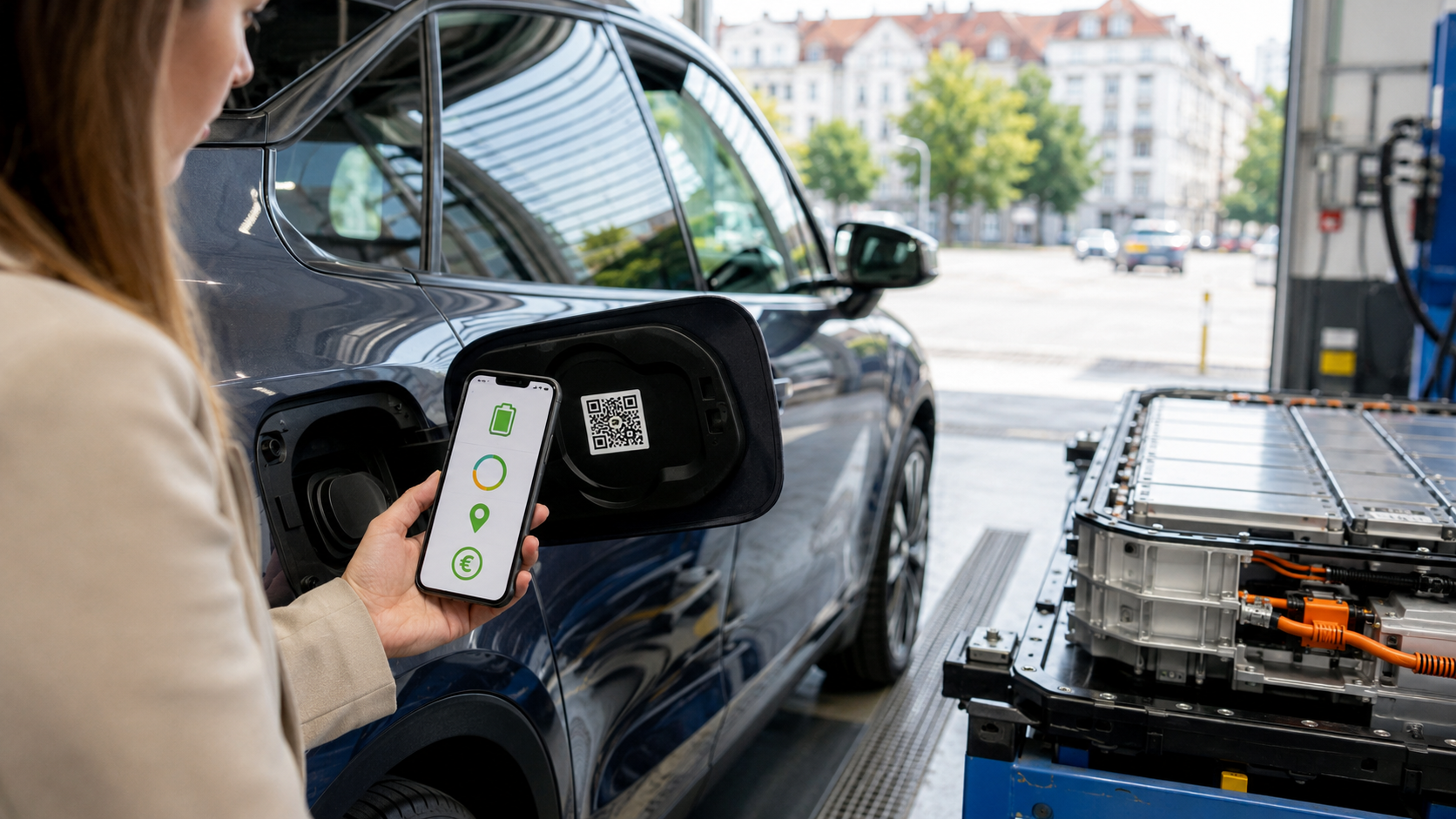
Information checked on 29 July 2026. The EU Batteries Regulation has applied since 18 February 2024. A digital battery passport will be mandatory for electric-vehicle batteries placed on the market or put into service from 18 February 2027. This does not mean that every electric vehicle registered before that date will automatically receive a complete battery passport.
When buying a used petrol or diesel vehicle, buyers usually check the mileage, technical-inspection history, accident record, service history and engine condition.
In an electric vehicle, one of the most important and expensive components is the traction battery.
However, buyers often struggle to determine how much energy the battery can still store, how many charging cycles it has completed, whether it has been exposed to extreme temperatures for long periods and whether it has been repaired or rebuilt after an accident.
One seller shows the range estimate displayed on the vehicle’s dashboard. Another provides a workshop diagnostic printout. A third claims that the battery is “as good as new” but cannot provide a single independently verifiable measurement.
The European Union’s digital battery passport is intended to standardise some of this information and link it to the specific battery throughout its lifecycle.
The passport will not be a paper booklet stored in the glove compartment. It will be an electronic record accessible through a unique identifier assigned to the battery and a QR code.


The short conclusion: from 2027, the battery passport will make the origin and technical characteristics of new electric-vehicle batteries more transparent. However, scanning the QR code will not automatically reveal the battery’s entire history. Public information will be available to everyone, while health data, charging cycles, temperatures and adverse-event information will be protected by access controls.
What is a digital battery passport?
A digital battery passport is an electronic record linked to a specific battery.
It will combine information about:
• the battery manufacturer and model;
• the manufacturing location and date;
• the battery category and chemical composition;
• rated capacity, voltage and power;
• expected lifetime and warranty period;
• the carbon footprint;
• recycled and renewable-material content;
• responsible sourcing of raw materials;
• the battery’s current status;
• health and operating information when the user has the right to receive it;
• repair, dismantling, second-life and recycling information for relevant professionals.
The passport must be based on open standards and be machine-readable, structured, searchable and interoperable with other European digital product passports.
The Regulation also requires the information system to avoid locking users into a single technology provider.
The most important dates
| Date | What does it mean? |
|---|---|
| 18 February 2024 | The EU Batteries Regulation began to apply, except for provisions with separate implementation dates |
| 18 August 2024 | The battery-management system of an electric-vehicle battery must contain up-to-date information about the state of certified energy |
| 18 August 2026 | The deadline established in the Regulation for a Commission act specifying persons with a legitimate interest and their access rights to battery-passport data |
| 18 February 2027 | A battery passport becomes mandatory for electric-vehicle batteries, light-means-of-transport batteries and industrial batteries above 2 kWh placed on the market or put into service from this date |
| 18 February 2027 | All batteries must carry a QR code in accordance with the applicable requirements |
| 18 August 2027 | Following the 2025 amendment, certain companies become subject to battery raw-material supply-chain due-diligence requirements from this date |
| 18 August 2028 or later | Batteries will gradually need documentation concerning the proportion of recycled cobalt, lithium, nickel and lead; the precise start also depends on the entry into force of the necessary EU acts |
| 18 August 2031 | The initially scheduled minimum recycled-material content requirements for electric-vehicle and certain other batteries |
Not every requirement has one absolute starting date. The practical application of the carbon-footprint declaration, carbon-footprint performance classes and maximum carbon-footprint thresholds may begin later because the Regulation uses the principle of “the stated date or a specified number of months after the necessary delegated or implementing act enters into force, whichever is later”.
Which vehicles will require a battery passport?
The battery-passport requirement applies to the battery itself, not merely to the vehicle’s model name or registration year.
| Battery type | Will a passport be mandatory from 18 February 2027? |
|---|---|
| Traction battery of a fully electric passenger vehicle | Yes, when the battery is placed on the market or put into service from that date |
| Traction battery of an externally chargeable or plug-in hybrid | Usually yes, when it meets the definition of an electric-vehicle battery |
| Traction battery of a conventional hybrid | It depends on the battery classification and the specific vehicle |
| Light-means-of-transport battery used in an electric bicycle or scooter | Yes |
| Industrial battery above 2 kWh | Yes |
| Conventional 12-volt starter battery | It will have a QR label and other mandatory information, but not the same complete battery passport as an electric-vehicle traction battery |
| Small remote-control or watch battery | A complete digital battery passport is not required, although other labelling and collection requirements apply |
Will the passport apply to older electric vehicles?
The complete 2027 battery-passport requirement does not automatically apply to every battery that was already on the market before that date.
| Situation | Possible result |
|---|---|
| An electric vehicle was first registered in 2022 with its original battery | There is no automatic obligation to create a complete 2027 battery passport retrospectively |
| A 2022 vehicle receives a new factory battery after 2027 | When the replacement battery is placed on the market or put into service after the requirement begins, it may need a passport |
| A new vehicle is ordered in 2026 but delivered in spring 2027 | The decisive factor will be the battery’s placing-on-the-market or putting-into-service status, not only the order date |
| A battery is reused or remanufactured after repair | It may require a new passport linked to the original battery passport |
An older electric vehicle may still provide manufacturer-application data, battery-management-system readings and diagnostic information.
However, that information is not automatically identical to a standardised EU battery passport.
How will the QR code work?
From 18 February 2027, batteries must carry a QR code.
For an electric-vehicle battery, the QR code will lead to the passport of the specific battery through its unique identifier.
The code must be visible, legible and durable. When it cannot reasonably be placed on the battery because of its nature or size, the code may be attached to the packaging and documents accompanying the battery.
The QR code may not be conveniently accessible to the driver. An electric-vehicle traction battery is usually located beneath the floor and protected by a casing. This does not mean the owner must lift the vehicle every time. Practical access may also be provided through documents, a workshop or the manufacturer’s digital system.
What will anyone be able to see through the QR code?
Battery-passport information will be divided into several access levels.
The publicly available section is expected to include information about the battery model and sustainability.
| Public information | What can it help you understand? |
|---|---|
| Manufacturer, battery model and category | Whether the battery corresponds to the particular vehicle and which company is responsible for it |
| Manufacturing location and date | The battery’s actual age and the manufacturing facility |
| Chemical composition and critical raw materials | Whether the battery uses, for example, NMC, LFP or another chemistry and which materials must be considered during recycling |
| Rated capacity in ampere-hours | The battery’s original technical parameters |
| Minimum, rated and maximum voltage | The characteristics of the battery’s electrical system |
| Original power capability | How much power the battery was designed to provide under specified conditions |
| Expected lifetime in cycles | The manufacturer’s stated durability reference point |
| Capacity threshold for battery exhaustion | The remaining-capacity level at which the battery no longer meets its intended vehicle use |
| Commercial warranty period | The calendar period covered by the manufacturer’s stated warranty |
| Carbon-footprint information | Comparison of the climate impact of battery production and lifecycle |
| Recycled-material content | How much cobalt, lithium, nickel or lead has been recovered from waste |
| EU declaration of conformity | Whether the battery model has the required conformity documentation |
| Waste-prevention and management information | Safe return, collection and recycling at the end of the lifecycle |
What will not be visible to every passer-by?
Detailed and commercially sensitive information will not become public merely because someone scans the QR code.
• the precise composition of the cathode, anode and electrolyte;
• component numbers and sources of replacement parts;
• detailed battery-pack dismantling diagrams;
• required tools and dismantling sequence;
• safety measures for dismantling the battery;
• complete conformity-test reports;
• individual battery-health data;
• the number of charging and discharging cycles;
• operating-temperature history;
• adverse-event information, including accidents.
This information will be available only to certain authorities or persons with a legitimate interest, such as repairers, remanufacturers, second-life operators and recyclers.
Will a used-EV buyer see the battery’s health?
Not necessarily by scanning the public QR code alone.
Battery-health information is included in the restricted-access data for the individual battery.
Access may be provided to a person with a legitimate interest, such as:
• the lawful purchaser or owner of the battery;
• a repair shop acting on the owner’s behalf;
• a business assessing the battery’s residual value;
• a second-life or remanufacturing operator;
• a recycling business;
• another authorised person under the detailed EU access rules.
A person who is merely looking at an advertisement may not yet be the lawful purchaser of the battery.
Before the purchase, the seller may therefore need to open the protected information personally, authorise a workshop or provide an independent battery-inspection report.
What are battery SOH and SOCE?
In everyday language, the abbreviation SOH, or “state of health”, is commonly used.
For electric-vehicle batteries, the EU Regulation specifically uses the state of certified energy, or SOCE.
In simplified terms, it indicates how much certified energy the battery can still provide compared with its original condition.
100%: under the reference conditions, the battery corresponds to the original certified-energy level.
90%: the available certified-energy amount is approximately ten percent lower.
80%: the battery may still be fully usable, but its range and market value may be lower.
70%: the battery may continue operating in the vehicle or be suitable for another use, but the warranty, safety, power capability and economic justification should be assessed.
A single health percentage does not reveal everything.
Two batteries may have a similar amount of remaining energy but differ in:
• maximum power;
• DC rapid-charging capability;
• cell-voltage balance;
• internal resistance;
• temperature behaviour;
• self-discharge;
• the technical condition of individual modules.
A simplified capacity example
Assume that a new electric vehicle initially has 64 kWh of usable battery energy and a WLTP range of 450 kilometres.
| Simplified health level | Approximate remaining energy | Theoretical range based on 450 km |
|---|---|---|
| 100% | 64.0 kWh | 450 km |
| 90% | 57.6 kWh | 405 km |
| 80% | 51.2 kWh | 360 km |
| 70% | 44.8 kWh | 315 km |
This is only an illustrative mathematical example.
Real-world range is affected by temperature, tyres, speed, cabin heating, wind, terrain, the battery’s software buffer and vehicle efficiency.
A manufacturer may also change the usable-energy buffer through a software update, meaning that the health percentage and the range shown on the display are not exactly the same measurement.
Will the battery passport replace diagnostics?
No.
The battery passport will be a highly valuable source of information, but it will not replace:
• a physical inspection of the battery casing;
• checks for leakage and corrosion;
• evaluation of cell and module voltages;
• an insulation-resistance test;
• inspection of the cooling system;
• a test drive;
• a rapid-charging test;
• professional interpretation of the data.
When the passport shows a good health indicator but the battery casing has been deformed in an accident or the cooling system is leaking, the vehicle may still be unsafe.
The battery passport and manufacturer warranty are not the same thing
| Battery passport | Manufacturer warranty |
|---|---|
| A digital information record required by EU law | Contractual obligations of the manufacturer towards the customer |
| May state the warranty period and battery parameters | Determines when the battery will be repaired or replaced |
| Continues to follow the battery after a change of ownership | May contain limitations, exclusions and maintenance requirements |
| Provides transparency and traceability | Defines the customer’s rights in the event of a specific defect |
When the passport shows that battery health is 69%, this does not automatically mean that the manufacturer must replace the entire battery free of charge.
The warranty agreement, mileage limit, age, measurement method, exclusions and cause of the defect must still be checked.
Will charging cycles and accidents appear in the passport?
The restricted-access data for an individual battery is expected to include operating information such as:
• the number of charging and discharging cycles;
• battery state-of-charge records;
• operating temperature;
• adverse events;
• events such as accidents when they are recorded by the battery system and form part of the applicable dataset.
This does not mean that the battery passport will become a complete vehicle-accident database.
Minor body damage that did not affect the battery and was not recorded by the battery-management system may not appear in the passport.
By contrast, an impact, overheating event or another incident significant to the battery may be important when assessing its safety and residual value.
What will the passport change when buying a used electric vehicle?
| Inspection without a standardised passport | Inspection with a battery passport |
|---|---|
| The buyer must rely on the seller’s printout or software used by a particular workshop | The battery’s identity and model data are available in a standardised record |
| It may be difficult to determine whether the battery is original | The passport status may indicate whether the battery is original, reused, repurposed, remanufactured or a waste battery |
| Different health-measurement formats are used | Access to more standardised battery-health and performance information |
| The production date and factory may be unclear | Publicly available information about the model, manufacturing and origin |
| It is difficult to assess second-life potential | Professionals can access information concerning remaining-use options, repairs and dismantling |
The buyer will still need to agree with the seller on access to protected data.
A practical safe-purchase procedure could look like this:
1. Scan or review the public information in the battery passport.
2. Compare the battery identifier with the vehicle documents and manufacturer system.
3. Ask the seller to authorise access to protected health data.
4. Check the battery status and information about repairs or repurposing.
5. Carry out an independent diagnostic inspection.
6. Test rapid charging and cell balance.
7. Compare the state of health with the price and remaining warranty conditions.
8. Record the battery identifier and the condition declared by the seller in the purchase agreement.
Will the battery passport increase an electric vehicle’s residual value?
The passport itself does not guarantee a high price.
It may reduce uncertainty for the buyer.
| Passport information | Possible effect on value |
|---|---|
| High state of health and stable operating history | May support a higher price compared with a vehicle that has no verifiable battery data |
| Extensive exposure to extreme temperatures or adverse events | May increase buyer risk and reduce the price |
| A professionally remanufactured battery with linked history | May be more valuable than a replacement battery of unknown origin |
| Incomplete or contradictory information | May raise concerns about poor-quality repairs or data problems |
Leasing companies, insurers and used-vehicle dealers may find it easier to develop more consistent methods for valuing batteries.
However, the vehicle’s price will still depend on mileage, model demand, body condition, charging speed, warranty and parts availability.
What will the battery carbon footprint mean?
The battery carbon-footprint calculation is intended to cover its entire lifecycle.
It includes:
• extraction and initial processing of raw materials;
• production of active materials and battery cells;
• assembly of modules and the battery pack;
• energy used by the manufacturing facility;
• transport to the market;
• battery collection, dismantling and recycling at the end of its lifecycle.
The declaration will be specific to a particular battery model and production facility.
This matters because the same battery model may be produced at different factories using different electricity sources, material-supply routes and manufacturing processes.
A lower carbon footprint does not automatically mean that the battery has a longer range or warranty period.
It describes climate impact rather than technical performance alone.
Recycled-material requirements
The EU Regulation gradually introduces requirements for minimum proportions of materials recovered from waste.
| Material | Initially scheduled minimum from 18 August 2031 | Initially scheduled minimum from 18 August 2036 |
|---|---|---|
| Cobalt | 16% | 26% |
| Lead | 85% | 85% |
| Lithium | 6% | 12% |
| Nickel | 6% | 15% |
These targets may be reviewed in light of material availability, developments in battery chemistry and recycling technologies.
An LFP battery, for example, does not require the same amount of cobalt and nickel as certain NMC batteries, so one percentage table cannot be applied mechanically to every chemistry.
Battery repair and second-life use
When an electric-vehicle battery is no longer powerful enough for the vehicle, it does not necessarily become waste immediately.
Possible battery-passport statuses include:
| Status | What may it mean? |
|---|---|
| Original | The battery has not officially changed from its original-use status |
| Reused | The battery or part of it is used again for the intended or a similar function |
| Repurposed | The battery has been assigned a different use, such as stationary energy storage |
| Remanufactured | The battery has been professionally dismantled, tested and rebuilt using serviceable or new cells and components |
| Waste battery | The battery is no longer intended for further use and must be transferred for appropriate treatment |
A repurposed or remanufactured battery will have a new passport linked to the passport of the original battery.
This reduces the risk that a battery of unknown origin completely loses its previous identity after modification.
The battery passport ceases to exist after the battery has been recycled.
Will an electric-vehicle owner be able to replace the traction battery personally?
No. The Batteries Regulation requirement for batteries to be readily removable by the end user mainly applies to portable batteries in appliances.
An electric-vehicle high-voltage battery is:
• extremely heavy;
• connected to a high-voltage system;
• integrated into the vehicle structure;
• equipped with cooling and control systems;
• potentially dangerous during unqualified removal;
• repairable or replaceable only with appropriate equipment and qualifications.
The battery passport will help professionals obtain dismantling and safety information, but it is not an instruction for the vehicle owner to open the high-voltage battery casing personally.
What happens to a worn-out electric-vehicle battery?
An electric-vehicle battery must not be placed in household waste or abandoned at an illegal dumping site.
Producers or their producer-responsibility organisations must arrange free collection of waste electric-vehicle batteries.
The final user does not have to purchase a new battery or prove that the old battery was bought from the particular collection operator.
The battery must be transferred to a professional operator because a damaged lithium battery can create:
• a high-voltage electric-shock risk;
• a short circuit;
• thermal runaway and fire;
• the release of toxic gases;
• environmental contamination during improper storage.
Recycling targets
| Target | By the end of 2027 | By the end of 2031 |
|---|---|---|
| Cobalt recovery | 90% | 95% |
| Copper recovery | 90% | 95% |
| Lead recovery | 90% | 95% |
| Lithium recovery | 50% | 80% |
| Nickel recovery | 90% | 95% |
The material-recovery percentage is not the same as the recycling efficiency for the total battery mass.
The Regulation sets separate targets for overall recycling efficiency and for the recovery of specific materials.
Will the battery passport make electric vehicles more expensive?
Creating the battery passport, operating the data infrastructure, applying the label and updating the information will create costs for manufacturers.
However, there is no single mandatory surcharge that must be added to the price of every electric vehicle.
Manufacturers already use battery-management systems, production traceability and conformity documentation. Some of the new requirements will extend and standardise existing systems rather than require completely new systems to be created from nothing.
| Possible additional cost | Possible long-term benefit |
|---|---|
| Data platforms and QR identification | Lower risk of counterfeiting and batteries of unknown origin |
| Data storage and updating | Simpler assessment of battery condition and value |
| Supply-chain due diligence | More responsible sourcing of raw materials |
| Carbon-footprint calculations | Better comparability between factories and battery models |
| More detailed service documentation | Greater opportunities for battery repair and second-life use |
Privacy and data security
The battery passport must not become a publicly available history of the driver’s movements.
The Regulation provides for several access levels and requirements concerning data authenticity, integrity, privacy and protection against fraud.
A buyer and repair shop should receive the information necessary to assess the battery, but the following should not be disclosed without justification:
• the vehicle’s precise routes;
• the owner’s home address;
• personal charging-location history;
• payment information;
• user-account passwords;
• other personal data not required to assess the battery.
What should you ask the dealer when buying a new electric vehicle?
1. Will the specific battery have an EU digital battery passport?
2. Where is the battery QR code located?
3. Will the passport also be accessible through the manufacturer’s mobile application?
4. Which passport information will be public?
5. How will the owner obtain battery-health information?
6. Will the health information be downloadable as a file?
7. Will the owner be able to authorise an independent repair shop?
8. What is the health threshold under the warranty?
9. How does the manufacturer calculate SOCE or SOH?
10. Will module replacements and battery repairs be recorded in the passport?
11. What happens to passport access after the vehicle is sold?
12. How will the battery be collected and recycled at the end of its lifecycle?
What should you check when buying a used electric vehicle with a battery passport?
1. Does the battery’s unique identifier correspond to the particular vehicle?
2. Is the battery status “original”, “reused” or “remanufactured”?
3. What is the battery’s production date?
4. What is the current state of certified energy?
5. Is the health information up to date?
6. Have adverse events or accidents been recorded?
7. Has the battery operated in extreme temperatures for long periods?
8. Have any modules, the control unit or cooling system been replaced?
9. Is the manufacturer’s warranty still valid?
10. Does workshop diagnostics correspond with the passport information?
11. Is the battery casing free from impacts, deformation and corrosion?
12. Does the vehicle charge normally using both AC and DC charging?
Common myths about the battery passport
| Myth | Reality |
|---|---|
| From 2027, every electric vehicle ever produced will require a passport | The requirement applies to batteries placed on the market or put into service from 18 February 2027 |
| Scanning the QR code will allow anyone to see the battery’s entire history | Some information will be public, but health, cycle, temperature and adverse-event information will be restricted |
| The battery passport is the same as the warranty | The passport is an information record, while the warranty is a contractual obligation of the manufacturer |
| A good health percentage proves that the battery is undamaged | The casing, cooling system, insulation, modules and charging operation must also be inspected |
| A battery with 70% health must immediately be discarded | It may continue to be used in the vehicle or another application when it remains safe and economically viable |
| The vehicle owner will be able to dismantle the traction battery personally | High-voltage battery repair and dismantling must be performed by qualified professionals |
| The passport will replace a workshop inspection | The passport supplements diagnostics but does not replace physical and electronic inspection |
| The passport will show every accident involving the vehicle | It may contain adverse events significant to the battery, not a complete history of bodywork accidents |
| The old history will disappear after remanufacturing | The new passport must be linked to the passport of the original battery |
Mini test: have you understood the battery passport?
Answer yes or no:
1. Will the electric-vehicle battery passport become mandatory from 18 February 2027?
2. Will the complete passport requirement automatically apply to every electric-vehicle battery from 2020?
3. Will the passport be linked to a unique identifier and QR code?
4. Will everyone who scans the QR code see every charging cycle and accident?
5. May the public information include the battery chemistry and manufacturing location?
6. Does the battery passport automatically guarantee free battery replacement?
7. Can a remanufactured battery have a new passport linked to the old one?
8. Does the battery passport cease to exist after the battery is recycled?
9. May collection of a waste electric-vehicle battery be made conditional on purchasing a new battery?
10. Does the passport completely replace professional battery diagnostics?
Correct answers: 1 — yes; 2 — no; 3 — yes; 4 — no; 5 — yes; 6 — no; 7 — yes; 8 — yes; 9 — no; 10 — no.
Will my current electric vehicle automatically receive a battery passport in 2027?
Not necessarily. The complete requirement applies to electric-vehicle batteries placed on the market or put into service from 18 February 2027. An older vehicle may still have manufacturer or workshop battery data, but that information may not correspond to the full EU battery-passport structure.
Will the QR code be visible on the vehicle body?
Not necessarily. The code is linked to the battery and may be located on the battery casing. When placing it on the battery is not possible or reasonable, it may be included on the packaging and in the documents accompanying the battery. The manufacturer may also provide convenient digital access.
Will a used-vehicle buyer see the battery SOH before purchase?
Battery-health information will not be fully public. The buyer may require the seller’s authorisation, a professional workshop inspection or another legal basis for accessing the protected data.
Does 80% health mean exactly 20% less real-world range?
Not necessarily. Range is affected by temperature, speed, tyres, heating, the software buffer and efficiency. The health indicator is important, but it is not the only factor determining real-world range.
Will the passport show that the battery has been replaced?
The passport is linked to a specific battery, not only to the vehicle. When another battery is installed, it will have its own identifier and passport if the requirement applies to it. The buyer should compare the vehicle and battery documents.
Will an independent repair shop be able to access dismantling information?
Persons with a legitimate interest, including repairers, may receive access to detailed composition, spare-part information, dismantling sequences and safety measures in accordance with the applicable access rules.
Will the battery passport prevent mileage or health-data fraud?
The Regulation includes requirements concerning data authenticity, reliability, integrity and fraud prevention. However, no digital system can eliminate malicious activity completely, so the passport should be compared with vehicle diagnostics and physical condition.
Will the battery passport be free?
Consumers and other users must be given access free of charge in accordance with their access rights. A workshop may still charge for diagnostics, data analysis or repairs.
What happens if the battery manufacturer ceases trading?
The battery-passport system must be designed so that the passport remains available even when the company originally responsible for maintaining it ceases to exist or stops operating in the European Union.
Can the battery passport be transferred to another vehicle?
The passport follows the specific battery. When the battery is lawfully installed in another vehicle or its status changes, the record must be updated in accordance with the applicable requirements. The identities of the vehicle and battery should be checked separately.
A practical battery-assessment formula
An electric-vehicle battery should not be assessed using only one percentage:
state of certified energy
+ cell and module balance
+ charging power
+ temperature and adverse-event history
+ condition of the battery casing and cooling system
+ remaining warranty
+ repair and replacement costs
= the battery’s real technical and economic condition.
Conclusion: the battery passport will reduce uncertainty but will not remove the need for professional inspection
The digital battery passport is one of the most important changes affecting the electric-vehicle aftermarket.
From 18 February 2027, new electric-vehicle batteries will have an electronic record, a unique identifier and a QR code.
The public will be able to check the battery model, chemistry, manufacturing location, technical parameters, warranty period, carbon footprint and recycled-material information.
Detailed battery-health information, charging cycles, temperatures, adverse events and dismantling instructions will not be available to everyone. These data will be subject to legitimate-interest, safety, trade-secret and privacy requirements.
For a used-electric-vehicle buyer, the passport may help distinguish a well-maintained battery from a battery of unknown origin or one repaired without transparent records.
For repair shops, it may provide more precise information about components, safe dismantling and repair. For second-life operators, it may help determine whether the battery is suitable for stationary energy storage. Recyclers will be able to identify its chemical composition and the safest treatment method more quickly.
However, the existence of a passport does not automatically mean that the vehicle is in good technical condition.
A safe purchase will still require a physical inspection of the battery, cooling system, high-voltage insulation and charging operation.
The driver’s main takeaway: the battery passport is not merely a QR sticker. It is the battery’s digital identity, which can follow it from the factory through repairs, second-life use and recycling. It will provide buyers with more verifiable facts, but a sound decision will still require combining the passport information with independent diagnostics.