
 LV
 EN
 RU
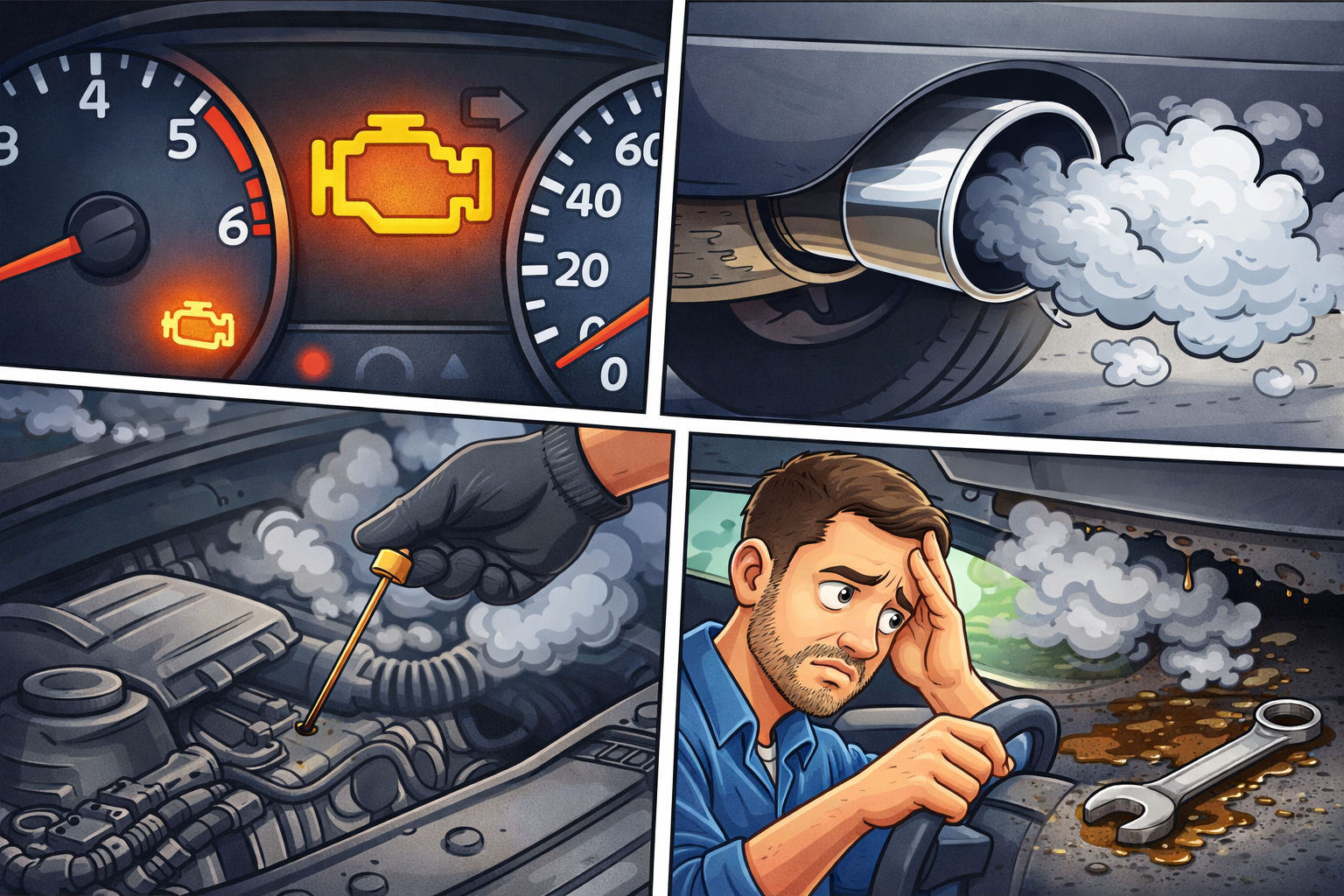
A car engine rarely fails without giving any warning at all. Much more often, it starts sending signals beforehand — unusual noises, loss of power, rough running, smoke, or increased oil consumption. The problem is that many drivers ignore these symptoms at first, hoping that things will simply go back to normal on their own. Unfortunately, that is exactly how a smaller and relatively affordable issue often turns into an expensive repair.
The engine is one of the most important and expensive parts of any car, so any change in how it behaves is worth taking seriously. That does not mean every vibration or every strange sound automatically means disaster. But if your car suddenly starts behaving differently than before, there is usually a reason. The sooner that reason is noticed, the better the chance of avoiding more serious consequences.
In this article, we will look at 15 common signs that may point to engine trouble. These signs can help drivers understand what they can notice themselves, when a simple check may be enough, and when it is clearly time to take the car to a workshop.
Why engine symptoms should not be ignored
Engine problems often begin gradually. At first, the car may feel slightly less responsive, develop a small vibration, or make an unusual sound only under certain conditions. Later, the symptoms become more obvious — the engine starts running unevenly, the car loses power, a warning light comes on, or fuel and oil consumption increase.
If these signs are ignored, the damage often spreads further. For example, a relatively small ignition or fuel mixture problem can create extra stress for the catalytic converter, turbocharger, or the engine itself. That is why paying attention to the early signs often means real long-term savings.
| Sign | Should you worry? | What to do |
|---|---|---|
| Check Engine light | Yes | Run diagnostics |
| Blue or white smoke | Yes | Inspect the engine and fluids |
| Minor noise on cold start | Sometimes | Monitor whether it gets worse |
| Loss of power | Yes | Check for fault codes and engine issues |
1. The Check Engine light comes on
One of the clearest warning signs is the Check Engine light on the dashboard. Many drivers take it too lightly, especially if the car still seems to drive normally. But this light means the car’s electronics have detected an abnormality in the engine, fuel, or emissions system.
Sometimes the issue may indeed be relatively small, such as a sensor or a fuel mixture deviation. In other cases, it may be related to misfires, the oxygen sensor, the catalytic converter, or another important system.
The key is not to guess, but to run diagnostics. The light itself does not tell you the exact cause, but it is a clear signal that something is not working as it should.
2. The car loses power
If the car becomes sluggish, accelerates poorly, or no longer responds as sharply to the throttle as before, this may point to an engine problem. In some cases, the cause may be fuel delivery, ignition, a faulty sensor, or turbocharger issues.
Drivers often notice it as a feeling that the car simply “does not go” the way it used to, or that normal performance is suddenly missing during overtaking. This can be especially noticeable uphill, under load, or on the highway.
Loss of power is not something that should be ignored for long, because it is often linked to a problem that can get worse over time.
3. The engine runs unevenly at idle
If the engine starts vibrating, shaking, or idling unstably while the car is standing still, it may mean the engine is not running evenly. Possible causes include ignition problems, spark plugs, coils, fuel delivery issues, vacuum leaks, or sensor faults.
Some cars may naturally have very slight fluctuations at idle, but obvious shaking or unstable RPM usually means something is not working correctly.
If the idle has become worse than before, that is a good reason to check the car rather than waiting for additional symptoms to appear.
4. The engine becomes harder to start
If the engine starts becoming harder to start than usual, especially in the morning or after sitting for a longer time, this may be an early warning sign. Difficult starting can be related to fuel delivery, the battery, the ignition system, glow plugs in diesel engines, or even sensors.
It is important to notice whether the problem only happens in cold weather or whether it starts happening more regularly. The more often it appears, the less likely it is to be a minor random issue.
An engine usually does not become “hard to start” without a reason. It is a symptom worth taking seriously, even if the car still seems to drive normally afterwards.
5. Unusual smoke comes from the exhaust
Exhaust smoke color can reveal a lot. Blue smoke often points to burning oil, white smoke may indicate coolant entering the combustion chamber or excessive condensation, and black smoke often suggests an overly rich fuel mixture.
Of course, in cold weather, short-term white vapor can be normal, especially right after startup. But if the smoke is strong, does not go away, or appears regularly, that is already a sign of a possible issue.
Smoke is not just a cosmetic issue — it is often one of the clearest visible symptoms that something inside the engine is not right.
6. Oil consumption increases
If the oil level drops faster than before and you need to top it up more often, this may point to engine wear or another problem. Some engines do consume a small amount of oil normally, but sudden changes are not normal.
Possible causes include piston rings, valve seals, the turbocharger, or leaks. Many people only realize the problem once oil consumption has already become unpleasantly high.
The earlier it is noticed, the better the chance of fixing the cause before the wear becomes more serious.
7. The engine starts jerking while driving
Jerking during acceleration or even while driving steadily often means the engine is not operating smoothly. This can be connected to misfires, fuel delivery issues, air leaks, sensor problems, or injection faults.
Sometimes the symptom only appears at a certain speed or under a specific load. That does not make it unimportant — on the contrary, it may mean the issue is still in an early stage.
If the car starts jerking more often, it should not be ignored, because it affects both comfort and the long-term health of the engine.
8. Strange noises appear from the engine area
Knocking, rattling, tapping, or metallic noises from the engine bay are never a good sign. Of course, different cars have different characteristics, but if a sound is new, getting worse, or clearly different from normal, it should be taken seriously.
In some cases, the cause may be relatively simple, such as a component or belt-related issue. In other situations, it may point to a more serious internal engine problem.
Engine-related noises are one of those things that are best checked early rather than waiting for them to become louder and more expensive.
9. Fuel consumption increases for no clear reason
If the car suddenly starts using more fuel even though your route and driving habits have not changed much, the reason may be an engine or sensor issue. Incorrect fuel mixture, a faulty oxygen sensor, a mass airflow sensor, or ignition problems can all increase fuel consumption.
Many people first blame weather or traffic, and sometimes that is true. But if the increase is noticeable and long-lasting, the cause is often technical.
Higher fuel consumption is not only a cost issue — it is often a sign that the engine is no longer working efficiently.
10. The engine overheats
An increase in engine temperature or repeated overheating is one of the most serious warning signs. If the temperature gauge rises above normal, this should not be ignored even if the car is still moving.
The causes of overheating can vary — coolant leaks, a thermostat, water pump, radiator, or even a head gasket problem. But the consequences can almost always be expensive if driving continues.
If the engine begins to overheat, the priority is to stop safely and prevent the problem from becoming more severe.
11. You notice the smell of fuel or oil
An unusual smell of fuel or burning oil inside the cabin or around the car may point to a leak, an overly rich mixture, or fluids getting where they should not be. This is not something to ignore, because besides indicating an engine problem, it can also be a safety risk.
If the smell appears regularly, gets stronger, or is accompanied by smoke, the situation should be taken seriously. The engine bay is not a place where strange smells should be considered normal.
Even if the car still drives, this may still be a sign of a leak or the beginning of an overheating issue.
12. The RPM behaves strangely
If the RPM rises and falls unexpectedly at idle, or the engine reacts oddly to the throttle while driving, this may point to air intake, fuel system, or electronic control problems.
Sometimes it feels as if the car is slightly “breathing” on its own even though the driver is maintaining a steady input. In other cases, the idle RPM becomes unusually high or low.
Such changes are often explainable technically, but they should not be accepted as normal if they were not there before.
13. The car vibrates more than before
Extra vibration in the cabin, steering wheel, or seats can be related not only to wheels or suspension, but also to the engine itself. If vibrations are especially noticeable at idle or during acceleration, the engine may not be running smoothly.
In some cases, worn engine mounts may be the cause, but that is still connected to the overall behavior of the powertrain. In other cases, the vibration comes from misfires or uneven combustion.
If the car has become noticeably rougher than before, it is worth finding out why.
14. Fluids appear under the car or in the engine bay
Puddles or stains under the car are never a reassuring sign. Oil, coolant, or fuel leaks may be directly related to engine trouble or the systems that keep it operating properly.
Not every leak means immediate disaster, but all of them deserve attention. A minor seep can turn into a significant fluid loss, and that is when the consequences become much more serious.
If fluid appears under the car regularly, it should not be postponed for “later.”
15. The engine suddenly feels louder or rougher
Sometimes a driver cannot describe exactly what is wrong, but clearly feels that the car no longer sounds or behaves the way it used to. The engine feels louder, rougher, heavier, or simply “unhealthy.”
That kind of instinct should not be dismissed immediately. Someone who drives the same car every day usually notices when its normal behavior changes.
Even if the symptom is still difficult to describe, a clear change in engine behavior is often enough reason for a preventive inspection.
What drivers can check themselves
Before going to a workshop, drivers can pay attention to several things themselves — whether the Check Engine light is on, whether oil or coolant levels have dropped, whether there are visible leaks, what color the exhaust smoke is, and whether the issue appears under specific conditions. This information can be very helpful at the workshop.
It is also worth noting when the symptoms began, whether they are getting worse, and whether they appear only when the engine is cold or also when warm. The more accurately the driver can describe the problem, the faster the real cause can often be found.
When you should go to a workshop immediately
There are situations where delay is a bad idea. If the engine overheats, the exhaust produces strong blue or white smoke, loud knocking appears, the car suddenly loses a lot of power, the Check Engine light flashes, or there is a noticeable fuel smell, the car should be checked as soon as possible.
In these cases, continuing to drive while hoping “maybe it is nothing” is risky. Sometimes just a few extra kilometers are all it takes for a relatively minor issue to turn into major damage.
Conclusion
Engine problems very often begin with signs that can be noticed early. Loss of power, vibrations, smoke, the Check Engine light, unusual noises, and increased oil or fuel consumption are not small details that should be ignored for months.
The sooner a driver realizes that the engine is no longer working the way it normally does, the better the chance of avoiding more serious and expensive consequences. Sometimes the issue turns out to be relatively minor. But you can only find that out if you react to the symptoms in time.
If you want to better understand your car’s running costs and how technical condition can affect fuel consumption, use the fuel calculator below.