
 LV
 EN
 RU
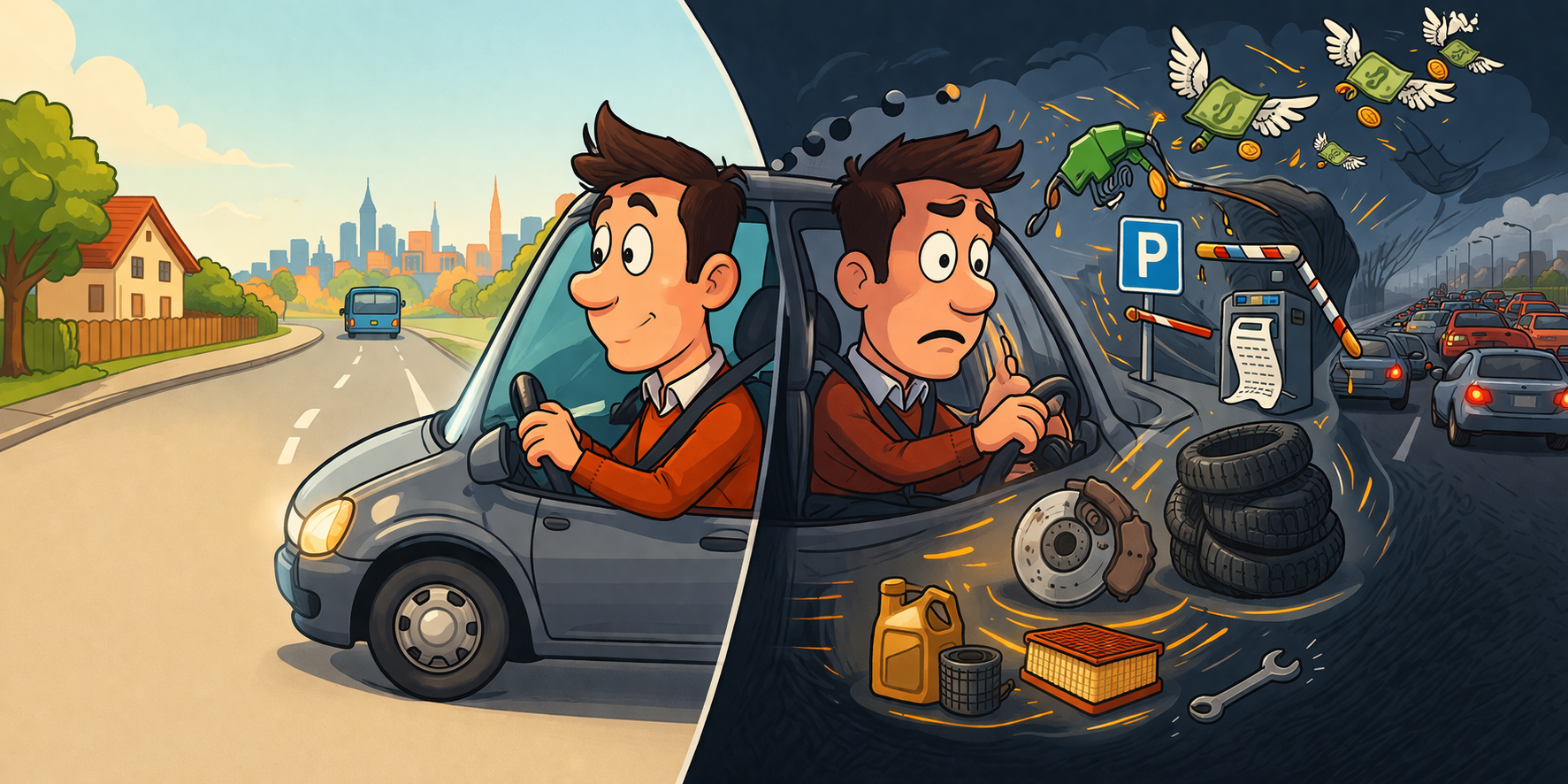
There are expenses that a person feels immediately, and there are expenses that pretend to be smaller than they actually are. Commuting to work by car very often belongs to the second category. It is not one large, dramatic payment that you make at the beginning of the month and forget. It is more like a constant drip — a few liters here, another refill there, a bit of wear, a few extra kilometers, slightly delayed maintenance, a little more than planned. And that is exactly why so many drivers live with an approximate feeling about their commuting costs, rather than a real understanding.
From the outside, the question “how much does it cost to commute to work by car per month?” seems very simple. It feels like you only need to know the distance, fuel consumption, and fuel price. But in real life, it is almost never that flat of a calculation. Because one person lives 7 kilometers from work and spends most of their time in city traffic. Another drives 35 kilometers one way every day on the highway. A third lives in the suburbs, takes a child to school, stops by a store on the way, sometimes gives a colleague a ride, and only then arrives at work. All three technically “drive to work by car”, but their monthly cost reality is completely different.
That is exactly why this article will not be a simple rewrite of a fuel calculator. We will look at this topic in a much more human and honest way. How much does it cost to commute to work by car in Latvia per month? What are the real scenarios? What do people regularly forget to include? When does commuting start to become a serious part of your budget? And why does it sometimes feel like you are “just living normally”, while in reality a significant part of your money quietly goes just to getting to work?
This is one of those topics where the truth can be not only interesting, but also slightly uncomfortable. Because once the real numbers start to appear, many people realize for the first time that work is not just a place where you earn. Work is also a place you have to reach every month. And that “getting there” sometimes costs more than you want to admit to yourself.
The first mistake: thinking that commuting only costs fuel
This is the most classic mistake. A person tries to understand how much it costs to commute and limits the thinking to: how many liters do I use per week? It is understandable, because fuel is the most visible part of the cost. You see it on the price board. You see it on the receipt. You feel it the most. But this visibility can also be misleading. Because fuel is very often only the first layer.
Commuting to work is, at the same time, tire wear, oil life reduction, depreciation, brake usage, suspension load, filter wear, possible parking costs, small unexpected repairs, and simply the fact that the car is used actively every day. In other words, your daily commute does not only “consume fuel”. It consumes the car itself.
No one is saying that everyone now needs to live in spreadsheets and divide every cent per kilometer. But if a person wants to understand the real picture, fuel alone is not enough. Many drivers say that commuting “is not that bad”, until the end of the year when they look at the total car expenses and realize how much of it was actually caused by the daily work routine.
A very typical thought in driver forums: “For a long time I only calculated fuel. Then came tires, brakes, and maintenance, and suddenly I realized that my job not only pays me, but also slowly consumes my car.”
The simple base: how do people usually try to calculate it?
To understand monthly costs, people usually start with the simplest formula. Distance to work one way, multiplied by two. Then multiplied by the number of working days per month. Then they look at the car’s average fuel consumption per 100 kilometers. Then they add the fuel price. This is a completely normal starting point, and it cannot be avoided. For example, if a person lives 15 kilometers from work, then they drive 30 kilometers per day. If there are 22 working days per month, that is already 660 kilometers. If the car consumes 7 liters per 100 kilometers, then around 46 liters are used per month. If fuel costs, say, 1.75 euros per liter, then fuel alone for commuting costs a little over 80 euros per month.
On paper, that does not sound terrible. And this is exactly where people often calm themselves too quickly. Because 80 euros in fuel is only what you put into the tank to get to work and back. But that is not yet the full answer to “how much does commuting cost?”. That is only the answer to “how much does fuel for commuting cost?”. And there is a big difference between these two questions.
Still, this simple calculation is valuable because it quickly shows one thing: even a “small distance” turns into a very concrete number at the end of the month. Commuting is not a small daily movement. It is a repeating financial mechanism. And that is exactly why it is worth taking more seriously.
No. 1: a short city route that sounds cheap, but is not always
Let’s imagine a very typical situation. A person lives only 6 kilometers from work. They live in the city, work in the city, and from the outside it seems that their car costs must be very low. After all, it is so close. That is only 12 kilometers per day. Over 22 working days, that is 264 kilometers. If the car consumed an ideal 7 liters per 100 kilometers, that would be less than 19 liters per month. In fuel — about 33 euros at 1.75 euros per liter.
But in reality, the city rarely allows such clean mathematics. Short trips, traffic lights, cold starts, congestion, slow traffic, parking searches, constant stop-and-go movement — all of this means that real consumption in this mode can be noticeably worse than in theory. And then this “small” commute is no longer as cheap as it first seemed.
Even more — in short trips people often forget that wear still happens. Because it feels like: I barely drive anything. But the car experiences cold starts every day, short inefficient cycles, and often does not even fully warm up. This kind of usage is actually much more expensive for some cars than people intuitively think.
A good driver comment from discussions: “For a long time I thought my commute was cheap because I live close. Then I realized my car spends every day in its least efficient mode.”
No. 2: 20 kilometers one way — the classic suburban reality
Now let’s look at a very common scenario in Latvia. A person lives in the suburbs or just outside the city but works in the city. One way is 20 kilometers. That is 40 kilometers per day. Over 22 working days, that becomes 880 kilometers. If the car consumes 6.8 liters per 100 kilometers, then almost 60 liters are used per month. At 1.75 euros per liter, that is about 105 euros.
And here the feeling starts to change. 100+ euros per month just for fuel to get to work and back is already something a person feels. It is no longer “just something small”. It becomes a clear budget category. And once you add even a modest layer of wear, maintenance, and other car-related costs, commuting starts to look significantly heavier.
This is the range where many drivers begin asking more serious questions. Is this car suitable for this route? Does it make sense to switch to something more economical? Can part of the commute be organized differently? Because in suburban living, commuting often becomes one of the central pillars of car expenses.
No. 3: 35–40 kilometers one way — here commuting becomes a financial system of its own
There are also many people whose work is not 10 or 20 minutes away. They live in one city or region but work in another. 35 or 40 kilometers one way is not unusual. That means 70 to 80 kilometers per day. Over 22 working days, that is already 1540 to 1760 kilometers just for commuting.
With a car consuming 6.5–7 liters per 100 kilometers, that can mean 100–120 liters per month. At 1.75 euros per liter, that is about 175 to 210 euros just in fuel. And this is the point where commuting is no longer a small detail. It becomes a very real monthly cost that starts competing with utilities, food, or other important budget categories.
At this level, many drivers also begin to feel a psychological burden. Because work does not only bring income. It also requires a very specific cost just to get there. And sometimes, for the first time, a person reluctantly asks: how much of my salary is actually left after I have simply reached my workplace?
A typical thought from drivers: “When I started calculating not per tank, but per month, my commute suddenly looked much more expensive than I had been telling myself.”
The real cost of commuting begins where “just fuel” ends
This is where the most important idea of the entire article appears. Fuel is only the most visible part of the cost. But if a person drives to work regularly and extensively, they significantly impact the total wear of the car. Those kilometers do not disappear. They accumulate. The car reaches its next service sooner. Tires wear out faster. Brakes, oil, filters, suspension — all of it lives off kilometers, not off our feelings.
If someone wants a more honest monthly picture, many experts and experienced drivers suggest thinking not only about fuel, but also about approximate cost per kilometer. Even if not perfectly calculated, the principle itself is valuable: commuting does not only burn fuel, it consumes the car’s lifespan. And the higher the monthly mileage, the more significant this hidden cost becomes.
This is where a person moves from “I spend about 100 euros on fuel for work” to a much less comfortable but more honest realization: I spend not only fuel, but also part of my car’s life. And that is already a much deeper calculation than a simple refill on Friday evening.
What do drivers most often forget to include?
The first forgotten thing is parking. For many people, it is a regular expense, but psychologically it is often not counted as part of commuting. As if parking existed separately from the fact that you drive to work. But in reality, it is a direct cost of that decision. If parking costs 30, 50, or more euros per month, that is already a significant part of commuting.
The second is additional routes attached to work. For example, dropping a child at school, stopping at a store, pharmacy, or gym. These kilometers are often not perceived as part of commuting, even though in practice they exist because of it.
The third is time. Yes, you cannot pour time into the fuel tank. But more and more people realize that commuting is not only about money, but also about quality of life. Spending one or more hours per day in traffic eventually becomes a much bigger question than fuel consumption alone.
A very good thought: “Until I started adding parking and those ‘small detours’, I was telling myself a much cheaper story about my commute.”
City vs highway: same distance, completely different monthly cost
This is where many people realize how misleading distance alone can be. Two people can drive the same distance to work, but their monthly costs can differ significantly. One drives 18 kilometers on a smoother suburban or highway route. The other drives the same 18 kilometers through city traffic, with lights, congestion, cold starts, and stop-and-go patterns.
On paper, they are the same. From the car’s perspective, they are completely different realities. That is why commuting cost should always be evaluated not only in kilometers, but also in driving conditions.
City driving is not only more frustrating — it is often more expensive in very real terms: fuel, wear, and time.
When does commuting become a reason to rethink your car?
Not every expensive commute means you should immediately buy a new car. But there is a point where your daily route starts revealing whether your car is suitable at all. If you drive 1000–1700 kilometers per month just for work, and your car is inefficient for that pattern, this question eventually becomes practical.
This is where comparisons appear: petrol, diesel, hybrid, LPG, even electric cars. But the smartest approach is not to jump to conclusions. It is to first understand your current cost and compare it realistically.
Because many people live for years with a commute that does not fit their car — until they finally calculate it.
Work as income vs work as a cost — the uncomfortable truth
This is one of the most uncomfortable but important thoughts. People see work as income. But if commuting is expensive, it is also a cost.
That does not mean commuting is always bad. Sometimes the salary justifies it. But many people never ask the real question: how much of my income is spent just getting to work?
“At one point I realized I’m not just driving to work. I’m paying every month for the ability to work there.”
What to do if your commute already feels too expensive?
Start calculating honestly. Then review your habits, route, and car suitability.
Often there is more flexibility than it seems.
Conclusion
Commuting costs vary widely — from small to significant. The key is understanding the real picture.
Use the calculator below to estimate your real costs.