
 LV
 EN
 RU
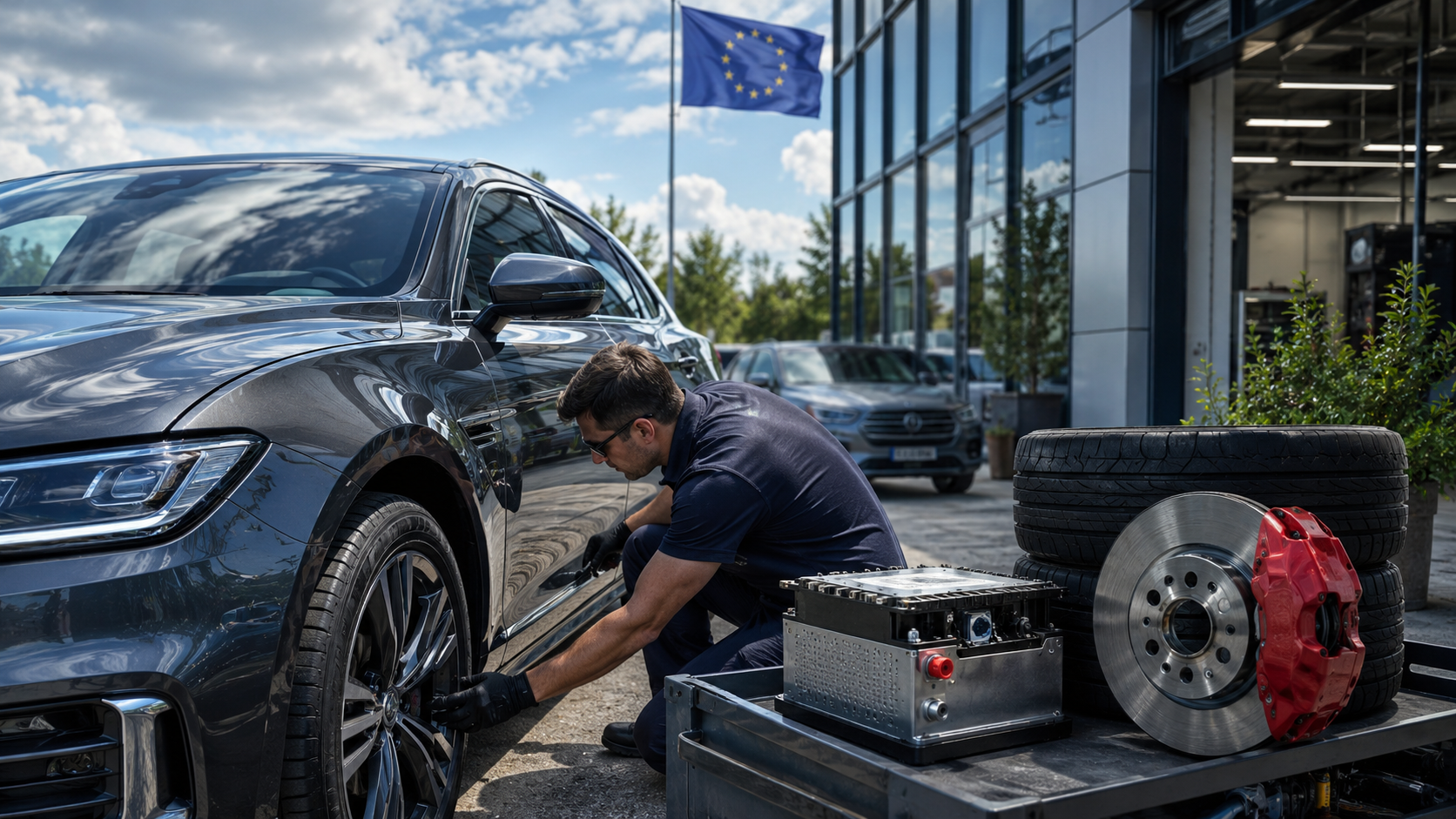
Information checked on 29 July 2026. The Euro 7 Regulation is already in force, but its requirements are being introduced gradually. It will become mandatory for new types of M1 and N1 vehicles from 29 November 2026 and for all new vehicles in these categories from 29 November 2027. The regulation does not require an already registered Euro 6, Euro 5 or older vehicle to be modified or scrapped.
The name Euro 7 may create the impression that it is simply another exhaust-emissions standard for diesel and petrol engines.
In reality, the changes are much broader this time.
For the first time, the European Union is using one vehicle-emissions framework to cover not only the exhaust pipe but also brake dust, tyre wear, the durability of electric-vehicle and plug-in-hybrid batteries, real fuel and electricity consumption, system-performance monitoring and environmental information available for each individual vehicle.
Euro 7 will therefore also affect a fully electric car that has no exhaust pipe at all.
This does not mean that every Euro 6 vehicle will suddenly disappear from Latvian showrooms at the end of 2026. The first date applies to the type approval of new vehicle types. Models that have already been approved may still be manufactured and registered during the transition period according to the applicable timetable.


The short conclusion: Euro 7 will not make existing vehicles illegal and does not impose one mandatory price increase. However, manufacturers of new vehicles will have to certify their brakes, monitor system performance, ensure battery durability and gradually use tyres with controlled wear. For some models, this may increase production costs or accelerate their removal from the market.
What exactly is Euro 7?
Euro 7 is the European Union regulation governing vehicle emissions and battery durability.
It replaces the existing Euro 6 framework for passenger cars and the Euro VI framework for heavy-duty vehicles, combining the requirements into a more unified system.
The regulation applies to:
• petrol vehicles;
• diesel vehicles;
• conventional hybrids;
• plug-in hybrids;
• fully electric vehicles;
• hydrogen vehicles;
• light commercial vehicles;
• and, at a later stage, buses, lorries, trailers and the relevant components.
The difference is that not every requirement applies identically to every type of powertrain.
An electric vehicle has no exhaust emissions, but it still has brakes, tyres, a battery, energy-consumption data and systems whose operation must be monitored.
The most important dates
| Date | What does it mean? |
|---|---|
| 28 May 2024 | The Euro 7 Regulation legally entered into force |
| 29 November 2026 | Euro 7 becomes mandatory for new types of M1 passenger cars and N1 light commercial vehicles |
| 29 November 2027 | Euro 7 becomes mandatory for all new M1 and N1 vehicles, except for specified transition or small-series cases |
| 1 July 2028 | The requirements begin to apply to new C1 passenger-car tyre types |
| 29 May 2028 | Euro 7 begins to apply to new heavy-duty vehicle types |
| 29 May 2029 | Euro 7 becomes mandatory for all new vehicles in the relevant heavy-duty categories |
| 1 July 2030 | Non-compliant C1 tyres may no longer be placed on the market, and new vehicles may not be registered with non-compliant C1 tyres |
| 1 January 2035 | A uniform brake PM10 limit of 3 mg/km is planned for all M1 and N1 powertrains |
The date for a new vehicle type is not the same as the date for every new vehicle. A model whose type was approved before 29 November 2026 may still be manufactured and registered as Euro 6 for a specified period. Euro 6 and Euro 7 vehicles may therefore be available in showrooms at the same time during 2027.
Will an existing Euro 6 car become prohibited?
No.
Euro 7 regulates the type approval and placing on the market of new vehicles. It does not automatically change the emissions class of a vehicle that has already been registered.
| Situation | Effect of Euro 7 |
|---|---|
| Euro 6 car registered in 2022 | It does not have to be converted into a Euro 7 vehicle |
| Used Euro 5 car from Germany | Euro 7 itself does not prohibit its import or registration when the other requirements are satisfied |
| New model whose type is approved after 29 November 2026 | It will generally have to comply with Euro 7 |
| Previously type-approved Euro 6 model in early 2027 | It may still be sold and registered during the transition period |
| New passenger car after 29 November 2027 | It will generally have to comply with Euro 7 |
Individual cities may introduce low-emission zones or other local restrictions in the future, but that is a separate legal issue. The Euro 7 Regulation itself does not remove the right to use an older vehicle.
What will change for exhaust emissions?
The Euro 7 exhaust-emission limits for passenger cars are not dramatically lower than the limits under the latest stage of Euro 6.
The important changes are broader testing, longer compliance monitoring and particle-number measurement covering smaller particles.
| Indicator for an M1 passenger car | Petrol engine | Diesel engine |
|---|---|---|
| Carbon monoxide CO | 1,000 mg/km | 500 mg/km |
| Nitrogen oxides NOx | 60 mg/km | 80 mg/km |
| Particulate mass PM | 4.5 mg/km | 4.5 mg/km |
| Particle number PN10 | 6 × 10¹¹/km | 6 × 10¹¹/km |
PN10 means that particles with a diameter of approximately 10 nanometres are also taken into account, rather than only the larger particles covered by some previous measurements.
Manufacturers will have to demonstrate compliance under a wider range of driving, temperature and operating conditions, rather than only during an ideal laboratory cycle.
Brake dust: why does the requirement also apply to electric vehicles?
When a car brakes, its pads and discs wear through friction. Some of that material becomes fine particles that enter the air and settle on the road.
Electric vehicles use regenerative braking, in which the electric motor slows the car and recovers energy. Their mechanical brakes may therefore be used less often in urban driving.
However, electric vehicles still need friction brakes for:
• emergency braking;
• very rapid deceleration;
• situations in which the battery is full and cannot accept recovered energy;
• low temperatures or system limitations;
• the final metres before coming to a complete stop;
• backup operation if an electronic or drivetrain system fails.
Euro 7 brake-particle limits until the end of 2029
| Powertrain | PM10 brake-particle limit for M1 and most N1 vehicles |
|---|---|
| Fully electric vehicle | 3 mg/km |
| Plug-in hybrid | 7 mg/km |
| Conventional hybrid | 7 mg/km |
| Hydrogen vehicle | 7 mg/km |
| Petrol or diesel vehicle | 7 mg/km |
The initial limits are higher for heavier N1 Class III vans: 5 mg/km for electric powertrains and 11 mg/km for other powertrains.
From 2035, a uniform limit of 3 mg/km is planned for M1 and N1 vehicles regardless of their powertrain.
The lower figure for electric vehicles does not mean that their brakes are always inherently cleaner in design. The test result is strongly affected by the use of regenerative braking, vehicle mass, control software and the frequency with which the mechanical brakes engage.
Will special Euro 7 brake pads and discs appear?
Manufacturers may use several solutions:
• pad materials producing fewer particles;
• more durable or coated brake discs;
• more effective distribution between regenerative and mechanical braking;
• brake-control software changes;
• more enclosed brake assemblies or particle-capture solutions;
• automatic disc cleaning to reduce corrosion on infrequently used electric-vehicle brakes.
The most important issue for buyers will be replacement-part availability.
When Euro 7 compliance has been certified for a specific combination of discs, pads, control software and vehicle configuration, the use of unsuitable low-cost parts may worsen emissions performance or braking characteristics.
This does not mean that every repair will necessarily require a component bearing the vehicle manufacturer’s logo. However, an independent parts manufacturer will have to provide suitable quality and type approval when the relevant component requires it.
Tyre wear: Euro 7 will also tackle microplastics
As a tyre rolls, its tread gradually wears away. The material does not disappear: tiny particles of rubber, fillers and road surface enter the environment.
Euro 7 introduces tyre-abrasion testing and limits so that more durable tyres are gradually placed on the market.
| Tyre class | For new tyre types | Ban on placing all non-compliant tyres on the market | Remaining stocks available until |
|---|---|---|---|
| C1 — passenger-car tyres | 1 July 2028 | 1 July 2030 | 30 June 2032 |
| C2 — light-commercial-vehicle tyres | 1 April 2030 | 1 April 2032 | 31 March 2034 |
| C3 — heavy-vehicle tyres | 1 April 2032 | 1 April 2034 | 31 March 2036 |
This does not mean that a previously purchased set of tyres will have to be discarded from 2028.
The requirements mainly concern tyre type approval, placing tyres on the market and equipping new vehicles.
Will a more durable tyre always be safer?
Not necessarily.
A tyre manufacturer must balance several properties at the same time:
• wear resistance;
• wet-road grip;
• snow and ice grip;
• rolling resistance;
• noise;
• comfort;
• price.
A very hard rubber compound may last longer but provide poorer grip on wet or cold roads. Euro 7 abrasion requirements therefore do not replace the EU tyre label, independent tests or the driver’s responsibility to choose tyres suitable for the season.
Battery durability: what do 80% and 72% mean?
Euro 7 establishes a minimum traction-battery energy-retention level for fully electric vehicles and plug-in hybrids.
| Vehicle category | Up to 5 years or 100,000 km | More than 5 years or 100,000 km and up to 8 years or 160,000 km |
|---|---|---|
| M1 passenger car | At least 80% | At least 72% |
| N1 light commercial vehicle | At least 75% | At least 67% |
The principle used is “whichever comes first.”
Example A: the car is four years old but has covered 110,000 km. It has already exceeded the first-stage distance threshold of 100,000 km.
Example B: the car is six years old but has covered only 55,000 km. It has already exceeded the five-year threshold.
Example C: the car reaches eight years of age before covering 160,000 km. The second specified stage ends according to the age criterion.
Illustrative driving-range example
Assume that a new electric vehicle has a WLTP range of 500 km.
| Battery energy retention | Simplified calculated range from 500 km |
|---|---|
| 100% | 500 km |
| 80% | 400 km |
| 72% | 360 km |
Real driving range is not directly equal to the battery-energy percentage because it is affected by temperature, speed, tyres, heating, software, changes to the usable buffer and vehicle efficiency.
However, the example helps demonstrate the scale of the requirement.
The Euro 7 limit is not automatically the same as the manufacturer’s warranty. The warranty terms determine what the manufacturer will repair or replace, how battery health will be measured and which exclusions apply. Euro 7 is a type-approval and compliance requirement that manufacturers must take into account when designing and monitoring the vehicle.
Does 72% mean that the battery is allowed to fail suddenly?
No.
A reduction in energy capacity and a technical battery failure are not the same thing.
| Situation | What does it mean? |
|---|---|
| Gradual reduction in capacity | The vehicle may continue to operate normally but with a shorter electric range |
| Defect in an individual module or cells | An error, power restriction or battery repair may be required |
| Cooling-system failure | Battery durability and safety may be affected |
| Incorrect battery-health calculation by software | A display or diagnostic reading may not reflect the actual usable energy |
Euro 7 provides for monitoring of battery health and other environmental parameters so that non-compliance can be identified more easily.
What is an Environmental Vehicle Passport?
Euro 7 introduces the Environmental Vehicle Passport.
Its purpose is to provide structured information about the environmental performance of a specific vehicle.
Depending on the vehicle type and technical implementation, it may contain information about:
• the emissions standard;
• exhaust-emission limits and declared results;
• fuel consumption;
• electricity consumption;
• electric range;
• battery-durability data;
• brake-particle emissions;
• other type-approval and in-use environmental parameters.
This may help a used-electric-vehicle buyer, a workshop, a technical supervisory authority and market-surveillance bodies understand whether a particular vehicle is operating as declared.
The vehicle will monitor the operation of its own emissions systems
Euro 7 expands the importance of onboard diagnostic and monitoring systems.
Manufacturers will have to use systems capable of:
• detecting failures in emissions-control systems;
• monitoring specified emissions parameters during use;
• recording real fuel or electricity consumption;
• monitoring electric range and battery condition;
• detecting manipulation of emissions, consumption or battery data;
• providing diagnostic information for repairs and market surveillance.
This may make it more difficult to disable DPF, AdBlue, EGR or other emissions systems illegally.
At the same time, more complex diagnostics may increase the importance of software, sensors and electronic repairs.
What will Euro 7 change for each type of powertrain?
| Powertrain | Main Euro 7 requirements | Possible practical effect |
|---|---|---|
| Petrol | Exhaust emissions, evaporative emissions, PN10, brakes, tyres and diagnostics | Broader emissions control and potentially additional sensors or improved filtration |
| Diesel | NOx, PM, PN10, DPF/SCR performance, brakes, tyres and diagnostics | The operation of emissions systems over longer use and under varied conditions will be particularly important |
| Conventional hybrid | Exhaust, brakes, tyres and fuel-consumption monitoring | Regeneration helps reduce brake emissions, but a conventional hybrid does not face the same Euro 7 minimum traction-battery requirement as a plug-in hybrid |
| Plug-in hybrid | Exhaust, brakes, tyres, battery durability, and monitoring of fuel and electricity consumption | The manufacturer must monitor both the combustion system and the traction battery |
| Electric vehicle | Brake particles, tyres, battery durability, energy consumption and the Environmental Vehicle Passport | There are no exhaust requirements, but a stricter brake limit and minimum battery durability apply |
Will Euro 7 make new cars more expensive?
Possibly, but there is no single legally prescribed amount.
The Euro 7 Regulation does not state that, for example, €500 or €1,000 must be added to the price of every vehicle.
The cost depends on how closely the specific model already meets the requirements.
| Source of cost | Possible effect |
|---|---|
| New brake materials or coated discs | More expensive brake assemblies or replacement parts |
| Additional sensors and diagnostics | Higher electronics, software and type-approval costs |
| Exhaust-system improvements | May make certain petrol and diesel models more expensive |
| Battery cooling and protection | May increase electric-vehicle or plug-in-hybrid construction costs while improving durability |
| New type approval and testing | Especially significant for models with low sales volumes |
| Tyre-abrasion requirements | May change the factory tyre selection and its cost |
Illustrative price scenarios
Assume that Euro 7 increases the manufacturer’s or importer’s net cost for a particular model by €150, €400 or €800 and that the full amount is passed on to the buyer. Latvia applies 21% VAT.
| Increase in net cost | Effect of 21% VAT | Possible final price increase | Simplified monthly amount over 60 months without interest |
|---|---|---|---|
| €150 | €31.50 | €181.50 | €3.03 |
| €400 | €84 | €484 | €8.07 |
| €800 | €168 | €968 | €16.13 |
These are illustrative scenarios only, not forecasts or official Euro 7 surcharges.
A manufacturer may absorb the costs, reduce the available discount, revise the equipment specification, increase the price for the next model year or discontinue a particular version altogether.
Why could an inexpensive small car be at greater risk than an expensive SUV?
Fixed type-approval and development costs are easier to absorb within the price of an expensive vehicle.
When €500 of additional cost is added to an €80,000 vehicle, it represents less than one percent of the price.
When the same amount is added to a €16,000 small car, it represents more than three percent.
| Vehicle price | Share represented by a €500 cost |
|---|---|
| €16,000 | 3.13% |
| €30,000 | 1.67% |
| €50,000 | 1.00% |
| €80,000 | 0.63% |
A manufacturer may therefore conclude that updating an inexpensive model is not economically justified, particularly when sales volumes are low or a new generation of the vehicle is due soon.
Should you buy a Euro 6 vehicle before Euro 7?
There is no single correct answer.
| Possible Euro 6 advantage | Possible Euro 7 advantage |
|---|---|
| A transition-period discount on vehicles already in stock | Newer design and longer model relevance |
| More information available about an already proven model | Brake-particle, battery and monitoring requirements |
| Potentially simpler and cheaper replacement-part selection | Broader environmental and diagnostic data |
| No risk from first-generation Euro 7 technical solutions | Potentially better battery durability and resale value |
| A lower initial price may matter more than the emissions label | A newer emissions standard may be more attractive to the next buyer |
When a Euro 6 vehicle is offered with a discount of several thousand euros and is intended for long-term use in Latvia, it may be more economical than a more expensive Euro 7 version.
When the vehicle will be sold in Western Europe after three or four years or used in cities with stricter emissions zones, the newer emissions class may be more valuable.
Will a Euro 7 vehicle be cheaper to maintain?
Not necessarily.
Some requirements may reduce long-term risks, while others may increase repair complexity.
| Potential saving | Potential additional cost |
|---|---|
| More durable electric-vehicle battery | More sensors and monitoring electronics |
| Longer-lasting tyres | More expensive specialised tyres |
| Lower brake-particle wear | More expensive discs, pads or coatings |
| Failures detected earlier | More specialised diagnostics required |
| Better information for a used-vehicle buyer | Software and data-access costs for workshops |
What will Euro 7 mean for technical inspections in Latvia?
The Euro 7 Regulation does not automatically mean that Latvian inspection stations will begin measuring brake PM10 particles or tyre microplastics in laboratory conditions from November 2026.
Brake and tyre limits are primarily checked during vehicle or component type approval.
Over the longer term, however, the following may become more important during technical inspections and roadside checks:
• onboard diagnostic fault data;
• detection of manipulation involving emissions systems;
• verification of DPF, SCR, EGR and sensor operation;
• battery-health data;
• Environmental Vehicle Passport information;
• identification of non-compliant software or components.
The precise changes to Latvian technical-inspection procedures will depend on further EU and Latvian legislation.
Will any brakes and tyres be permitted after an accident repair?
Vehicles must already be fitted with safe parts suitable for their particular design.
Euro 7 makes this issue more important because the brake system and tyres form part of the vehicle’s environmental compliance.
After a repair, check:
• whether the component is intended for the specific model and axle;
• whether the pads and discs are mutually compatible;
• whether the component has the necessary approval;
• whether the tyre load and speed ratings comply with the vehicle requirements;
• whether software must be adapted or calibrated after replacement;
• whether any diagnostic faults remain after the repair.
What should you check when buying a used Euro 7 electric vehicle?
1. The battery’s actual state of health, not only the predicted range shown on the display.
2. The remaining manufacturer battery warranty.
3. Whether Environmental Vehicle Passport and diagnostic information is available.
4. The rapid-charging history and maximum charging power.
5. Operation of the battery-cooling system.
6. Whether unauthorised software modifications have been made.
7. Brake-disc corrosion and even brake operation.
8. The tyre model, origin, size and wear.
9. Real consumption in summer and winter.
10. Whether every recall and software update has been completed.
What should you ask a dealer about a new Euro 7 vehicle?
1. Is the specific vehicle Euro 6 or Euro 7?
2. Where is this shown in the certificate of conformity?
3. Does the Euro 7 version use a different brake system?
4. How much do the front and rear brake discs and pads cost?
5. Which tyres are installed as standard at the factory?
6. Will replacement tyres have any special requirements?
7. How can the battery’s state of health be viewed in the vehicle?
8. What is the battery warranty and its minimum percentage threshold?
9. Will the owner have access to the Environmental Vehicle Passport?
10. Which diagnostic data will be available to an independent workshop?
11. Is a substantial discount available on a Euro 6 vehicle already in stock?
12. Are there differences in the warranty, maintenance intervals or insurance costs?
Common myths about Euro 7
| Myth | Reality |
|---|---|
| Every Euro 6 vehicle will be prohibited from the end of 2026 | The first deadline concerns type approval for new vehicle types, not the use of existing vehicles |
| Euro 7 applies only to diesel vehicles | It covers petrol vehicles, hybrids, electric vehicles, hydrogen vehicles, brakes, tyres and batteries |
| Electric vehicles face no Euro 7 requirements | Electric vehicles must comply with brake, tyre, battery, energy-monitoring and environmental-data requirements |
| Every new vehicle will become more expensive by the same amount | Costs depend on the model, powertrain, existing technology and manufacturer pricing policy |
| Euro 7 guarantees the battery up to 160,000 km | The regulation establishes a minimum durability requirement, while specific warranty obligations are determined by the manufacturer’s contract |
| A battery must be discarded after reaching 72% | The vehicle may continue to operate; 72% is a regulatory durability threshold for the specified period, not an automatic disposal point |
| Every old tyre must be discarded from 2028 | The requirements are introduced for new tyre types and their placing on the market, rather than prohibiting safe tyres that have already been purchased |
| A Euro 7 vehicle will never have technical-inspection problems | More complex systems may produce more diagnostic faults, particularly after poor repairs or manipulation |
| Euro 7 will always be more economical than Euro 6 | Value depends on the price, discount, ownership period, residual value and the specific model |
Mini test: have you understood Euro 7?
Answer yes or no:
1. Will Euro 7 prohibit the use of an already registered Euro 6 vehicle in November 2026?
2. Does the 29 November 2026 deadline initially apply to new vehicle types?
3. Does Euro 7 establish brake-particle limits for electric vehicles as well?
4. Is the initial brake PM10 limit for a fully electric vehicle lower than the limit for a petrol vehicle?
5. Must the battery of an M1 electric vehicle retain at least 80% of its energy for up to five years or 100,000 km?
6. Is the Euro 7 requirement of 80% automatically identical to every manufacturer’s warranty?
7. Do the tyre-abrasion requirements for new C1 tyre types begin on 1 July 2028?
8. Will every new vehicle become more expensive by the same amount because of Euro 7?
9. Can the Environmental Vehicle Passport help assess the technical and environmental condition of a used vehicle?
10. Should the discount on a Euro 6 stock vehicle be compared with the benefits of the Euro 7 model before purchase?
Correct answers: 1 — no; 2 — yes; 3 — yes; 4 — yes; 5 — yes; 6 — no; 7 — yes; 8 — no; 9 — yes; 10 — yes.
When will Euro 7 begin to apply to passenger cars?
For new types of M1 and N1 vehicles, from 29 November 2026. For all new M1 and N1 vehicles, from 29 November 2027, subject to the special transition cases provided for in the regulation.
Will it remain possible to drive a Euro 5 or Euro 6 vehicle after Euro 7 is introduced?
Yes. Euro 7 itself does not prohibit the use of existing vehicles. Technical-inspection, taxation, insurance and any local low-emission-zone rules must still be followed.
Are Euro 7 petrol and diesel exhaust limits much stricter?
The main limits for passenger cars are largely based on the level of the latest Euro 6 stage. The significant changes are broader real-world testing, PN10 particle measurement, longer compliance periods and stricter system monitoring.
Why is the electric-vehicle brake limit 3 mg/km?
An electric vehicle can perform a large proportion of everyday deceleration through regenerative braking, which means that the mechanical brakes are used less frequently. However, the entire braking system must work together to meet the limit.
Does the 80% battery requirement apply to a conventional hybrid?
The traction-battery energy-retention requirements specified in the Euro 7 annex for light vehicles apply to fully electric vehicles and externally chargeable hybrids. The situation is not identical for a conventional non-plug-in hybrid.
What happens if the battery falls below 80% during the warranty period?
The practical solution will depend on the manufacturer’s warranty terms, the measurement method, the cause of the problem and applicable consumer-protection rules. The Euro 7 threshold alone does not determine whether the manufacturer will replace the entire battery, repair a module or carry out another form of repair.
Will Euro 7 tyres already be mandatory in 2026?
The timetable for tyre-abrasion requirements is later. It begins for new C1 tyre types on 1 July 2028, while the general prohibition on placing non-compliant C1 tyres on the market begins on 1 July 2030.
Will a Euro 7 vehicle be easier to sell after five years?
Possibly, because a newer emissions standard, battery data and the Environmental Vehicle Passport may increase buyer confidence. However, residual value will depend much more on the model’s reputation, condition, mileage, repair costs and market demand.
Is it worth waiting for a Euro 7 model?
Waiting may make sense when a newer design, battery monitoring, longer future relevance or a major model update is important. When a Euro 6 vehicle already in stock is substantially cheaper and is intended for long-term use, waiting may not be economically worthwhile.
Does Euro 7 prohibit repairs at an independent workshop?
No. However, the workshop will need suitable components, diagnostic capabilities and access to technical information. Poor-quality modifications to emissions systems, brakes or software may create non-compliance and technical problems.
Practical purchase-comparison formula
Compare Euro 6 and Euro 7 using the following calculation:
purchase price
− dealer discount
+ financing interest
+ expected maintenance and replacement-part costs
+ insurance
+ fuel or electricity costs
− expected resale value
= actual ownership cost over the chosen period.
The emissions standard is only one part of the calculation.
Conclusion: Euro 7 is not a ban on old cars but a new vehicle-life-cycle standard
The greatest change introduced by Euro 7 is not one new exhaust-emission limit.
It represents a shift from looking only at the exhaust pipe to assessing the vehicle’s wider environmental effect and technical durability.
Petrol and diesel vehicles will be monitored more strictly under real-world conditions and over longer periods of use. Electric vehicles will have to comply with brake-particle and battery-durability requirements. Tyres will gradually also be assessed according to the amount of material they lose while driving.
The most important point for Latvian drivers is to understand the dates.
29 November 2026 applies to new passenger-car types. 29 November 2027 applies to all new passenger cars. An existing Euro 6 or older vehicle does not have to be scrapped because of Euro 7.
The price of a new vehicle may increase, but not equally for every model. Some manufacturers already use technology required by Euro 7, while others will have to change their brakes, sensors, software, tyres or battery management.
The transition period may create attractive discounts on Euro 6 stock vehicles, while a Euro 7 vehicle may offer advantages in long-term value, diagnostics and battery transparency.
The purchasing decision should therefore not be based only on the label “Euro 7.” Buyers should compare the specific model’s price, warranty, brake and tyre costs, consumption, battery terms and expected resale value.
The driver’s final takeaway: Euro 7 does not make your current vehicle unusable. It changes the requirements for vehicles that manufacturers will place on the market in the future — less brake dust, controlled tyre wear, more durable batteries and more verifiable data showing how the vehicle actually performs after several years on the road.