
 LV
 EN
 RU
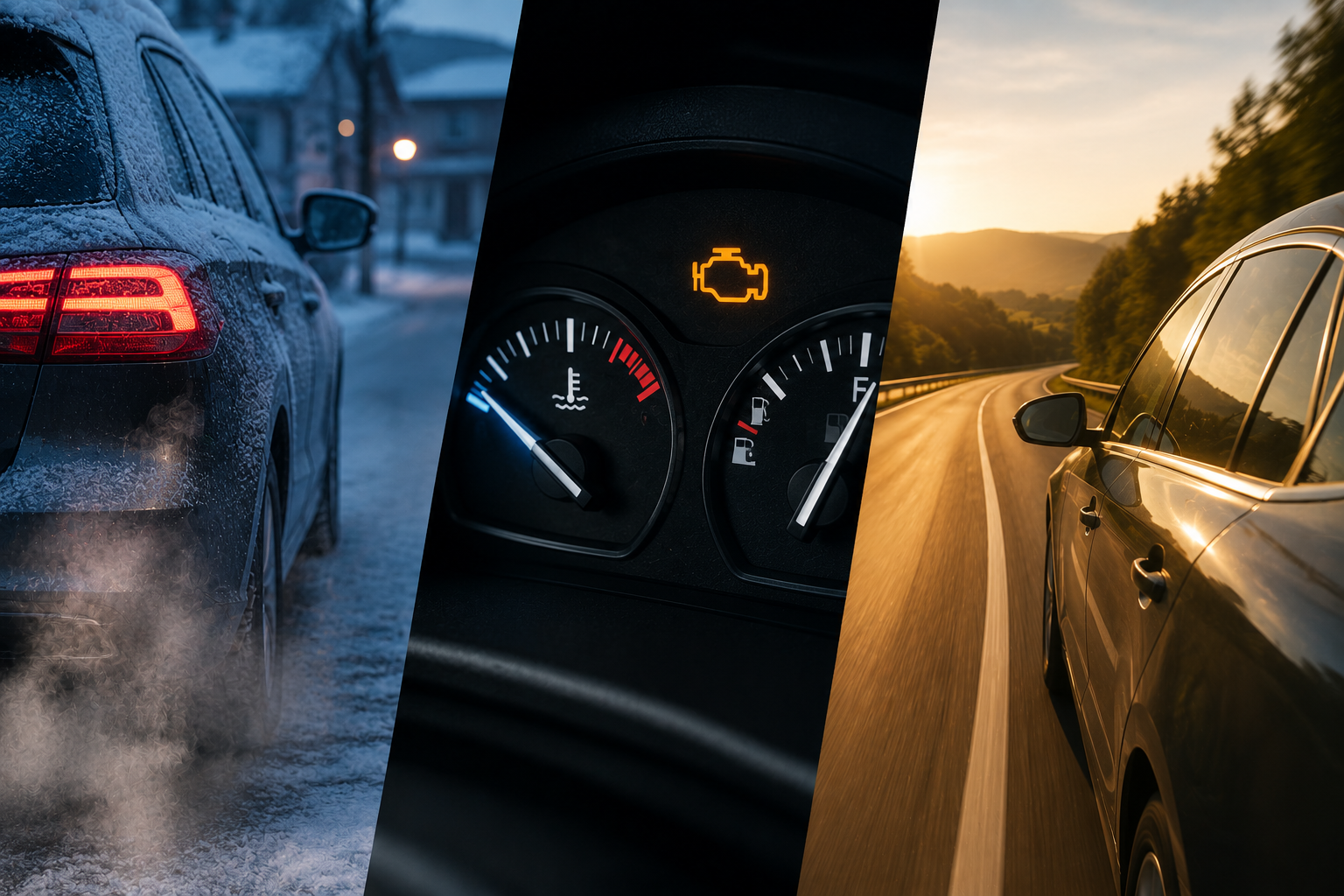
Many drivers notice the same thing: in summer the car’s fuel consumption is acceptable, but as soon as cold weather arrives, the average consumption suddenly rises. The trip seems the same. The route is the same. The driver is the same. But the fuel gauge drops faster, the onboard computer shows higher numbers, and the question appears — has something gone wrong with the car?
Not necessarily. Very often, the cause is not one specific fault, but a cold engine and winter conditions as a whole. When the car is started in the morning after a cold night, it is not immediately ready to work as efficiently as on a warm summer day. The engine, oil, transmission, tyres, battery, cabin heating and even the air around the car all behave differently.
That is why the first kilometres are often the most expensive. The car is still trying to reach operating temperature, while the driver is already driving, heating the cabin, defrosting the windows, using seat heating and often completing a short journey just when the engine would finally begin working more efficiently.

Quick answer for the reader:
A cold engine uses more fuel because it has not yet reached its most efficient operating temperature, the oil is thicker, friction is higher, cabin heating and window defrosting require extra energy, and on short trips the car spends much of its time in this inefficient warm-up phase.
A typical driver thought: “In summer my car used 6.5 l/100 km, but in winter the same route shows 8 or more. It turns out the car is not necessarily broken — the first cold kilometres simply cost much more.”
What happens to the engine when it is cold?
When the engine is cold, it is not yet in its optimal operating state. Fuel combustion, lubrication, thermal expansion of parts, exhaust system operation and the engine control unit strategy differ from the situation where the engine is already warm. The car’s control system knows the engine is cold and adjusts fuel delivery, idle speed and other functions so the engine can run smoothly.
Simply put, a cold engine needs more energy to operate normally. The oil is thicker at first, mechanical resistance is higher, the fuel mixture can be richer in certain modes, and the exhaust system has not yet reached the temperature where it works most efficiently.
That is why fuel consumption in the first minutes after starting can look unpleasantly high. On a short trip, the onboard computer may show numbers that seem alarming, such as 12, 15 or even more litres per 100 km. This does not mean the car will use that much all day. It means that over a very short distance, the cold-running phase dominates everything else.
Why are the first kilometres the most expensive?
The first kilometres after a cold start are especially expensive because the car is still warming up. The engine has not reached operating temperature, transmission fluids are cold, tyres are stiffer, the battery works less efficiently, and the cabin is often being heated intensively. If the trip is long, this cold phase later becomes a small part of the overall average consumption. If the trip is short, it becomes almost the whole trip.
For example, if you drive only 4 kilometres to work in the morning, the engine may spend a large part of the journey warming up. That is exactly when consumption is highest. If the car then sits all day and is started cold again in the evening, the cycle repeats.
This is why short winter trips are so unpleasant in terms of fuel costs. Instead of warming up once and then working efficiently for a long time, the car restarts the whole process several times a day. This is what makes winter city driving more expensive than many drivers expect.
Mini explanation:
On a long journey, the cold start is only a small part of the total route. On a short journey, the cold start can be almost the entire route. That is why 5 km in winter can be proportionally much more expensive than 50 km on the highway.
Cold oil: why does friction increase consumption?
The job of engine oil is to lubricate and protect engine parts. But in cold weather, oil is thicker and does not flow as easily at first as it does in a warm engine. This does not mean that good oil “does not work”, but in the first minutes the engine has to work harder to overcome internal resistance.
The higher the resistance, the more energy is needed for the engine to turn and the car to move. That energy comes from fuel. So fuel consumption increases in cold weather not only because the driver heats the cabin, but also because the engine and drivetrain themselves are harder to operate at first.
The correct oil is very important here. If the car manufacturer specifies a certain oil standard and viscosity, it should not be ignored. Especially in winter, the wrong oil can make cold starts harder and increase engine load.

Cabin heating, window defrosting and seat heating
In winter, a car uses more energy not only because of the engine. The driver wants a warm cabin, a clear windscreen, defrosted mirrors, warm seats and often a heated rear window. All of this requires energy. Some energy comes from engine heat, and some comes from the electrical system, whose load is ultimately supported by the engine.
This does not mean you should drive in a freezing cabin with fogged-up windows. Safety comes first. But it is worth understanding that “winter comfort” is not completely free. If on a short trip you switch everything to maximum — fan, window heating, seat heating, steering wheel heating and mirror heating — consumption will be higher.
The smartest solution is not to avoid heating, but to use it sensibly. First, clear the windows, ensure visibility and comfort, then reduce intensity once the cabin is warm enough. In short trips, every extra load is more noticeable.
Should you warm up the car for a long time at idle?
This is one of the most common winter questions. Many people still believe that a car should idle for 10 or 15 minutes in winter so the engine has an “easier” start. With older carburetted cars, this thinking made more sense. Modern cars with electronic fuel injection usually do not need such long idling.
In addition, at idle the car uses fuel but does not go anywhere. From a fuel economy point of view, that is the worst possible mode — fuel is being used, but distance covered is zero. Of course, there are situations where a short warm-up is necessary: clearing windows, ensuring visibility, allowing oil to circulate and preparing the car for safe driving.
Usually a much better approach is to start the car, prepare for the trip, clear the windows, fasten the seat belt, adjust the mirrors and then begin driving gently. The engine reaches operating temperature faster under light load than by standing still for a long time at idle. The key is not to drive aggressively or rev the engine hard in the first minutes.
Important:
Long idling is not the same as warming the engine gently. Gentle warm-up means calm driving in the first minutes, not standing for 15 minutes with the engine running.
Short trips: why are they so expensive in winter?
Short trips are one of the biggest reasons for higher winter fuel consumption. If the car is started cold every time, driven only a few kilometres and then switched off again, it spends almost its whole life in an inefficient phase. In this situation, even an economical car can show an unpleasantly high average consumption.
This is especially noticeable in the city. The first kilometres, traffic jams, traffic lights, braking, repeated acceleration, window heating and cabin warming all happen in one short drive. If that drive lasts only 5–10 minutes, the car has no time to “recover” the cold-start consumption with more efficient operation later.
That is why a person who only drives short city distances in winter may be surprised that their car uses much more than a friend’s car, even if the friend drives a similar vehicle but covers 40 km on the highway every day. The cars may be similar and the engines may be similar, but the driving profile is completely different.
| Winter trip | What happens to the engine? | Consumption risk |
|---|---|---|
| 2–3 km to the shop | The engine barely warms up. | Very high relative consumption. |
| 5–8 km to work in the city | A large part of the trip happens in cold mode. | High, especially with traffic jams. |
| 15–20 km mixed route | The engine usually gets close to operating temperature. | Medium. |
| 40+ km steady drive | The cold start is a small part of the full route. | Lower if driving is calm. |
Tyre pressure in cold weather also matters a lot
In cold weather, tyre pressure usually drops. If the tyres become softer, rolling resistance increases. This means the engine needs more energy to keep the car moving. The result is higher fuel consumption and poorer handling.
Many drivers check their tyres visually in winter. But a tyre can look normal even when the pressure is not ideal. That is why it is worth checking tyre pressure more often in winter, especially after sharp temperature changes.
It is important to measure pressure when the tyres are cold, not immediately after a longer drive. The manufacturer’s recommended pressure is usually shown on a sticker in the door frame, near the fuel filler area or in the owner’s manual.
Denser air and snow: physics you cannot cheat
In winter, the air is denser than in warm weather. This means more aerodynamic resistance, especially at higher speeds. On the highway, this can be one reason why consumption is higher even when the engine is already warm and the drive is steady.
Snow, slush and ice also increase rolling resistance. The car no longer rolls as easily as it does on dry asphalt. If the road is covered with snow, if all-wheel drive is working more often or if the tyres constantly fight for grip, fuel disappears faster.
The driver cannot fully defeat physics here. It is only possible to reduce the impact: choose a sensible speed, maintain correct tyre pressure, remove unnecessary weight and avoid aggressive driving in conditions where the car already uses more energy.
Petrol, diesel, hybrid and electric cars: cold affects them all
Cold weather affects all types of cars, but in different ways. A petrol car uses more fuel in cold weather because the engine needs to warm up and on short trips it spends a long time in an inefficient state. In a diesel car, DPF regeneration and exhaust system temperature may also matter.
In a hybrid, some advantages can be reduced in winter because the engine may need to start more often for cabin heating, the battery behaves differently in the cold and regenerative braking may not be as effective as in ideal conditions. Still, in city driving a hybrid can remain very good if driving is calm and the system works properly.
An electric car does not lose fuel in winter, but it can lose part of its range because the battery behaves differently in cold temperatures and cabin heating requires a lot of energy. So the principle is similar: in cold weather, more energy is needed, whether it comes from petrol, diesel or a battery.
| Car type | What becomes worse in cold weather? | What should you do? |
|---|---|---|
| Petrol | Cold engine, richer operation, short trips. | Drive gently in the first minutes and combine short trips. |
| Diesel | Cold engine, DPF conditions, longer warm-up. | Give the car regular longer drives and do not ignore warnings. |
| Hybrid | Heating, battery efficiency, less regeneration. | Drive smoothly and use heating sensibly. |
| Electric car | Reduced range, cabin heating consumption. | Preheat the cabin while plugged in, if possible. |
Mini test: are your winter trips “expensive”?
To understand whether your car is affected by short winter trips, answer these questions honestly.
Tick what applies to you:
- My daily trips are often shorter than 10 minutes.
- The car is started cold several times per day.
- In winter, I often sit in the car with the engine running while clearing snow or waiting.
- I rarely check tyre pressure in cold weather.
- I almost always switch on maximum heating, window heating and seat heating.
- My car rarely drives long enough for the engine to fully warm up.
If 4 or more points apply to you, higher winter consumption is probably not a surprise. Your driving profile is very suitable for the first cold kilometres becoming the biggest part of your fuel cost.
What can you do to reduce consumption in cold weather?
You cannot cancel cold weather, but you can change habits. Some things have a small effect, others are more noticeable. The main idea is that winter fuel economy is not one magic action. It is the sum of several small habits.
- Do not idle the car for too long. A short preparation is normal, but long idling uses fuel without covering distance.
- Drive gently in the first minutes. Do not rev the engine hard or accelerate aggressively while everything is still cold.
- Combine short trips. If possible, combine the shop, post office and other errands into one route instead of several cold starts.
- Check tyre pressure. This is especially important in cold weather.
- Remove excess snow and ice. Driving with a layer of snow on the roof is neither economical nor safe.
- Do not use heating longer than necessary. Visibility and safety are important, but after that the intensity can be reduced.
- Remove unnecessary weight from the boot. In winter, every extra load makes the situation worse.
Is an engine pre-heater worth using?
For some drivers, an engine or cabin pre-heater can be very useful. Especially if the car is often used on cold mornings, parked outside and regularly driven on short routes. Pre-heating can improve comfort, help clear windows faster and reduce the unpleasant effect of a cold start.
But there is no universal answer. If the pre-heater itself uses fuel or electricity, the total balance should be considered. If it provides safety, comfort and less strain on the engine, it can be a very good solution. If the car is used rarely or mainly for long journeys, the benefit may be more about comfort than direct fuel economy.
In an electric car, pre-heating the cabin while the car is still plugged into the charger can be very useful. Then part of the energy comes from the grid instead of the battery during the trip, and range loss may be smaller.
Short answer: does a pre-heater pay off?
It pays off most for drivers who often start in very cold weather, keep the car outside and regularly make short trips. If journeys are long and the car reaches operating temperature quickly, the benefit may be more about comfort than direct fuel savings.
Why can the onboard computer look scary on short trips?
The onboard computer shows very unstable numbers on short trips. If the car has just been started, consumption in the first few hundred metres can be very high. If the trip ends after only a couple of kilometres, the average reading has no time to normalise.
It is similar to calculating average speed after the first minute. If the first minute was spent leaving a parking space, the result will look very low. But on a longer drive, the average becomes much more realistic. It is the same with fuel consumption: a short winter trip can show a shocking number, but that does not mean the car would consume that much on a longer route.
So you should not judge a car’s fuel consumption from one cold 3 km trip. It is better to look at average consumption over several days or a full tank. That gives a much more accurate picture.
7-day winter consumption observation
If you want to understand where fuel disappears in winter, do a simple 7-day observation. This can help separate normal cold-weather effects from possible technical problems.
7-day check:
- Write down the approximate length and duration of each trip.
- Note how many times the car was started cold.
- Write down whether the car was idled for a long time.
- Check tyre pressure when the tyres are cold.
- Observe when the engine reaches operating temperature.
- Compare short trips with one longer trip.
- Look at the overall trend, not just one number.
If you see that consumption is very high only on short cold trips, that may be normal. If consumption is unusually high even on long journeys when the engine is warm, then it is worth looking for other causes: thermostat, brakes, air filter, sensors, tyres or fuel system.
When can higher winter consumption indicate a problem?
Higher winter consumption is not always only caused by the weather. There are situations where increased consumption may also point to a technical problem. For example, if the engine takes a very long time to reach operating temperature, the thermostat may be faulty. If the car does not roll freely, a brake may be slightly sticking. If the tyres are too soft, consumption will increase regardless of engine temperature.
You should also pay attention if consumption suddenly rises sharply and does not drop even on longer trips. The same applies if dashboard faults appear, the engine runs unevenly, the car loses power, there is an unusual smell or visible smoke.
When is it worth checking the car at a workshop?
- The engine takes a very long time to warm up or the temperature gauge drops while driving.
- Consumption is high even on a long warm drive.
- The car rolls poorly or one wheel/disc is unusually hot after a drive.
- Engine faults or unstable running appear.
- The increase in consumption is sudden, not gradual with the arrival of cold weather.
Common myths about cold engines and fuel consumption
Myth No. 1: “In winter, the car must idle for 15 minutes.”
Modern cars usually warm up better through gentle driving than by standing still for a long time. A short preparation is normal, but long idling uses fuel without covering distance.
Myth No. 2: “If consumption rises in winter, the car is definitely broken.”
Not always. A cold engine, heating, tyre pressure and short trips can normally increase consumption. But a very large or sudden increase should be checked.
Myth No. 3: “Seat heating has no effect.”
It is not the biggest reason for higher consumption, but every electrical load has an energy cost. On short winter trips, this is more noticeable.
Myth No. 4: “A short trip cannot affect average consumption much.”
Short cold trips are often the most expensive relative to distance. A few kilometres in cold mode can significantly raise the average.
Myth No. 5: “There is nothing you can do in winter — you just have to pay more.”
Part of the increase is unavoidable, but good habits can reduce unnecessary losses.
A practical winter fuel-saving strategy
If you want to use less fuel in winter without harming the engine or driving uncomfortably, use a simple strategy.
Winter economy formula:
- Start the car and prepare for driving without unnecessary delay.
- Clear the windows and ensure visibility.
- Start driving gently, without harsh acceleration.
- Avoid high revs in the first minutes.
- Combine short trips into one route when possible.
- Check tyre pressure regularly.
- Judge consumption over a longer period, not after one cold start.
Conclusion: a cold engine is not a defect, but it does cost money
A cold engine uses more fuel because the car has not yet reached its most efficient operating state. The oil is thicker, friction is higher, the engine is warming up, cabin heating and window defrosting require energy, tyre pressure can drop in cold weather, and short trips do not allow all of this to balance out over a longer route.
That does not mean you can do nothing in winter. You can drive smarter: avoid excessive idling, begin driving gently, combine short trips, keep tyre pressure correct, use heating sensibly and avoid overreacting to one short-trip onboard computer reading.
The most important thing is to understand the difference between normal winter consumption increase and a technical problem. If consumption rises mainly on short cold trips, it is often logical. If it remains high even on long journeys with a warm engine, then the car should be checked.
The first kilometres in winter will almost always be more expensive. But with the right habits, they can be less expensive — and the car will operate more calmly, safely and pleasantly.
Short driver conclusion: “In winter, fuel is not lost because of one big reason, but because of many small ones — a cold engine, short trips, heating, tyres and idling. The better you understand them, the easier it becomes to reduce unnecessary costs.”