
 LV
 EN
 RU
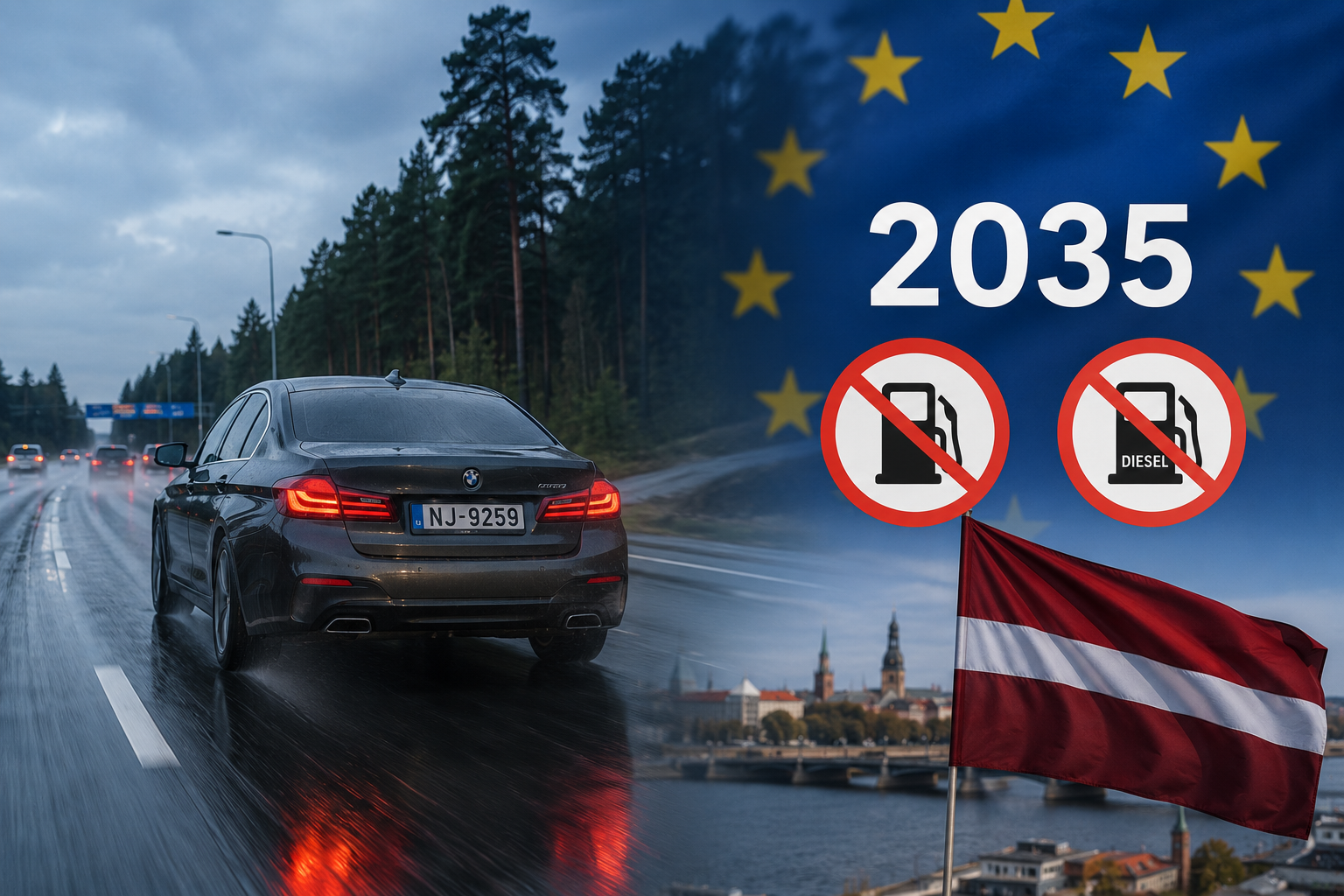
Information checked on 28 July 2026. The European Commission’s proposed 90% target has not yet been finally adopted. Until the European Parliament and the Council of the European Union reach an agreement and the amended regulation is published, the existing 100% reduction target from 2035 remains legally in force.
Until recently, the story appeared relatively simple. From 2035, new passenger cars and vans sold in the European Union would need to produce no carbon dioxide emissions from their exhaust pipes. The era of new petrol and diesel vehicles would therefore end, while the market would move towards battery-electric and hydrogen-powered vehicles.
The European Commission then presented a new proposal. It suggested replacing the 100% reduction target from 2035 with a 90% target, with the remaining share compensated through low-carbon steel produced in the European Union, e-fuels and certain biofuels.
In news headlines, this quickly turned into much louder claims: “the combustion-engine ban has been cancelled”, “diesel has been saved”, “the electric transition has failed” or, at the other extreme, “nothing has changed at all”.
The truth once again lies somewhere in the middle. The proposal would represent a significant policy change because, for the first time, it could officially leave room after 2035 for certain vehicles that still produce exhaust emissions. However, it would not amount to a complete return to a petrol- and diesel-dominated market.
Nothing has yet been finally decided. The Commission has submitted a proposal, but the final legislation must be agreed jointly by the European Parliament and the Council of the European Union. The text may still be amended, restricted, expanded or rejected.


The short conclusion at the beginning: 2035 is not the date on which driving a petrol or diesel car will be prohibited in Latvia. The debate concerns which new vehicles manufacturers will be able to offer on the EU market after that date and how their average emissions will be calculated.
What is currently legally in force?
The EU regulation currently in force requires the average CO₂ emissions of new passenger cars and light commercial vehicles to be reduced by 100% from 2035 compared with the defined 2021 reference level.
In practical terms, this means a target of 0 g CO₂/km for manufacturers’ new vehicle fleets. It is therefore commonly described as the end of new petrol and diesel car sales.
The legal mechanism is not written as a simple sentence stating that internal-combustion engines are banned. Instead, the regulation establishes fleet-average emissions targets for manufacturers and financial penalties when those targets are exceeded.
| Period | Current regulation | What does it mean? |
|---|---|---|
| 2025–2029 | 15% emissions reduction compared with the 2021 level | Manufacturers must increase the share of low- and zero-emission models |
| 2030–2034 | 55% reduction for new passenger cars | The market requires a very large share of electric and other zero-emission vehicles |
| From 2035 | 100% reduction, equivalent to 0 g CO₂/km | New models must effectively produce no exhaust-pipe CO₂ emissions |
What does the new European Commission proposal contain?
The European Commission’s December 2025 proposal would replace the 100% target from 2035 with a 90% reduction target for exhaust-pipe emissions.
Manufacturers would compensate for the remaining ten percentage points through special credits:
• up to seven percentage points through the use of low-carbon steel manufactured in the European Union;
• up to three percentage points through qualifying e-fuels and biofuels;
• the overall system would still preserve a very strong market signal in favour of electric and other zero-emission vehicles.
The Commission has indicated that this approach could leave a role after 2035 for plug-in hybrids, range-extender vehicles, mild hybrids and even certain conventional internal-combustion models.
However, the phrase “could leave a role” does not mean that manufacturers would be free to continue selling their current range of petrol and diesel vehicles without restrictions.
The most important point: the 90% figure is currently a European Commission proposal, not finally adopted legislation. Until the legislative process is complete, the 100% target remains legally in force.
A 90% target does not mean that 10% of new cars will be diesels
This is one of the most important misunderstandings in the entire debate.
A 90% emissions reduction is an average target for a manufacturer’s fleet of newly registered vehicles. It is not a simple numerical division in which 90 out of 100 vehicles are electric and the remaining ten may be any type of petrol or diesel vehicle.
The result would depend on each vehicle’s certified emissions, the number of each model sold and the way the credit system is designed.
| Highly simplified example | Zero-emission vehicles | Other vehicles | Average result |
|---|---|---|---|
| A | 90 cars at 0 g/km | 10 cars at 100 g/km | 10 g/km |
| B | 80 cars at 0 g/km | 20 cars at 50 g/km | 10 g/km |
| C | 50 cars at 0 g/km | 50 cars at 20 g/km | 10 g/km |
The table only illustrates the mathematical principle. The actual regulation involves much more complicated reference levels, manufacturer-specific targets, certification procedures and credits.
The correct wording is not “10% of new cars may be petrol-powered”. A more accurate statement is that the average emissions of a manufacturer’s new vehicle fleet would need to be approximately 90% below the reference level, with additional credits available under the regulation.
Could a new petrol car still be available after 2035?
If the Commission proposal were adopted in its current form, theoretically the answer would be yes. A manufacturer’s model range could retain certain vehicles that still produce exhaust emissions.
However, their number and type would be heavily restricted by the overall 90% target.
A much more plausible market composition would include:
• a large share of battery-electric vehicles;
• a certain share of hydrogen-powered vehicles if that technology develops;
• plug-in hybrids with very low certified emissions;
• electric range-extender vehicles using a small combustion engine as a generator;
• certain highly efficient full hybrids or mild hybrids;
• a small volume of specialised internal-combustion models whose emissions a manufacturer can compensate for within its wider fleet.
A large petrol SUV with high emissions would impose a much greater burden on a manufacturer’s emissions calculation than a small, efficient hybrid. Even if combustion vehicles retain a legal place in the market, the fleet-average mathematics would strongly influence which models remain commercially viable.
Could a new diesel remain available after 2035?
In theory, the proposal does not identify diesel as a separately prohibited technology. If a vehicle complies with all other technical and pollution requirements, its emissions could potentially be included in the manufacturer’s overall fleet calculation.
In practice, the future of diesel would depend on much more than the 2035 CO₂ regulation.
Manufacturers would also need to consider:
• Euro 7 and other pollutant-emissions requirements;
• the cost of complex exhaust-treatment systems;
• declining demand in the passenger-car market;
• the development of low-emission zones in different European cities;
• the need to offset every diesel vehicle with a large number of zero-emission vehicles;
• whether manufacturers are willing to continue investing in a shrinking market niche.
A political possibility does not therefore guarantee that every manufacturer will offer several new diesel models in 2036.
What are plug-in hybrids, range extenders and mild hybrids?
| Technology | How does it work? | Why could it remain? | Main risk |
|---|---|---|---|
| Plug-in hybrid | Uses a rechargeable battery, electric motor and internal-combustion engine | Short journeys can be completed electrically, while fuel remains available for longer trips | Without regular charging, it becomes a heavy petrol vehicle |
| Range extender | The wheels are mainly driven by an electric motor, while a small combustion engine generates electricity | Reduces anxiety about driving range and charging availability | The system is more complicated and still produces emissions |
| Full hybrid | A small battery assists the petrol engine and recovers braking energy | Can be highly efficient in urban driving without external charging | Still entirely dependent on liquid fuel |
| Mild hybrid | A small electrical system assists the engine but normally cannot drive the car independently | A relatively inexpensive way to reduce emissions slightly | The real fuel saving may be fairly small |
| Battery-electric vehicle | The wheels are driven exclusively by electric motors | Produces 0 g/km of exhaust-pipe CO₂ and uses energy efficiently | Charging, purchase price and depreciation vary considerably between models |
Will e-fuel save every existing petrol car?
E-fuels are generally produced using electricity, hydrogen and captured carbon dioxide. The result can be a liquid fuel suitable for use in an internal-combustion engine.
In theory, such fuels can reduce the use of fossil carbon and allow part of the existing fuelling infrastructure to remain in service.
However, this does not mean that every Latvian petrol station will offer inexpensive synthetic petrol after 2035.
Two separate issues must be distinguished:
1. the manufacturer’s ability to receive regulatory credit for the use of certain renewable fuels;
2. the driver’s practical ability to purchase those fuels in sufficient quantities at an affordable price.
Producing e-fuel requires a large amount of electricity, while its future price, production volume and availability for the mass market remain uncertain.
It would therefore be unwise to buy a highly inefficient vehicle today on the assumption that it will definitely run on cheap synthetic fuel in ten years.
What will happen to petrol and diesel cars already on the road?
Neither the existing 100% regulation nor the Commission’s new proposal requires existing cars to be scrapped in 2035.
A petrol or diesel vehicle may continue to be used if it:
• remains in roadworthy condition;
• passes its required technical inspection;
• is properly insured;
• complies with the relevant national tax and traffic requirements;
• is not used in an area where local restrictions apply to its specific emissions class.
The year 2035 is not an expiry date printed in the vehicle registration certificate.
If someone buys a new petrol car in 2034, the current EU fleet-emissions rules would not prohibit that car from being used in 2035, 2040 or later.
Will used petrol and diesel cars still be bought and sold after 2035?
Yes. The current rules apply to manufacturers’ new vehicle fleets and the new-car market, not to private sales of vehicles that have already been registered.
The used petrol and diesel car market will not disappear overnight.
However, a vehicle’s value could be influenced by:
• fuel prices;
• ownership and registration taxes;
• urban emissions restrictions;
• the availability of parts and servicing;
• the reliability of the particular model;
• the price of electric and hybrid alternatives;
• buyers’ willingness to accept future running-cost risks.
Why will Latvia’s transition be much slower than the change in new-car showrooms?
Latvia has a comparatively old vehicle fleet. At the end of 2025, 802,784 passenger cars were registered in the country.
| Vehicle age | Number at the end of 2025 | Share of the vehicle fleet |
|---|---|---|
| Under 2 years | 37,751 | Approximately 4.7% |
| 2–5 years | 51,975 | Approximately 6.5% |
| 5–10 years | 108,199 | Approximately 13.5% |
| 10–20 years | 376,970 | Approximately 47.0% |
| More than 20 years | 227,889 | Approximately 28.4% |
In total, approximately 75.3% of Latvia’s passenger cars are more than ten years old.
This means that even rapid growth in new electric-car sales would only change the overall fleet gradually. Older vehicles will not disappear at the same rate as manufacturers change their new-model line-ups.
At the beginning of 2026, Latvia had 13,916 registered electric passenger cars, representing 1.73% of the passenger-car fleet.
The Latvian reality: even if almost every new car sold in 2035 is electric, hundreds of thousands of petrol and diesel vehicles will remain on Latvian roads for many years afterwards.
Will petrol and diesel car values collapse?
An automatic collapse in value is not guaranteed. A used car’s price is determined not only by its powertrain but also by demand, technical condition, reliability and the cost of alternatives.
In Latvia, a simple and economical petrol car may retain demand for longer than a complicated premium plug-in hybrid with an expensive potential battery repair.
At the same time, some combustion vehicles may face a greater risk of depreciation.
| Vehicle type | Possible future position | Main risk |
|---|---|---|
| Small, economical petrol car | May retain demand because of its affordability | Fuel prices and taxation |
| Full hybrid | Could become a popular transition technology | Battery age and model-specific reliability |
| Economical diesel for long-distance use | May retain niche demand among high-mileage drivers | Low-emission zones, DPF, AdBlue and repair costs |
| Large petrol SUV | Could lose value more quickly if running costs increase | High consumption, taxation and a smaller buyer pool |
| Plug-in hybrid | Useful for buyers who can charge regularly | Complexity of two powertrains and battery condition |
| Electric vehicle | Low energy and maintenance costs may support demand | Technology development, battery condition and falling new-car prices |
These are possible market scenarios, not guaranteed price forecasts.
What could the 2035 changes mean for new-car prices?
On the one hand, greater technological flexibility could allow manufacturers to continue offering vehicles suitable for regions where charging infrastructure develops more slowly.
On the other hand, an extremely low fleet-average emissions target could make every high-emission vehicle expensive within a manufacturer’s overall CO₂ calculation.
Several possible outcomes could follow:
• large petrol models become more expensive or available only in limited numbers;
• manufacturers add hybrid systems to combustion-engine vehicles;
• popular model ranges increasingly shift towards electric versions;
• simple and inexpensive petrol cars become rarer if manufacturing them is no longer profitable;
• specialised combustion models remain as more expensive niche products.
Energy-cost example: the powertrain still matters more than a political headline
Even if combustion vehicles do not disappear completely after 2035, buyers must still calculate everyday running costs.
Assume a hypothetical annual distance of 15,000 km, a fuel price of €1.70 per litre and electric-car consumption of 18 kWh/100 km.
| Powertrain | Consumption assumption | Energy price | Annual cost | Cost over 5 years |
|---|---|---|---|---|
| Petrol car | 6.5 l/100 km | €1.70/l | €1,657.50 | €8,287.50 |
| Full hybrid | 5.0 l/100 km | €1.70/l | €1,275.00 | €6,375.00 |
| Electric car, home charging | 18 kWh/100 km | €0.20/kWh | €540.00 | €2,700.00 |
| Electric car, public charging only | 18 kWh/100 km | €0.45/kWh | €1,215.00 | €6,075.00 |
The calculation does not include the purchase price, financing costs, depreciation, insurance, servicing or repairs. It shows energy costs only.
It also demonstrates that an electric vehicle’s advantage depends strongly on where it is charged. A driver with inexpensive home charging may achieve a very different result from someone who relies exclusively on costly rapid chargers.
Is it still safe to buy a petrol car?
A petrol car can still be a rational choice when annual mileage is low, home charging is unavailable and the vehicle is expected to remain in use for many years.
A simple and economical petrol car without excessively complicated technology may be particularly sensible.
A petrol car may be suitable when:
• annual mileage is approximately 5,000–12,000 km;
• journeys are varied but not predominantly very long;
• reliable charging is unavailable;
• the purchase budget is limited;
• the selected model is reliable and has moderate fuel consumption.
However, a large and inefficient petrol vehicle should not be chosen merely because someone has claimed that the “ban has been cancelled”.
Is it still safe to buy a diesel?
Diesel can still be economical for drivers who regularly complete long journeys and cover a high annual distance.
A diesel may be suitable when:
• annual mileage exceeds approximately 20,000–25,000 km;
• most journeys take place on main roads or motorways;
• the vehicle regularly reaches full operating temperature;
• towing or carrying heavy loads is required;
• the buyer is prepared for possible DPF, EGR, AdBlue and turbocharger expenses.
Diesel is generally not the best choice for short urban journeys merely because its official fuel-consumption figure appears lower.
Does a hybrid now become the safest compromise?
A full hybrid may indeed be one of the safest transition-period solutions. It does not depend on external charging, can be economical in the city and still allows long journeys without charging plans.
However, the specific model, battery warranty, system reliability and real motorway consumption must still be examined.
A plug-in hybrid only makes sense when it is charged regularly.
Illustrative driver comment: “I chose a plug-in hybrid because of its low official consumption, but my first flat had no charging facility. I ended up carrying a heavy battery every day and using more fuel in the city than I had with my previous full hybrid.”
Is an electric car still a safe long-term purchase?
The Commission proposal does not abandon electrification. Even under a 90% target, most new vehicles sold after 2035 would still need to be zero-emission.
The long-term position of electric vehicles is determined not only by regulation but also by:
• the development of battery prices;
• charging infrastructure;
• electricity prices;
• real winter range;
• the availability of battery-health checks in the used-car market;
• the arrival of newer and less expensive models.
For a driver with home charging and a predictable daily route, an electric vehicle may remain highly economical regardless of whether the final 2035 target is 90% or 100%.
Three possible scenarios for 2035
| Scenario | What happens in the regulation? | Possible market effect |
|---|---|---|
| A — the existing target remains | The 100% reduction target remains in force from 2035 | The new-car market moves towards electric and other 0 g/km vehicles |
| B — the Commission proposal is adopted | The target is reduced to 90%, with fuel and steel credits | A limited selection of hybrids and combustion vehicles remains available |
| C — a compromise version | Parliament and the Council change the percentage, credit system or technology conditions | Combustion models receive an even narrower or differently regulated market niche |
As of summer 2026, there is no basis for claiming that any one of these scenarios has been finally confirmed.
How should dramatic news headlines be interpreted?
| Dramatic claim | More accurate explanation |
|---|---|
| “The EU has cancelled the combustion-engine ban” | The Commission has proposed changing the target, but the proposal has not yet been finally adopted |
| “From 2035, 10% of new cars will be diesels” | The 90% figure refers to an average emissions reduction, not a simple division of vehicle numbers |
| “The electric-car transition is over” | Even the new proposal would leave zero-emission vehicles as the dominant part of the market |
| “Old diesels must be scrapped in 2035” | The EU’s new-car CO₂ regulation does not require existing cars to be scrapped |
| “E-fuel will allow everyone to continue exactly as today” | Its future price, production volume and widespread availability are not guaranteed |
What should drivers avoid doing in panic?
• do not sell a technically sound vehicle merely because 2035 is approaching;
• do not buy a large diesel merely because the word “flexibility” appeared in the news;
• do not buy a plug-in hybrid without a realistic way to charge it;
• do not assume that e-fuel will definitely be inexpensive;
• do not assume that electric vehicles have lost their future because of one policy proposal;
• do not make a ten-year purchasing decision based on one sensational headline.
Practical selection table for a Latvian buyer
| Your situation | What should you consider? | What should be checked before purchase? |
|---|---|---|
| Low annual mileage and no charging | An economical petrol car or full hybrid | Short-trip consumption, taxation and reliability |
| Frequent urban driving with home charging | An electric car or plug-in hybrid | Winter range, charging speed and battery warranty |
| 20,000–40,000 km per year on main roads | An efficient diesel, hybrid or aerodynamic electric vehicle | Real consumption, rapid-charging prices and repair risk |
| The car will be kept for only 3–4 years | Resale value and market demand are especially important | Warranty, finance balance and model reputation |
| The car will be kept for 10–15 years | Choose a simple and reliable technology suited to your route | Corrosion, parts, battery, emissions systems and servicing |
Mini test before buying a car between 2026 and 2030
Answer these questions:
1. How many kilometres do I genuinely drive each year?
2. What percentage of my driving is urban and what percentage is on main roads?
3. Do I have permanent charging at home or work?
4. How many years do I intend to keep the vehicle?
5. Can I afford not only the purchase but also tyres, repairs and insurance?
6. Will the selected diesel regularly complete sufficiently long journeys?
7. Will I genuinely charge a plug-in hybrid almost every day?
8. Does the electric car’s winter range cover my daily needs with a reserve?
9. What are the specific model’s tax and CO₂ figures?
10. Am I choosing according to my actual needs or merely reacting to a political headline?
Will it be legal to drive a diesel car in Latvia after 2035?
Yes. The EU regulation governing CO₂ emissions from new cars does not prohibit the continued use of a vehicle that has already been registered. It must continue to comply with technical-inspection, insurance, taxation and other applicable requirements.
Has the 90% target already been adopted?
No. It is a European Commission legislative proposal. As of 28 July 2026, it was still awaiting a decision from the responsible committee in the European Parliament and would also require agreement from the Council of the European Union.
Will 10% of all new cars be allowed to use petrol engines?
Not necessarily. The target applies to the average emissions of a manufacturer’s new vehicle fleet. The possible number of combustion models would depend on their emissions, zero-emission vehicle sales and the credit system.
Will it still be possible to buy a used petrol car after 2035?
Yes. The current rules do not prohibit the purchase or sale of used petrol or diesel vehicles that have already been registered.
Will petrol stations disappear after 2035?
There is no reason to expect them to disappear immediately. A very large number of combustion-engine cars, motorcycles, commercial vehicles and other machines will remain in use. The number of stations and the products they offer may change gradually as demand changes.
Does the new proposal mean that buying an electric car is no longer worthwhile?
No. The value of an electric vehicle depends on its purchase price, charging options, mileage, energy price and the quality of the particular model. The Commission’s new proposal would also preserve a central role for electric vehicles.
Should someone buy a new combustion car before 2035 while it is still possible?
Not for that reason alone. The decision should be based on annual mileage, charging options, budget, intended ownership period and the total costs of the particular vehicle.
Which stages of the political process should be followed?
Four main stages should be monitored to understand whether the 90% proposal will become law:
1. the vote in the responsible European Parliament committee;
2. the European Parliament’s first-reading position;
3. the common position of the EU member states in the Council;
4. the final agreement between Parliament and the Council and its publication in the Official Journal of the European Union.
Until final publication, every percentage, technology category and credit limit may still change.
Conclusion: the combustion car has not been saved, but it will not disappear on the morning of 2035
The European Commission’s new proposal represents a genuine retreat from an absolute 100% exhaust-emissions reduction target. It could leave limited room after 2035 for plug-in hybrids, range-extender vehicles, mild hybrids and certain combustion-engine models.
However, a 90% target would still be extraordinarily strict. Zero-emission vehicles would dominate manufacturers’ sales, while every high-emission model would need to be offset by many electric vehicles or by other credits recognised by the regulation.
The most important point for Latvian drivers is that 2035 does not prohibit the continued use of existing petrol or diesel vehicles. The purchase and sale of used cars will not disappear either.
Latvia has an old vehicle fleet, while electric vehicles still represent a relatively small share. The transition will therefore take place over several decades rather than on one particular date.
That does not mean that the choice of powertrain is irrelevant. Fuel prices, taxes, repairs, charging options and resale values will affect different vehicles in very different ways.
A buyer in 2026 does not need to predict which technology will “win politically”. The correct choice is the vehicle that is financially and practically suited to the buyer’s own route and circumstances.
The driver’s final takeaway: do not buy a car out of fear of 2035, and do not buy one merely because someone has announced that the “ban has been cancelled”. Examine your annual mileage, charging options, total costs and the reliability of the specific model.