
 LV
 EN
 RU
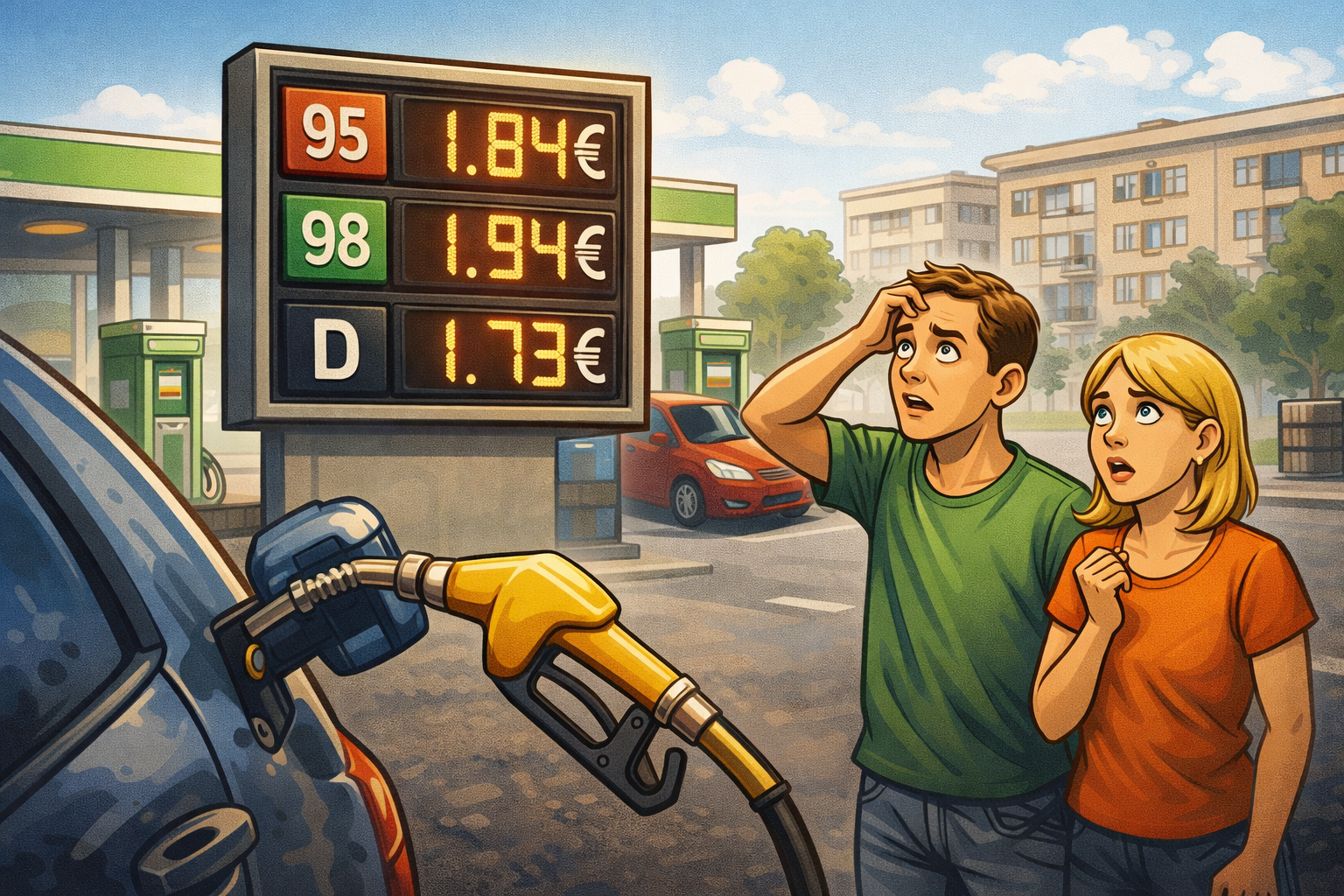
Whenever fuel prices in Latvia rise sharply, drivers usually ask the same questions. Why is fuel getting more expensive so quickly? Why do prices at different filling stations often change almost at the same time? And are fuel retailers really all “moving together” on purpose, or is there a more logical explanation behind it?
These questions are not surprising. Fuel is one of those costs drivers feel immediately. Unlike many other expenses, fuel is bought regularly, and even small price changes become noticeable by the end of the month. That is why people naturally want to understand what is actually happening in the market and what the final pump price is really made of.
In this article, we will explain in simple language how fuel prices are formed in Latvia, why prices at different stations often seem very similar, how global oil prices, taxes, logistics, and previously purchased stock affect what drivers pay, and what motorists can realistically do when fuel becomes more expensive.
Why do fuel prices change at all?
Although many people feel that the fuel price at the station is decided right there on the spot, in reality it is the result of several factors working together. The final price is influenced by global oil prices, wholesale fuel costs, delivery and logistics, currency movements, taxes, and the retailer’s own pricing strategy.
That means prices do not depend on just one thing. Even if oil prices start rising on the global market, the effect at the pump may not appear instantly and may not look identical everywhere. On the other hand, if wholesale costs are rising while taxes remain high, drivers feel the price increase even more strongly.
| Factor | How it affects the price | Is the effect immediate? |
|---|---|---|
| Global oil price | Raises or lowers the base cost | Not always |
| Taxes | Make up a large share of the final price | Yes, they are a constant element |
| Logistics and delivery | Increase the retailer’s cost | Usually with some delay |
| Previously purchased stock | Slows down or delays visible price changes | No |
Why do prices at different stations often change almost at the same time?
This is one of the most common questions, and from the outside it can really look suspicious. A driver sees prices rising by a similar amount at several stations almost at once, and the first conclusion is often that the companies must somehow be coordinating with each other.
In practice, however, simultaneous price changes can often be explained much more simply. If retailers are affected by the same outside pressures — for example similar wholesale prices, logistics costs, taxes, and rising oil prices on international markets — then it is perfectly logical that their final prices move in the same direction. In a free market, companies often react to the same signals at roughly the same time.
That does not automatically mean there is any prohibited agreement. It may simply mean that market participants operate under very similar cost conditions. For drivers, it is important to separate what feels suspicious from how pricing actually works.
Global oil prices affect Latvia too
Latvia does not exist outside the global energy market. If the global oil price rises, sooner or later it affects fuel costs in the Baltics too. The stronger the shock in international markets, the more likely it is to show up in the final price at filling stations.
Situations become especially sensitive when oil supply or market sentiment is affected by geopolitical events. The Middle East, shipping routes, sanctions, military conflicts, refinery capacity, or supply disruptions can all create strong volatility. Even if Latvia is not facing a physical shortage of fuel, tension in the global market itself can be enough to increase costs.
That is exactly why people sometimes feel that prices are rising “for no reason.” In reality, the reason may be far away from Latvia, but the financial effect still reaches local filling stations.
What role do taxes play?
A very important one. Many drivers underestimate how large a share of the final pump price is actually made up of taxes. A significant part of fuel prices comes from excise duty and value added tax. That means even when the base fuel cost itself changes only moderately, drivers often feel the final price movement much more strongly.
This is why public discussion about stabilising fuel prices often turns into a discussion about tax policy. But that is already a political issue, not just a market one. The state has to balance budget needs, public pressure, and market stability.
From the driver’s point of view, one thing matters most: the fuel price is not simply “whatever the retailer decided to add.” A large part of it is structural and tied to the tax burden set by the state.
Why does the price drop at the pump often come later?
This is another question that frustrates drivers a lot. When oil prices fall globally, many people expect fuel prices at stations to fall immediately too. But in practice, that often happens more slowly.
One reason is that fuel is not sold at stations based purely on “today’s world market price.” It is sold from stock that was purchased earlier. If a retailer bought that fuel at a higher cost, they cannot instantly switch to a lower price as if the older stock did not exist.
That means price decreases often show up with a time lag. From the outside, that can feel unfair, but from the retailer’s cost logic, it is understandable.
Can the government influence fuel prices at all?
Yes, but not as simply as many people imagine. The government cannot just permanently “order” a lower fuel price in a free market. What it can do is influence certain mechanisms — for example tax policy, oversight tools, crisis measures, and regulatory changes.
When public and political pressure increases because of rapid fuel price growth, the usual discussions involve measures such as excise relief, stronger market monitoring, excess profit oversight, or other stabilisation tools. But such measures are always a compromise between immediate relief for consumers and the broader fiscal and market impact.
So the most honest answer is this: the government can influence the environment, but it cannot fully cancel out the reality of global markets.
Does Latvia have fuel security reserves and what do they do?
Yes, Latvia maintains strategic oil product reserves. Their main role is to help guarantee continuity of supply during crisis situations. This matters because in a crisis, the biggest risk is not always just price, but also availability.
At the same time, it is important to understand that these reserves are not a tool designed simply to artificially lower prices in the everyday market. They are much more about supply security than about acting as a daily price-control mechanism.
So reserves support stability and security, but they do not automatically mean cheaper fuel at the pump.
What can drivers do when fuel becomes more expensive?
Even though drivers cannot influence global oil prices or government policy directly, they can influence their own everyday costs. The first and simplest step is comparing prices, because even within the same city there can be noticeable differences. The second is making use of loyalty programs and discounts, which become even more valuable when prices are high.
The third is taking a closer look at driving habits. Smoother acceleration, correct tire pressure, less unnecessary weight in the car, and better route planning can reduce fuel consumption more than many people expect. When prices rise, fuel saving stops being just theory and becomes a real budget issue.
Sometimes you cannot change the market, but you can become smarter in how you use it.
When rising prices are a normal market reaction, not a conspiracy
At times like these, it is easy for public discussion to become emotional and conclude that “someone must be profiting unfairly.” In some cases, oversight authorities may indeed have reason to review how market participants behave. But in many situations, rising prices are simply the result of several factors happening at the same time.
If oil prices rise, taxes remain high, logistics costs increase, and retailers react to the same market pressures, the final price will almost inevitably rise too. That may not be a pleasant conclusion, but it is often much more realistic than assuming everything is always based on suspicious coordination.
The smartest view is to stay critical, but also understand how the pricing mechanism actually works.
Conclusion
Fuel prices in Latvia are not the story of one simple number. They are influenced by global oil markets, taxes, logistics, previously purchased stock, and how retailers respond to those pressures. That is why situations where several stations change prices at almost the same time do not automatically mean anything unlawful — often they are simply the result of the same market forces acting on everyone.
For drivers, the most important thing is to understand that not every price movement can be controlled, but personal fuel costs can often be influenced more than people first think. The better someone understands the logic of the market, the less space there is for guesswork and the easier it becomes to make smart decisions.
If you want to understand how much your everyday driving actually costs at different fuel price levels, use the calculator below.