
 LV
 EN
 RU
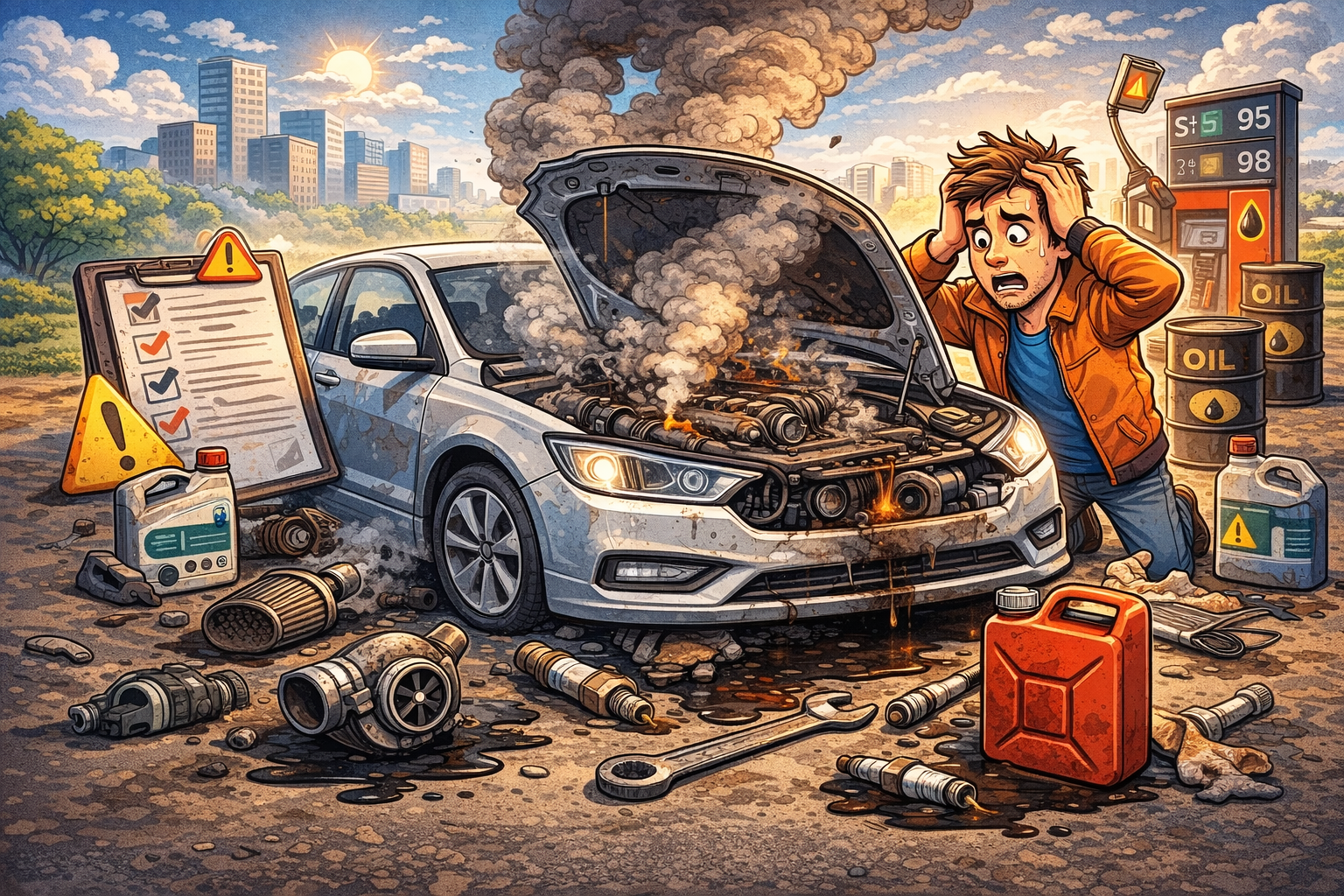
A car engine is one of the most complex mechanisms in a vehicle. Modern internal combustion engines consist of hundreds of moving parts – pistons, the crankshaft, the valvetrain, valves, turbochargers, fuel injection systems and electronic control units.
All of these parts work in a very precisely coordinated way. If even one system starts operating incorrectly, it can affect the entire engine. That is why proper use and regular maintenance are critically important.
Car service specialists often point out that most engine damage is not related to manufacturing defects. Much more often, problems are caused by drivers’ everyday habits – overly aggressive driving, irregular maintenance, or simply a lack of knowledge.
In this article, we will look at 20 things that can gradually damage a car engine. Many of these mistakes seem minor at first, but in the long run they can lead to very expensive repairs. The goal of this article is not to scare you, but to help you understand which mistakes drivers make most often and what to do to avoid them.
Why engine damage usually does not happen suddenly
In most cases, an engine does not fail in a single day. Problems develop gradually. At first, they may show up as slightly increased oil consumption, barely noticeable vibration, somewhat louder engine operation or reduced power during acceleration. This is exactly where many drivers make a mistake – they keep driving because the car “still runs.”
However, an engine is a system where one small issue often leads to the next one. If lubrication is insufficient, friction increases. If friction increases, temperature rises. If temperature rises, components wear out faster. As a result, a small issue turns into an expensive repair.
| Engine damage | Most common cause | Approximate cost |
|---|---|---|
| Piston wear | Insufficient lubrication, low oil level | 2000–5000 € |
| Head gasket failure | Engine overheating | 500–1800 € |
| Turbocharger failure | Improper use, poor oil | 700–2500 € |
| Injector damage | Poor-quality fuel | 300–1500 € |
1. Aggressive driving with a cold engine
When the engine has just been started, oil has not yet fully circulated through the engine’s lubrication channels. This means that during the first seconds or even minutes, engine components do not receive full lubrication. This is especially noticeable in winter, when the oil is thicker and circulates more slowly.
If the driver accelerates hard or raises engine revs at this moment, the pistons, crankshaft and valves are put under heavy load. Metal components begin to rub against each other with greater force, creating microscopic wear. This does not mean the engine will fail immediately, but in the long term this habit shortens engine life.
This wear is not immediately visible, but after many tens of thousands of kilometers it may lead to reduced engine compression, noisier operation or increased oil consumption. That is exactly why “cold start + hard acceleration” is one of the worst everyday combinations for an engine.
A mechanic in Riga admits: “Around a third of turbo and upper engine wear problems happen because drivers are aggressive with a cold engine. You should drive calmly during the first 5 minutes after starting.”
The safest way to protect the engine is to drive gently during the first kilometers and avoid high revs until the engine has reached operating temperature. There is no need to let the car idle for a long time, but flooring it right away is not smart either.
2. Irregular oil changes
Engine oil performs several functions at once. It not only lubricates engine components, but also helps cool the engine, reduces friction, and collects microscopic metal particles created during wear. In many ways, oil is the engine’s “blood.”
Over time, oil loses its properties. It becomes thicker, collects contaminants and loses its ability to protect engine components. If the oil is not changed regularly, deposits begin to form inside the engine. These deposits can block lubrication channels and reduce oil circulation.
As a result, engine parts start wearing out much faster. The turbocharger, valvetrain and crankshaft components are especially affected. Many drivers mistakenly rely on the maximum oil change intervals shown in marketing materials, but heavy city traffic, cold starts and short trips wear oil out much faster.
A Volkswagen Passat owner once shared on a forum: “I ignored my oil change for nearly 25,000 km. The engine started rattling and in the end I had to replace the turbo and bearings. The repair cost more than 2000 euros.”
Most specialists recommend changing oil every 10,000–15,000 km, and even more often in heavy city driving. If you want to save money, oil changes are not the place to do it – they are the cheapest way to protect an expensive engine.
3. Low oil level
A low oil level is one of the most dangerous situations for an engine. If there is too little oil, engine parts do not receive enough lubrication and start to overheat. In many cases, the driver only notices it once noise appears or a warning light comes on.
This can lead to crankshaft bearing damage, piston wear or even complete engine failure. In some cases, the engine can be ruined in just a few minutes if, under load, the oil system can no longer provide protection.
Many drivers only check oil during service visits, but specialists recommend doing it at least once a month. This is especially important for older cars, high-mileage vehicles and engines known for increased oil consumption.
A good habit is to check the oil level before a longer trip or every couple of weeks during normal use. It only takes a few minutes, but it can save you from a repair bill worth thousands.
4. Poor-quality fuel
Fuel quality directly affects engine performance. Fuel with contaminants can damage the injection system, injectors and fuel pump. This is especially important in modern direct-injection engines, where the systems operate under very high pressure and are sensitive to contamination.
If fuel contains water or dirt, it can clog injectors, cause uneven engine operation and reduce power. Diesel engines are often even more sensitive in this regard, because their high-pressure pumps and injectors are extremely precise components.
In addition, poor-quality fuel can create carbon deposits on valves and pistons, affecting combustion and increasing the risk of long-term damage. This does not mean every small fuel station is bad, but it does mean that filling up from questionable sources always carries risk.
A BMW owner once told a repair shop: “After filling up at a small fuel station, two injectors failed. The repair cost nearly 1000 euros.”
If the car starts jerking after refueling, becomes harder to start or develops unusual noise, it is worth remembering where and when you filled up. Sometimes that really is where the problem began.
5. Engine overheating
Engine overheating is one of the most dangerous causes of engine damage. If the cooling system does not work properly, the engine can reach a very high temperature. Overheating is not just “an annoying warning light on the dashboard” – it can cause costly damage in a very short time.
It can warp the cylinder head, damage the head gasket and even create cracks in the engine block. These types of failures often mean a very expensive repair or even the need to replace the entire engine.
Engine overheating is most commonly caused by a coolant leak, a faulty thermostat or a radiator fan that does not work. Sometimes the problem starts as a very small leak that the driver ignores, until one day the engine overheats in traffic or on the highway.
If the temperature gauge rises higher than usual, do not assume it will “go away on its own.” This is one of those situations where continuing to drive is far more dangerous than stopping.
6. A clogged air filter
The air filter is one of the simplest yet most important engine components. Its main job is to ensure that only clean air enters the engine, without dust, sand or other debris. Without enough clean air, fuel combustion cannot happen efficiently.
If the air filter becomes dirty or clogged, the engine receives less oxygen. As a result, combustion becomes less efficient, the engine loses power and fuel consumption increases. Sometimes the driver feels this as a “heavier” car or slower response from the accelerator.
Driving for a long time with a clogged air filter can put the engine under extra load. It can also contribute to carbon buildup on valves and pistons, especially if the car is mostly used in city traffic with constant stop-and-go driving.
A car service specialist explains: “Many drivers underestimate the role of the air filter. But even such a simple part can affect engine performance, fuel economy and combustion quality.”
In most cases, the air filter should be changed every 15,000–20,000 km, but in dusty environments or poor road conditions it may need to be replaced even sooner. It is a relatively cheap part that can have a very positive impact on engine performance.
7. Incorrect engine oil viscosity
Engine oil comes in different viscosity grades such as 5W-30, 5W-40 or 10W-40. Manufacturers specify a particular oil type for each engine to ensure proper protection and lubrication under different temperatures and loads.
If the oil used is too thick or too thin, it may not circulate through the engine correctly. In cold weather, oil that is too thick moves more slowly to critical engine parts, while in hot operating conditions oil that is too thin may fail to maintain a sufficient protective film between moving components.
As a result, engine parts may wear out faster than intended, especially during cold starts or under high load. Sometimes drivers think that “oil is just oil,” but in reality the wrong choice can directly affect engine health.
It is always best to use oil that matches the manufacturer’s specifications instead of simply choosing the cheapest option or using whatever happens to be available in the garage.
8. Prolonged driving at high engine revs
Driving at high engine revs puts additional stress on the engine. This is especially true during aggressive driving, when the engine is kept near maximum power output for long periods. A single hard acceleration will not usually ruin anything, but constant use in that way reduces engine lifespan.
High revs mean higher temperature, more friction and greater stress on pistons, valves and the turbocharger. The lubrication and cooling systems have to work harder, and every component is exposed to increased strain.
Occasional spirited driving is not necessarily a problem, but if it becomes a constant habit, the engine’s service life can be reduced significantly. This is especially true for small turbocharged engines that already operate at relatively high specific loads.
A motorsport mechanic once said: “An engine can handle high revs, but not all the time. Constant stress simply accelerates component fatigue.”
If the car is used mainly for normal daily driving, there is no reason to keep it near redline regularly. It offers little real benefit and increases the risk of wear.
9. Ignoring the Check Engine light
The Check Engine light warns the driver that there may be a problem in the engine system. Many drivers ignore this warning because the car still drives. That is a very common mistake, because the light rarely comes on without a reason.
It often points to problems with the fuel system, catalytic converter, oxygen sensors, ignition system or air supply. At first, the problem may be relatively simple and inexpensive to fix, but if ignored it often starts affecting other components too.
For example, poor combustion can overheat the catalytic converter, which is already a much more expensive repair. That is why the mindset of “if it still drives, nothing needs to be done” often ends up costing a lot.
A diagnostic check at a repair shop usually costs far less than an engine repair, so this warning should never be ignored. Even if the cause turns out to be minor, peace of mind is worth more than guessing.
10. Worn spark plugs
Spark plugs are responsible for igniting the fuel-air mixture in a petrol engine. If the plugs are worn, combustion becomes less efficient. That means the engine starts running unevenly, fuel consumption increases and performance drops.
Sometimes the driver notices it as slight hesitation, harder starting or reduced power during acceleration. Quite often the problem gets ignored because the car still “more or less runs.”
Driving for too long with worn spark plugs can also damage the catalytic converter or ignition coils. This happens because unburned fuel enters the exhaust system and creates extra thermal stress.
Repair shop mechanics often say: “Spark plugs may cost a few dozen euros, but catalytic converter repairs can cost hundreds or even more than a thousand.”
In general, spark plugs should be replaced every 30,000–60,000 km depending on engine type and manufacturer guidelines. It is a small investment that helps the engine run much more smoothly.
11. A clogged fuel filter
The fuel filter traps dirt and impurities before they can reach the fuel system. If the filter is not replaced on time, it can become clogged and reduce fuel flow to the engine.
At first, the driver may notice it as weaker acceleration, harder starting or engine hesitation. Later, the problem can become more serious because the fuel pump starts working harder to force fuel through a blocked filter.
This is especially important in diesel engines, where the injection system is very sensitive to fuel cleanliness. The filter itself is not expensive, but ignoring it can lead to much bigger costs.
If the car feels “heavier,” starts poorly or loses pulling power, the fuel filter is one of the first components worth checking.
12. Driving with an almost empty fuel tank
Many drivers regularly keep driving long after the fuel warning light has come on. It seems harmless, but over time this habit can damage the fuel pump. In many cars, the pump is cooled and partially protected by the fuel itself.
If the tank is often nearly empty, the pump can overheat. In addition, sediment and dirt collect at the bottom of the tank, and when the fuel level is low they are more likely to be drawn into the system, increasing the load on the filter and pump.
Of course, doing it once is not a disaster, but if it becomes a regular habit, fuel system wear increases. This is especially true for older cars, where the inside of the tank may no longer be in perfect condition.
It is safer not to let the fuel level regularly drop below a quarter of a tank. That helps protect the pump and reduces the chance of pulling more sediment into the system.
13. Improper turbocharger use
The turbocharger is one of the components that can greatly improve engine performance, but at the same time it is also very sensitive to improper use. One of the most common reasons for failure is shutting the engine off immediately after hard driving.
After a fast drive, the turbo is still extremely hot and continues spinning. If the engine is shut off right away, lubrication stops, while the turbo has not yet fully cooled down. This can damage the bearings and shorten turbo life significantly.
That does not mean you need to wait several minutes after every drive, but after heavy load – such as highway driving, towing or rapid acceleration – a few dozen seconds of calm idling is a good idea.
An Audi diesel owner once admitted: “I always stopped at home and switched the engine off immediately. When the turbo failed, the mechanic said that was one of the reasons.”
Proper turbo use comes down to two things – driving gently with a cold engine and not shutting the engine off immediately after heavy load.
14. Cheap or poor-quality engine oil
Not all engine oil is the same. Even if the label shows the correct viscosity grade, very cheap or questionable oils may not provide the protection needed under heat, load and longer service intervals.
This is especially important for modern turbocharged engines, which operate at higher temperatures and under greater stress. Poor-quality oil may break down faster, create deposits and reduce lubrication quality.
Sometimes drivers try to save ten or twenty euros on oil, only to later face repairs costing hundreds or thousands. In this case, “saving money” often turns out to be an illusion.
The safest choice is to use oil with the proper manufacturer approvals rather than choosing only by price or whatever “everyone else uses.”
15. Excessive engine load
Towing a heavy trailer, overloading the car or regularly driving under very heavy load can accelerate engine wear. This is particularly true for smaller engines that are often forced to work close to their maximum output.
When the engine is constantly strained, temperatures rise and the load on the oiling system, turbo and transmission increases. Even if the car “can pull it,” that does not mean it should be done regularly without consequences.
A good example is a small petrol engine towing a heavy trailer or carrying a fully loaded car through hilly terrain. It may be within legal limits, but such use makes proper maintenance even more important.
If the car is regularly used under heavy load, oil condition, cooling efficiency and the general condition of the engine should be monitored far more carefully than in normal driving.
16. Old coolant
Many drivers remember engine oil but forget about coolant. However, antifreeze does not last forever. Over time it loses its properties and no longer protects the system as effectively against corrosion and temperature fluctuations.
If the coolant is old, deposits and corrosion can develop inside the system, while heat transfer becomes less effective. That increases the risk of overheating and can damage the radiator, pump or thermostat.
Drivers often assume that if the coolant level still looks fine, everything is okay. In reality, not only the amount matters, but also the condition of the coolant.
Coolant should be replaced according to the manufacturer’s schedule. It is not something that needs to be done every year, but it definitely should not be forgotten for many years.
17. Improper ECU tuning
Engine control unit remapping, or tuning, can improve power and torque, but poorly executed tuning can seriously harm the engine. The problem is often not the idea itself, but bad implementation.
If the software increases load beyond safe parameters, the engine starts running hotter, the turbo is stressed more heavily and the fuel system must work at higher pressure. All of this shortens component lifespan.
Many drivers choose the “cheapest option” without thinking that the result may be a car that feels faster for a short time but becomes mechanically weaker in the long term. This is especially risky in high-mileage cars.
If you decide to increase power, it should only be done by specialists who understand the specific engine and do not sacrifice longevity just to produce impressive numbers.
18. Constantly driving very short distances
Short trips seem harmless, but they are often far from ideal for an engine. If the engine does not reach operating temperature, the oil does not work optimally, combustion is less efficient, and moisture and deposits can build up in different systems.
This is especially noticeable in diesel engines, where the DPF filter may not get a chance to regenerate properly during short trips. But petrol engines also suffer more wear when they spend their lives in a “shop–home–school” routine rather than in steady driving conditions.
If a car is used mainly for very short routes, maintenance may need to be done more often than the standard interval suggests. This kind of use is considered severe service.
A longer drive from time to time helps the engine and exhaust system reach proper operating temperature, which is beneficial in the long term.
19. Irregular maintenance
Regular maintenance makes it possible to detect problems before they become serious. Many drivers only visit a workshop once something has already broken. That is the most expensive possible approach to maintenance.
During servicing, it is possible to notice leaks, worn belts, dirty filters, cooling issues or unusual oil condition. These are things that may not be obvious in daily driving, but they can significantly affect engine health.
Drivers often delay maintenance because “the car still drives.” But small issues turn into larger ones over time. It is much cheaper to fix the cause than to deal with the consequences later.
Good maintenance is not just an oil change. It is a systematic approach to the overall health of the car.
20. Ignoring engine noises
Unusual sounds are often the first sign of a serious problem. Clicking, rattling, whistling, metallic knocking or an abnormal engine note should never be dismissed as “it will probably go away.” Engines rarely make new noises without a reason.
Sometimes the sound may indicate something relatively simple, such as a worn auxiliary belt or pulley. In other cases it may point to problems with the crankshaft, valvetrain or turbocharger. The difference between checking it early and ignoring it can be hundreds or thousands of euros.
Drivers often get used to gradual changes and begin to think that “my car just sounds like that.” That is a dangerous habit. If a sound is new or becoming more noticeable, it should be checked.
A workshop employee once put it perfectly: “An engine almost always tells you when something is wrong. The question is whether the driver is listening.”
The earlier the cause of a noise is identified, the better the chance of avoiding a more serious repair. In cases like this, time often literally means money.
Drivers’ real-life experiences
Jānis, BMW owner: “I ignored my oil change for nearly 20,000 km. The engine started rattling, oil consumption increased, and the repair cost more than 1500 euros.”
Mārtiņš: “My biggest mistake was driving hard with a cold engine in winter. It seemed harmless at first, but later the engine became noisier and the mechanic said it definitely had not done it any good.”
Andris: “After filling up at a suspicious place, the car started jerking. In the end, the fuel was the problem and I had to clean the system. Since then, I do not take that risk anymore.”
How to realistically extend engine life
Engine longevity is not just a matter of luck. It is strongly influenced by the driver’s habits. Regular oil and filter changes, good-quality fuel, attention to the cooling system and timely diagnostics are the foundations of a long engine life.
It is just as important to drive sensibly – do not push a cold engine hard, do not ignore warning lights, do not overload the car unnecessarily and do not let small issues turn into big ones. In many cases, an expensive repair starts with a small problem that someone failed to take seriously in time.
Put simply: an engine likes clean oil, proper temperature, quality fuel and a calm approach. If you give it those things, it will usually last a long time.
Conclusion
Most engine damage is caused by improper use. Regular maintenance, high-quality oil, good fuel and careful driving can significantly extend engine life.
The most important thing is not to wait until the car has already broken down. Engines usually warn you in advance – through sound, vibration, warning lights or changes in how they run. The sooner a driver reacts, the cheaper the problem usually is to fix.
If you want not only to protect your engine but also to plan your everyday driving costs better, you can use the fuel calculator below.