
 LV
 EN
 RU
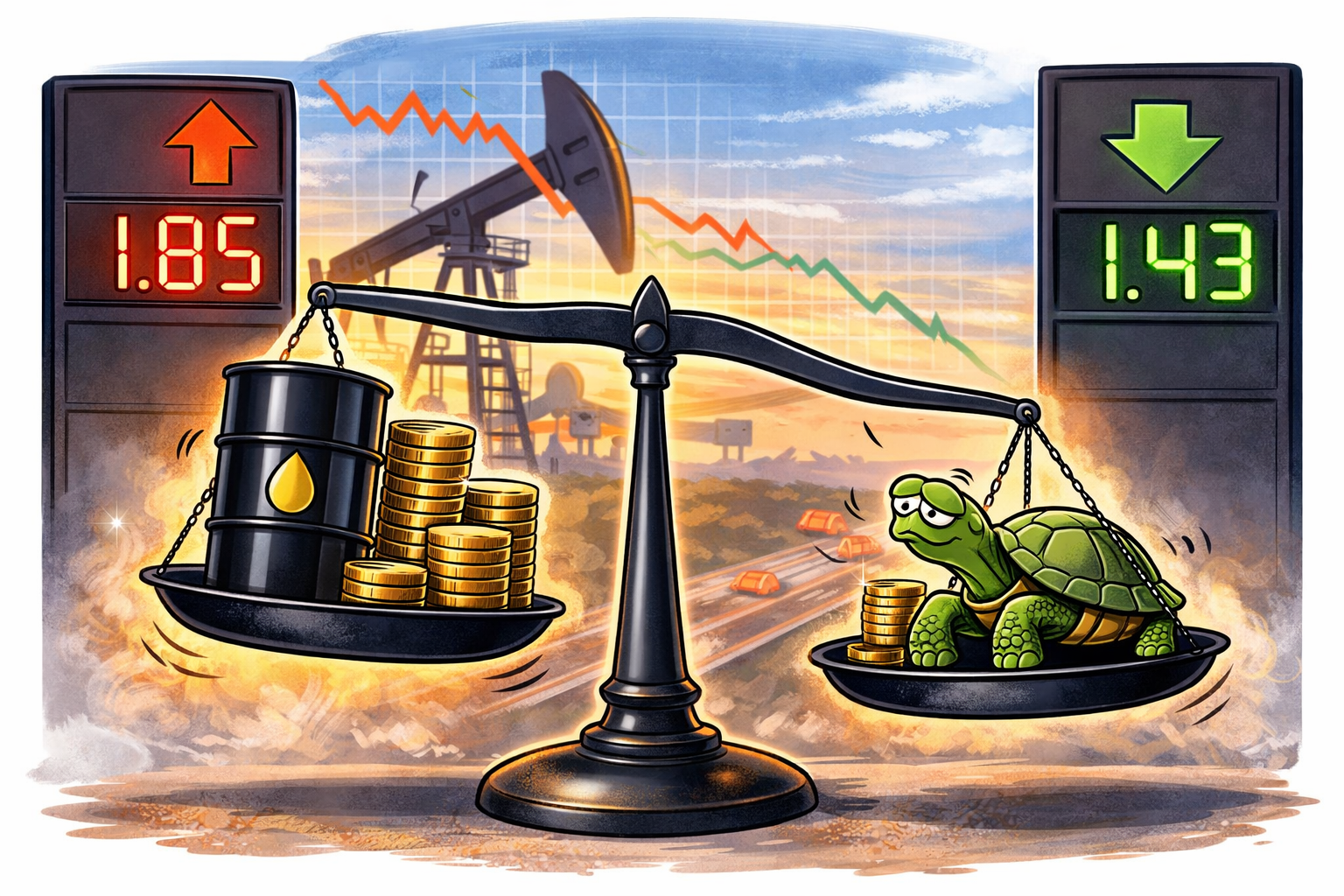
There is one question that irritates drivers almost as much as expensive fuel itself. It sounds simple, almost offended: why do prices shoot up so quickly, but come down so slowly? Why is it that one tense week in global markets can make the station board more painful almost immediately, but when the situation calms down, the price seems to lose all sense of urgency? This feeling is extremely common. And because it feels so personal and so visible, it also creates a lot of suspicion, frustration, and simplified conclusions.
From a human point of view, that frustration is completely understandable. People do not see every layer of the market. They do not see at what price the fuel was purchased, what the wholesale price looked like on a specific day, how refinery margins moved, or how delivery schedules and contracts shape a particular retail chain. They see one thing: the price board. And the board often creates the impression that the market is very sharp on the way up and very lazy on the way down.
But the reality is more complicated than the simple idea that “up is fast and down is slow because someone wants it that way.” Fuel price is not one button that someone turns every morning. It is shaped by previously purchased inventories, wholesale product prices, refinery costs, logistics, taxes, competition, and also by market psychology. Latvia’s Competition Council has explicitly noted that retail fuel prices are influenced by international wholesale prices, logistics, taxes, and supply-demand conditions, while stations also sell fuel purchased earlier, which means lower market prices do not necessarily appear at the pump immediately.
This article looks at why price decreases so often appear slower than price increases, what part of that is real market logic, what part is psychology, and why drivers’ feelings on this subject are often valid even when the cause is more complex than it first appears.
The first feeling is usually very simple: “when it gets more expensive, it happens immediately; when it gets cheaper, it never does”
That is exactly how most people describe the problem. And to be fair, from the point of view of everyday life, that is often how it looks. The driver does not see the chain behind the number. They see only the result. And the result often feels asymmetrical: painful changes arrive quickly, pleasant changes arrive cautiously.
That perception is not imaginary. Economists have long studied the idea of asymmetric price transmission — the observation that changes in upstream prices are not always passed on to retail consumers at the same speed in both directions. Research on European petroleum-product markets has specifically examined this kind of asymmetry.
But it is very important to understand that “prices fall more slowly” does not automatically mean “someone is deliberately cheating you.” Part of this pattern comes from the structure of the market itself, not only from bad intent. And that is where the more interesting explanation begins.
Previously purchased inventory is one of the biggest reasons
This is probably the single most important point in the whole article. Fuel at a station is not sold as an abstract number from today’s news headline. It is sold as a real product that has already been purchased, transported, stored, and moved through the retail chain. That means if a retailer acquired fuel at a higher cost earlier, that fuel does not magically disappear just because wholesale conditions start improving today.
That is one major reason why pump prices can fall more slowly. Retailing does not live only in today’s market signal. It also lives in yesterday’s purchasing reality. If the global or regional market decline is fresh, it cannot instantly rewrite the cost of the product already sitting inside the chain. The same basic logic appears in Latvian public explanations of fuel pricing: price reductions can be delayed because stations are still selling fuel acquired previously.
From a driver’s point of view, this can feel deeply annoying. And understandably so. But in market terms, it is one of the most powerful reasons why a price drop may not look as fast as people expect. They hope a better market headline today should mean cheaper fuel tomorrow. In practice, there is often already-purchased fuel standing in the way.
A driver often compares today’s station board with today’s news cycle. But the station may still be selling yesterday’s or the day before yesterday’s cost reality.
The signal to raise prices feels more urgent than the signal to lower them
There is another important layer here. When the market starts moving upward, that movement is often interpreted as risk. If geopolitical tension rises, if supply looks threatened, if crude benchmarks jump, or if wholesale product costs increase, retailers see a very clear warning: the next cargoes may be more expensive. That makes upward adjustment feel urgent, because nobody wants to be selling cheaply today and replacing stock at a sharply higher cost tomorrow.
A downward move feels different. If prices begin to soften, the market does not always interpret that as a new stable reality. It may look like a temporary pause, a short-lived easing, or a fragile improvement that could reverse quickly. So participants often move downward more cautiously because they want to see whether the decline is real and durable. In simple terms: a price increase often feels like an urgent threat, while a price decrease feels like a signal that still needs confirmation.
That difference in psychology helps create the impression that prices race upward and crawl downward. The market is not reacting to the two directions with the same emotional logic.
Refining and product markets are not the same thing as crude oil
Another common misunderstanding is the idea that pump prices are determined only by crude oil. People hear that oil has become cheaper and expect petrol and diesel to become cheaper at the same speed. But fuel at the pump is not crude oil. It is a finished product. Between crude and the retail nozzle there is refining, product pricing, transportation, storage, and distribution.
IEA market reports show clearly that oil-market dynamics are shaped not only by crude itself, but also by refinery throughputs, refining margins, product inventories, and disruptions in product flows. In early 2026, the IEA reported lower refining margins in some periods, but also weather disruptions, export constraints, and product-stock changes affecting the broader market environment. That means even when crude pressure softens, the price environment for finished petrol or diesel may soften more slowly.
This is one reason drivers often feel confused. News headlines may say oil is down, while the station price does not seem eager to follow. That is not necessarily a contradiction. It is often the difference between one layer of the market and another.
Logistics and the supply chain create inertia
The path fuel takes to your tank is longer than most people imagine. It includes purchasing, transport, storage, allocation between sites, operational planning, and the physical infrastructure that allows retail sales to happen at all. That means a fuel price is never only a market instant. It is also the product of a moving system with its own inertia.
When cost conditions improve upstream, the whole chain does not instantly behave as if everything has changed. There is time involved. There are deliveries already in motion. There are scheduling decisions already made. There are operating costs that do not melt away at the same speed as a market headline. That supply-chain heaviness is one reason a retail price decline often feels slower than consumers hope.
A driver looking only at the signboard does not see any of this. They see only that the downward move feels lazy. But beneath that laziness there is often not one bad decision, but a whole chain that is simply heavier than their expectations.
Taxes make declines feel smaller than people expect
Another reason falling prices can feel disappointing is very simple: a large share of the final pump price is made up of taxes and mandatory charges. When the market component starts to fall, many people intuitively expect the whole final price to fall dramatically. But the final number is not only the market component. It also includes excise duty, VAT, and other elements that do not move down automatically every time wholesale conditions improve.
So even when the market side of the price becomes more favorable, the visible effect at the pump may be more modest than drivers emotionally expected. This does not mean the price did not move. It means the moving part is only one layer inside a larger final structure.
That is why people often say, “I heard oil fell, but the station price barely moved.” They are comparing a change in one part of the structure with the total final number they pay.
Market psychology matters in fuel too
There is a subtle factor here that public discussion often underestimates: market psychology. Not only consumer psychology, but the psychology of market participants themselves. If the environment is unstable, if prices have been nervous for months, if geopolitical risk has not disappeared, then the market becomes cautious. That means traders and retailers may not rush to interpret every dip as a new normal.
This is where one of the most interesting things happens. Prices may be slow to fall not only because of inventory and logistics, but because the market itself does not yet trust that the decline will last. If participants fear that another disruption, sanction, weather shock, or export problem may appear very soon, downward movement naturally becomes more cautious.
And looking at the 2026 oil-market background, that caution is not difficult to understand. IEA reports in early 2026 described both growing supply expectations and continuing disruptions, outages, and geopolitical uncertainty. In a volatile environment, psychology itself becomes part of price inertia.
Why people feel it is unfair — and why that feeling does not go away
The emotional side of this topic matters a great deal. Fuel price is not some distant economic table hidden in a report. It is a large visible number that appears every refill. It is tied to commuting, family movement, shopping, deliveries, and monthly planning. That makes people notice upward pain much more sharply than gradual relief.
And in that sense, the feeling of unfairness is understandable. Not necessarily because the market is automatically behaving unlawfully, but because consumers experience the asymmetry directly. The painful move feels fast. The pleasant move feels hesitant. Human memory is also selective in exactly this way: people remember sharp, expensive jumps vividly, but experience gradual declines much less dramatically.
That is why this subject will always remain emotional even when the explanation is economic. It is not only about market mechanics. It is also about how people emotionally experience repeated price movement in everyday life.
Does this automatically mean something is wrong with competition?
No. And this is very important to say clearly. The fact that prices fall more slowly than they rise does not automatically mean there is collusion or a competition-law violation. Latvia’s Competition Council has said it monitors fuel-market developments and whether market participants act in line with competition law, while also explaining that international wholesale prices, logistics, taxes, and supply-demand conditions all shape retail pricing.
So the smarter conclusion is not “if it falls slowly, it must be cheating.” The smarter conclusion is: “if it falls slowly, I need to understand which factors are causing that delay, and whether the behavior is economically grounded.” That sounds less satisfying emotionally, but it is much closer to reality.
Conclusion
Fuel prices often fall more slowly than they rise because the final pump price is not just today’s market mood. It is influenced by previously purchased stock, delayed wholesale transmission, refining and finished-product costs, logistics, taxes, and market caution about moving downward too quickly. Together, those layers create the impression that the market runs upward and limps downward.
Drivers’ feeling that something unfair is happening is humanly understandable. But the full answer is usually more complicated than “greed” or “conspiracy.” Much more often, it is the structure of the market itself — a structure in which upward risk feels urgent, while downward relief has to pass through a slower, heavier system before it reaches the nozzle. That may not make refuelling any more pleasant, but it does make the pattern easier to understand.
If you want to see how different price moves affect your everyday budget, use the calculator below.