
 LV
 EN
 RU
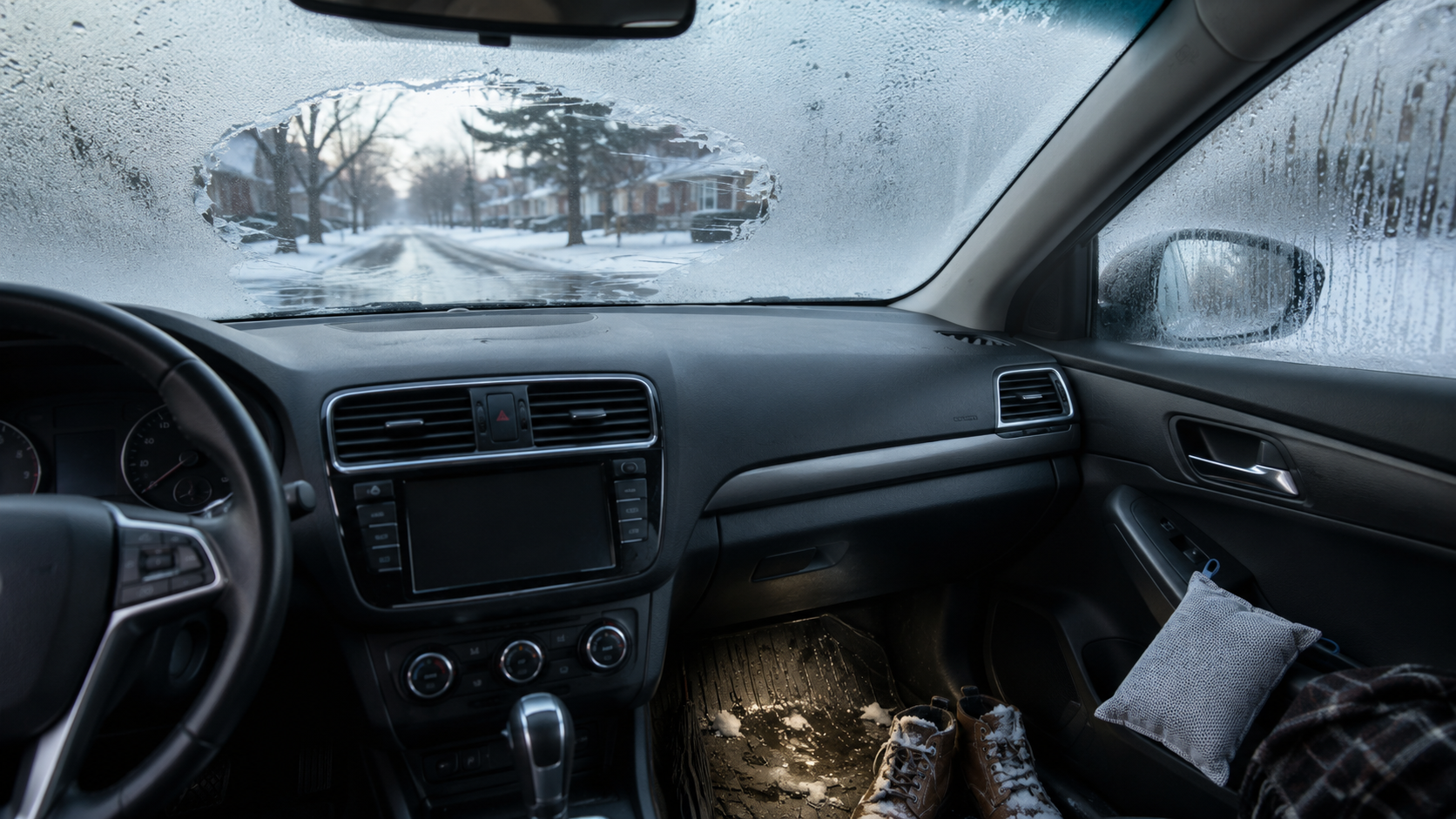
In the morning, the car appears completely normal. The driver clears the ice from the outside, gets inside, starts the engine and begins driving. A few minutes later, the lower edge of the windscreen turns grey. Then the side windows fog up, the mirrors become difficult to see and switching on the fan may sometimes make the situation even worse.
The driver wipes a small area with a hand, but it fogs up again shortly afterwards. A window is opened, the cabin becomes cold and visibility improves temporarily, but the moisture returns as soon as the window is closed. The following morning, the windscreen is no longer merely fogged — a layer of ice has formed on its inner surface.
This situation is often blamed on winter, wet weather or an “old car”. Persistent window fogging, however, is not merely an inconvenience. It may indicate wet carpets, a blocked cabin filter, incorrect use of recirculation mode, a non-functioning air-conditioning system, a water leak into the cabin or even a leaking heater matrix.
Two things are especially important. First, visibility must be restored immediately and safely. Second, the source of the moisture must be found, because turning the fan to maximum speed will not solve the problem when several litres of water are trapped beneath the carpet.
The main principle: a fogged window means that warm, humid cabin air is meeting a cold glass surface. Restoring visibility requires not only heat, but also drier air and a way for moisture to leave the cabin.
What actually happens when a window fogs up?
Air can hold a certain amount of water vapour. Warm air can contain more moisture than cold air. When warm and humid cabin air reaches a cold window, it cools. Once it reaches a certain temperature, some of the water vapour turns into tiny droplets on the glass surface.
These droplets scatter light, which makes the glass appear white or grey. At night, the situation becomes even worse: headlights from approaching vehicles, streetlights and illuminated signs create reflections on the damp surface and significantly reduce visibility.
The colder the glass and the more humid the cabin air, the faster condensation forms. This is why fogging often begins immediately after people enter a cold car. Passengers release moisture by breathing, snow or rain enters on footwear, and wet coats and carpets continue to evaporate moisture.
Why does the glass sometimes fog on the inside and sometimes on the outside?
The cabin air is warm and humid while the glass is cold. Condensation forms on the interior surface. This is common in autumn, winter, rain and a damp cabin.
The air conditioning has cooled the glass strongly from inside while the outside air is warm and humid. Condensation forms on the exterior surface and normally disappears when the windscreen wipers are used.
Before changing the climate-control settings, it is worth confirming which side of the glass is wet. If outside condensation is wiped from inside, or inside condensation is attacked with the wipers, the problem will obviously remain.
Immediate action when the windows fog up while driving
If visibility deteriorates quickly, the first task is not to search for the leak. Clear vision of the road must be restored first.
- Select the windscreen demisting or defrosting mode.
- Increase the fan speed.
- Direct the airflow towards the windscreen and front side windows.
- Switch off cabin-air recirculation.
- Switch on the air conditioning if the system allows it.
- Choose warm air, although it does not necessarily need to be at the maximum temperature.
- Open a side window slightly for a short time if the cabin is extremely humid.
- If visibility does not recover quickly enough, stop in a safe place.
On many vehicles, the dedicated windscreen mode automatically increases the fan speed, activates the air conditioning, selects outside air and directs airflow towards the glass. The operating logic differs between models, however, so the vehicle handbook is worth reading.
Do not continue driving through a hand-sized clear patch
The forward and side fields of vision must be clear enough to see the road, pedestrians, cyclists, mirrors and junctions. If the ventilation system cannot keep the windows clear, stop safely and restore visibility.
Why does warm air help?
Warm air heats the glass and can hold more moisture. When a stream of warm air is directed at the window, the condensation droplets begin to evaporate and the temperature of the glass gradually rises.
Increasing the temperature alone does not always solve the problem. If recirculation is switched on, the same humid cabin air is repeatedly reused. It becomes warmer, but the total amount of moisture inside the vehicle does not fall significantly.
Why does air conditioning help during winter?
Air conditioning is not only a cooling system. When operating, it also reduces the moisture content of the air. Air is cooled at the evaporator, some of its moisture condenses and is discharged beneath the vehicle through a drain. The drier air can then be reheated and directed towards the windscreen.
This is why the combination of air conditioning and warm air often removes fogging much faster than hot air alone.
On some vehicles, the air-conditioning compressor may not operate at very low outside temperatures because of system-protection or operating conditions. The button may remain illuminated even though the compressor itself is not running. This does not necessarily indicate a fault.
Recirculation: a useful function that can fog the windows very quickly
In recirculation mode, the vehicle reduces the supply of outside air and reuses the air already inside the cabin. This is useful when driving behind a smoky vehicle, through a tunnel, in dusty conditions or when initially cooling a very hot cabin more quickly.
When recirculation is used for a long time with several passengers, however, moisture and exhaled air accumulate. The windows may begin fogging within minutes.
For short periods around smoke, dust, unpleasant outside smells or during the initial cooling of a very hot cabin.
During rain, winter, with wet carpets, several passengers or in any situation where the windows have already begun to fog.
Where does so much cabin moisture come from?
Some moisture is completely normal. People, footwear and clothing bring it into the vehicle. The problem begins when the moisture level exceeds the ventilation system’s ability to remove it or when new water is continuously entering the cabin.
Snow and rain collect inside rubber mats, while some water may move beneath them and soak into the textile floor covering.
Coats, gloves, umbrellas, sports equipment and pushchairs continue releasing moisture inside the cabin or boot.
Restricted airflow prevents the ventilation system from removing moisture from the windows quickly enough.
Leaves, mud and debris may obstruct drainage beneath the windscreen, inside doors, around a sunroof or within the air-conditioning system.
Water may enter around the windscreen, doors, sunroof, roof rails, rear lamps or boot seal.
Coolant may enter the cabin, causing a sweet smell, an oily film on the windscreen and dampness near the front passenger’s feet.
Wet rubber mats may conceal a much larger problem
A rubber mat does not absorb water itself, but beneath it there may be textile carpet and thick sound insulation. If water spills over the edge of the rubber mat or is forced underneath it, the upper surface may later feel dry while the lower layers remain wet for days or even weeks.
To inspect the area, remove the mat and feel the floor covering by hand, particularly beneath the front seats and close to the door sills. If the material feels cool or damp, or a paper towel becomes wet when pressed against it, the cabin needs drying and the source of the leak must be found.
Simply heating the cabin may not be enough. Thick insulation can retain a significant quantity of water, while heating only moves that moisture into the cabin air and onto the windows.
The cabin filter: an inexpensive component with a major effect on visibility
The cabin filter traps dust, pollen, leaf particles and other contamination. Over time it fills up and restricts airflow.
If the fan sounds loud but little air comes through the vents, the cabin filter is one of the first components to inspect. This is especially likely when the filter has not been replaced for a long time, the vehicle is regularly parked beneath trees or it is often driven on dusty roads.
Signs of a blocked or damp filter
- weak airflow even at a high fan speed;
- windows fogging more quickly than before;
- the fan operating loudly;
- a dusty or damp smell inside the cabin;
- uneven airflow between different ventilation modes;
- leaves, dirt or signs of moisture visible on the filter.
The replacement interval should follow the vehicle manufacturer’s guidance and the actual operating conditions. In particularly dusty or damp environments, the filter may need to be inspected more frequently.
Air-conditioning drainage and water beneath the vehicle
When the air conditioning is operating, condensation forms on the evaporator. It is discharged beneath the vehicle through a drain tube. A small puddle of clean water beneath a parked car after air-conditioning use is therefore often completely normal.
If the drain becomes blocked or the tube becomes disconnected, water may collect inside the climate-control housing or enter the cabin. A sloshing sound may then be heard while cornering, dampness may appear around the passenger footwell or a mouldy smell may come from the vents.
Leaves beneath the windscreen and blocked body drains
A water-collection and drainage area is often located beneath the plastic trim at the base of the windscreen. Leaves, pine needles and mud accumulate there. If the drains become blocked, the water level may rise and reach the ventilation intake or body seams.
On some vehicles, this area also contains electronic housings, the windscreen-wiper mechanism and the cabin-filter intake. Regularly removing leaves is therefore more than cosmetic maintenance.
Water inside the doors is expected; water inside the cabin is not
Some rainwater normally enters the inside of a door past the outer window seal. Doors are designed with drain openings through which this water should flow out.
If the drains become blocked or the internal moisture membrane is damaged during a loudspeaker, window-regulator or other repair, water may move behind the door trim and then into the cabin.
Signs that may indicate a door leak
- water can be heard moving inside the door;
- the sill or carpet edge is wet after rain;
- dampness appears only on one side of the vehicle;
- water marks are visible along the lower edge of the door trim;
- the problem began after a door repair.
Sunroof drains
A sunroof assembly is not always completely watertight. A small amount of water may enter the sunroof frame and should then be carried to the underside of the vehicle through drain tubes.
If a drain becomes blocked, splits or disconnects, water may run along the headlining, pillars and airbag areas. Dampness may appear near the sun visors, interior light, or the front and rear footwells.
Sunroof drains must be cleaned carefully. Excessive compressed-air pressure or a sharp object may disconnect or damage a tube and make the leak worse.
Leaks around the windscreen and body seams
A windscreen that was bonded incorrectly or poorly installed after body repairs may allow water to enter. Dampness may appear near the front pillars, edges of the dashboard or front carpet area.
Similar problems may be caused by roof-rail mountings, the aerial base, bulkhead seals, cable-entry points, rear lamps and boot ventilation openings.
The point where water appears is not always directly beneath the leak. Water may travel along wiring, body panels and insulation before collecting at the lowest point.
A leaking heater matrix: a more serious cause of fogging
The cabin heater matrix is a small heat exchanger through which hot coolant flows in many internal-combustion vehicles. The fan blows air through the matrix and warms the cabin.
If the matrix or its connections begin leaking, coolant vapour and droplets may enter the cabin. Instead of ordinary water condensation, the windscreen may develop a slightly oily film that is difficult to wipe away.
- a sweet or chemical smell inside the cabin;
- an oily film on the windscreen;
- damp carpet in the front passenger or driver footwell;
- a gradually falling coolant level;
- inconsistent heater performance;
- vapour-like moisture coming from the vents;
- engine overheating because of insufficient coolant.
Coolant loss must not be ignored. If the level is falling or the engine begins overheating, stop the journey and identify the source of the leak.
Dirty glass fogs up more easily
A thin layer of grease, dust, plastic vapour and cleaning-product residue gradually forms on the inside of the glass. Condensation droplets spread unevenly across this surface and visibility becomes worse than it would be through clean glass.
The inside of the windows should be cleaned with a clean microfibre cloth and a product suitable for automotive glass. If streaks remain, use a second dry cloth. A cloth previously used with dashboard-care products should not be used on glass.
Does an anti-fog product solve the problem?
A good product may reduce droplet formation on a clean surface, but it cannot dry a wet carpet, repair a drain or replace proper ventilation. When applied incorrectly, it may create streaks and reflections at night.
Why does the windscreen freeze on the inside?
If the car is parked with a damp cabin, the air cools and moisture condenses on the glass. When the temperature falls below freezing, this water turns into ice.
Interior ice is particularly common in vehicles with wet carpets, short journeys, several passengers and insufficient cabin ventilation before parking.
What should be done before parking in cold weather?
- use outside air for several minutes near the end of the journey;
- switch off recirculation if it has been used for a long time;
- remove wet items from the cabin;
- empty water from rubber floor mats;
- briefly ventilate the cabin in a safe location;
- do not allow snow and ice from footwear to melt beneath the seats.
How should ice be removed safely from the inside of the glass?
First select the windscreen-defrosting mode and warm the glass gradually. Ice may be removed carefully with a clean plastic scraper, but care must be taken not to scratch the glass, coatings or films.
Boiling or very hot water should not be poured onto extremely cold glass. A rapid temperature change may create stress within the glass, especially if a stone chip or crack is already present.
Once the ice has melted, dry the glass and address the source of cabin moisture. Otherwise, the same situation is likely to return the following morning.
Why do the windows fog while the car is parked?
If the vehicle is locked after a journey with warm, humid air inside, the glass cools more quickly than the rest of the cabin. Moisture condenses on the coldest surfaces.
Minor fogging after carrying several wet passengers may be normal. If the windows are wet on the inside every morning even in dry weather and without passengers, however, a permanent source of moisture should be investigated.
The rear window and electrical heating
The rear-window heater uses electrical elements built into the glass. They warm the surface and help remove fogging or a thin layer of ice.
If part of the glass remains fogged in horizontal bands, one or more heating lines may be broken. Damage may occur through aggressive cleaning, sticker removal or damage to the electrical connection.
If the heater does not work at all, the fuse, relay, switch, connectors and wiring should be checked. Diagnosis of a high-current electrical circuit is best left to a specialist.
Automatic climate control: sometimes it is better not to interfere
Automatic climate control uses temperature, humidity and sunlight sensors to regulate the fan, airflow direction, air conditioning and recirculation. On many vehicles, automatic mode with the air-conditioning function enabled keeps the windows clearer than constant manual adjustment.
Problems arise when the driver permanently switches off the air conditioning to save energy, reduces the fan to its lowest setting and enables recirculation. The system can no longer control humidity effectively.
Differences between petrol, diesel, hybrid and electric vehicles
The engine normally begins producing useful cabin heat relatively quickly, although it still needs time after a cold start.
An efficient diesel engine may warm up more slowly in cold weather, especially at idle and during short journeys. Some vehicles have an auxiliary electric heater.
The internal-combustion engine may switch off periodically, so heat management depends on the particular hybrid system and any auxiliary heaters.
Heat is provided by an electric heater or heat pump. Preconditioning while connected to a charger can prepare the cabin and windows before departure.
Regardless of the powertrain, the physics remains the same: the glass needs sufficient heat, airflow and drier air. Only the method by which the vehicle produces heat and dehumidification changes.
The fan operates, but no air reaches the windscreen
If air flows from the central vents but almost nothing reaches the windscreen, there may be a problem with an air-distribution flap, cable, vacuum control or electrical actuator.
A flap may become stuck in one position, meaning the mode selected on the climate-control panel is not actually applied. Clicking may be heard beneath the dashboard, or the airflow direction may remain unchanged regardless of the buttons being pressed.
The fan does not work at all
If the fan does not operate at any speed, demisting will be extremely slow or impossible. The cause may be a fuse, blower motor, control unit, relay, earth connection or wiring fault.
If the fan operates only at maximum speed or only at certain settings, the resistor or electronic regulator may be faulty.
Driving in rain or cold weather with non-functioning ventilation may be unsafe because visibility cannot be maintained reliably.
The air conditioning does not dry the air
If the air conditioning no longer cools in summer and does not help with fogging in damp weather, the system may have insufficient refrigerant, a faulty compressor, pressure sensor, clutch, control system or another defect.
Simply refilling the system without checking for leaks is not a complete repair. Refrigerant is not normally “used up” like fuel; when a significant quantity is missing, the cause should be investigated.
Only one window or one side of the car fogs up
If only one side window fogs heavily, inspect the air vent, door seal and carpet on that side. Airflow may not be reaching the window, or water may be entering the cabin specifically on that side.
If fogging is concentrated in the boot or rear-cabin area, inspect the boot floor, spare-wheel well, rear-light seals, ventilation openings and boot-lid seal.
Damp, mouldy, fuel or exhaust smells
Smell can help indicate the likely direction of the problem. An ordinary damp smell is often associated with wet insulation or the air-conditioning evaporator. A sweet smell may indicate coolant.
A fuel or exhaust-gas smell is not a normal sign of cabin moisture. If exhaust fumes can be smelled inside, open the windows, stop safely and do not continue using the vehicle until the exhaust system, body seals and ventilation have been inspected.
What should not be done?
A hand leaves greasy marks and visibility soon becomes even worse.
Moisture from passengers and wet objects accumulates inside the cabin.
A rapid temperature change may increase the risk of an existing chip or crack spreading.
An air freshener does not dry insulation or remove the cause of mould, coolant leakage or water ingress.
If the cabin repeatedly becomes wet, the water-entry point must be located first.
If it overturns, its contents may damage the carpet, seat or metal components.
When must the journey not continue?
- the windscreen fogs faster than the ventilation system can clear it;
- the side windows or mirrors cannot be seen clearly;
- the fan does not work;
- a thick oily film forms on the glass;
- there is a strong exhaust or fuel smell inside the cabin;
- the coolant level is falling;
- the engine is overheating;
- steam or hot liquid is visible beneath the dashboard.
How does a workshop find the source of moisture?
Good diagnosis begins not with replacing parts, but with questions: under which conditions does the dampness appear, which side of the carpet becomes wet, and does it happen after rain, a car wash, air-conditioning use or coolant loss?
- inspection of the cabin filter and airflow;
- diagnosis of the fan and air-distribution flaps;
- testing of the air-conditioning system;
- inspection of the air-conditioning drain;
- lifting the carpet and insulation to check for moisture;
- inspection of door and sunroof drains;
- a controlled water test to locate body leaks;
- pressure testing of the cooling system;
- inspection of the heater matrix and its connections;
- professional cabin drying and disinfection.
Illustrative cost example
Assume the windows have begun fogging more frequently. In the first scenario, the driver checks the filter and cabin promptly, discovers a blocked drain and dries a small amount of moisture. In the second scenario, the vehicle continues collecting water beneath the carpet for several months until connectors corrode and safety-system faults appear.
The amounts are illustrative and are not a quotation from a specific workshop. Costs depend on the vehicle design, leak location, extent of interior disassembly and electrical damage.
A seven-day cabin-moisture observation test
If there are no visible puddles inside but the windows fog regularly, a simple observation test may help. It does not replace professional diagnosis, but it can reveal the conditions under which the problem appears.
- Remove and dry the rubber floor mats.
- Check the carpet beneath them with a dry paper towel.
- Clean the inside of the windows.
- Avoid prolonged use of recirculation for seven days.
- Record whether fogging begins after rain, washing or carrying passengers.
- Check the front and rear footwells every morning.
- Monitor the coolant level only when the engine is cold.
- If moisture returns or the coolant level falls, arrange a professional inspection.
What should be checked when buying a used car?
Persistently fogged windows may be one sign that a vehicle has a leak or has remained damp for a long period. Before sale, the cabin may have been dried and heavily treated with air freshener, so a closer inspection is necessary.
- the carpet beneath the rubber mats and seats;
- the spare-wheel well and side trim inside the boot;
- the headlining around the sunroof and pillars;
- whether the cabin smells of mould or excessive air freshener;
- whether an oily film is present on the inside of the glass;
- the coolant level and signs of leakage;
- fan operation at every speed;
- airflow towards the windscreen and side windows;
- air-conditioning operation;
- electrical and safety-system faults.
Driver’s checklist
☐ Windscreen mode operates correctly
☐ The fan works at every speed
☐ Airflow reaches the side windows
☐ Recirculation is switched off during fogging
☐ Air conditioning helps dry the air
☐ The cabin filter has been inspected
☐ No water is present in the rubber mats
☐ The carpet underneath is dry
☐ The boot well is dry
☐ Body drains are not blocked
☐ The coolant level is stable
☐ There is no sweet or exhaust smell inside
☐ The inside of the glass is clean
☐ Wet items have been removed
☐ The cabin has been ventilated before parking
☐ Visibility is fully restored before driving
A short self-check
The windows fog after four passengers enter during rainy weather. Does this immediately mean there is a leak?
Not necessarily. Several people, wet clothing and wet footwear can increase cabin humidity very quickly. Use outside air, air conditioning, warmth and a higher fan speed. If the problem continues in dry weather without passengers, look for a permanent source of moisture.
The fan is loud, but little air reaches the windscreen. What should be checked first?
Inspect the cabin filter and outside-air intake first. If the filter is clean, there may be a problem with an air-distribution flap, the blower or the ventilation ducts.
An oily film forms on the windscreen and the cabin smells sweet. Is cleaning the glass enough?
No. This combination may indicate a leaking heater matrix or cooling system. Check the coolant level and arrange professional diagnosis.
The windscreen freezes on the inside only after short winter journeys. Why?
During a short journey, the cabin and damp materials do not have enough time to dry. After parking, moisture condenses on the cold glass and freezes. Dry the mats, use outside air and briefly ventilate the cabin before parking.
Frequently asked questions
Can the air conditioning remain switched on during winter?
Yes, when the vehicle is designed for it. Air conditioning helps dry the air. At very low temperatures, the compressor may remain off automatically.
Does maximum heat always clear the windscreen fastest?
Not always. The important combination is sufficient airflow, outside air, air-conditioning dehumidification and warming the glass. Very hot but humid recirculated air may perform worse.
Does opening a window help with fogging?
Temporarily, yes, because humid cabin air is replaced by outside air. It is not a permanent alternative to proper ventilation or repairing a leak.
Do cat litter or rice remove moisture from the cabin?
A small quantity of absorbent material may collect some moisture from the air, but it cannot dry wet floor insulation or repair a leak. It is safer to use a purpose-made moisture absorber positioned securely.
Why do the windows fog more after a car wash?
Water may be entering through a seal, blocked drain or damaged door membrane. If the problem returns after every wash, the leak should be located.
Why do the windows still fog after replacing the cabin filter?
A new filter improves airflow, but it does not solve wet carpets, a blocked drain, incorrect recirculation use, an air-conditioning fault or a leaking heater matrix.
Can fogged windows be wiped with a paper tissue?
In an emergency it may help temporarily, but tissue may leave fibres and streaks. It is better to keep a clean microfibre cloth in the vehicle and use the ventilation system.
Can cabin moisture damage electronics?
Yes. Wiring, connectors and control modules are often located beneath the carpet. Prolonged moisture can promote corrosion and cause intermittent electrical faults.
Does ice on the inside always mean the car has a leak?
Not always. Wet footwear, short journeys and insufficient ventilation may also cause it. If it happens regularly even in dry conditions, the cabin should be inspected for permanent dampness.
Fogging is a symptom, not the underlying problem
A small amount of fogging on a cold and rainy day may be normal. Several people, wet footwear and cold glass can create a large amount of condensation in a short time. A correctly functioning ventilation system should nevertheless be able to remove it within a reasonable period.
If the windows fog every day, freeze on the inside, develop an oily film or the carpet feels damp, the problem is no longer limited to climate-control settings. The source of the water or coolant must be identified.
Timely inspection of the cabin filter, cleaning of drains and repair of a small leak can protect not only visibility, but also the carpet, body, wiring, control modules and safety systems.
The main takeaway: to clear a fogged windscreen quickly, use outside air, a higher fan speed, airflow directed at the glass, heat and air-conditioning dehumidification. If the moisture repeatedly returns, inspect the cabin filter, carpets, drains, seals and cooling system. Do not continue driving with insufficient visibility.