
 LV
 EN
 RU
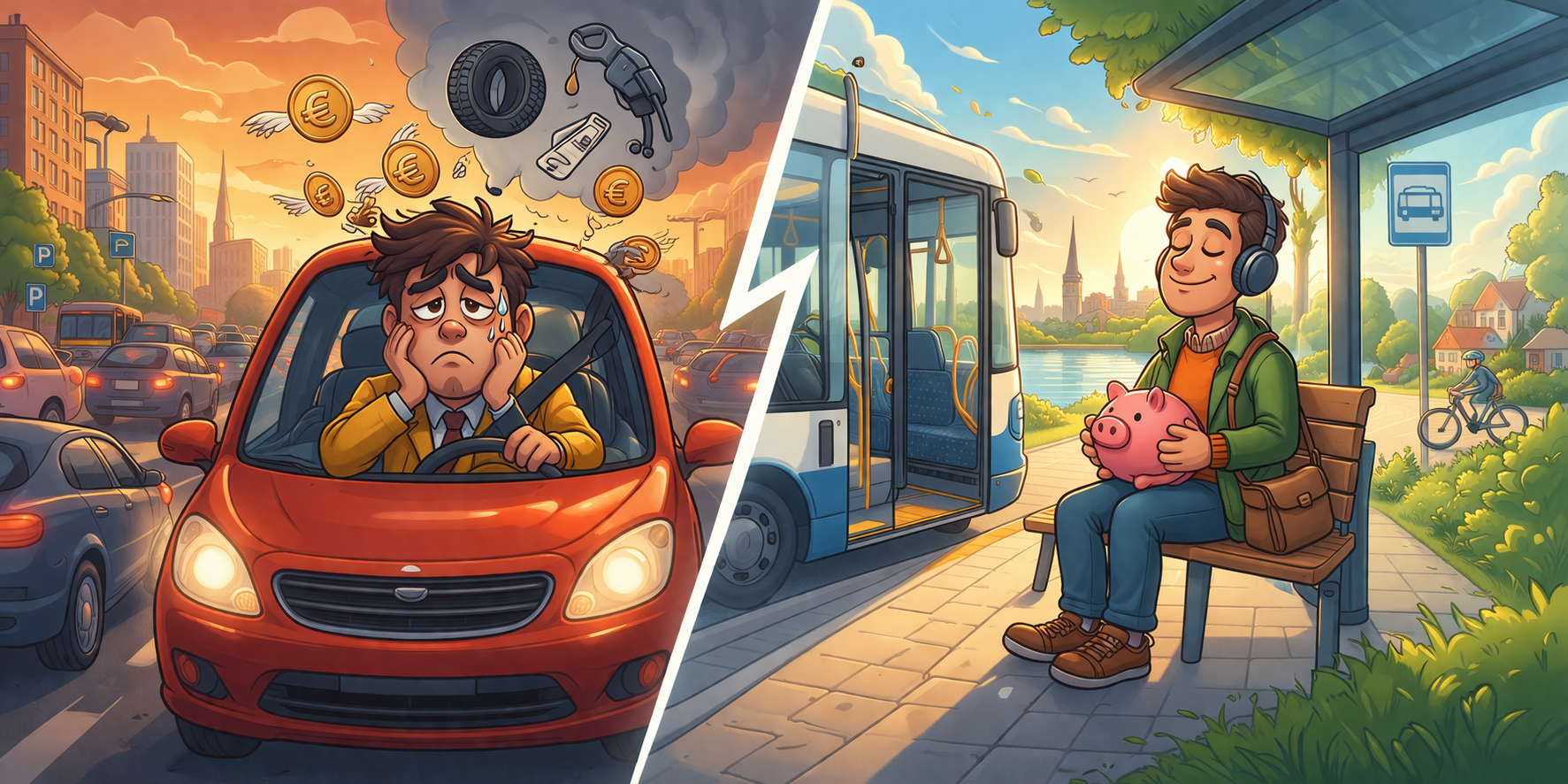
There are questions people ask not because they want to philosophize about life, but because their wallet and daily routine start demanding an honest answer. One of these questions is very simple in form but uncomfortable in content: is owning a car in Latvia still worth it compared to public transport? This is not just about fuel or ticket prices. It is a much broader question about the cost of movement, the price of freedom, the value of time, and the cost of comfort.
Many people answer this question too quickly. Some automatically say: of course, a car is expensive, public transport will always be cheaper. Others just as quickly reply: but with a car you have a life, without a car it’s impossible. And the problem is not that either side is completely absurd. The problem is that both too often pretend that everyone in Latvia has the same daily life. But that’s not true. Life in central Riga is not the same as life in the suburbs. Life without children is not the same as life in a family with two school-age kids. A job in the city center is not the same as shift work in a place where public transport in the evening no longer runs in a way that suits you.
That is exactly why this article will not be about one universal conclusion. It will be about reality. When is a car truly financially inefficient, yet still understandable in real life? When is public transport genuinely the smarter choice? When do people overpay for a car simply out of habit or ego? And when does public transport, even if cheaper on paper, demand so much time, energy, and nerves that the question is no longer just about money?
This is one of those topics where numbers matter, but numbers alone are not enough. Because transport is not just about getting from one place to another. It is also about a model of life. And sometimes, this is exactly the moment when a person realizes that they are not just choosing between a car and a bus. They are actually choosing between two very different forms of everyday life.
The first big mistake: comparing only fuel to a ticket
Most often, people start with an overly simple comparison. A monthly ticket costs this. Fuel costs that. Therefore — public transport wins or the car wins. But in real life, this is almost childishly incomplete. Because a car is not just fuel. A car is also insurance, tires, maintenance, parking, inspections, unexpected repairs, depreciation, washing, oil changes, and everything else that seems separate from the outside, but in reality is a direct cost of the car’s existence.
On the other hand, public transport is not just a ticket either. It is also the cost of time. It is walking to the stop. It is waiting. It is transfers. It is the reality that sometimes you miss one connection and the entire day’s schedule shifts. It is a situation where you may save money, but lose so much time and flexibility that this saving starts to feel less impressive in real life than it does in theory.
That is why the first smart idea in this topic is very simple: you can only compare a car with public transport if you compare the full picture. Because if you only compare fuel with a ticket, you are not comparing life — you are comparing a very small part of it.
A very typical comment from driver discussions: “For a long time, I thought fuel was what was killing me. Then I realized the car was costing me everything, not just the tank.”
On paper, public transport almost always looks cheaper
If you look purely mathematically, in many cases public transport really does look cheaper. And this is not surprising. A monthly pass or regular use of trains, trams, buses, or trolleybuses will often be a much smaller direct expense than maintaining a car. Especially if a person lives and works in an area where the route is simple, frequent, and without complicated transfers.
For example, a person lives in Riga, works in the center, has good access to public transport, and parking at work is expensive. In such a situation, a car very often loses in terms of cost efficiency. Not only because fuel is expensive, but also because the car starts charging you from all sides — driving, parking, traffic stress, time spent finding a spot, daily strain. And suddenly it turns out that public transport is not just cheaper. It is sometimes also simpler.
This is where many city residents eventually reach an uncomfortable but freeing conclusion: I am not using the car — I am maintaining it so it can stand still. And if public transport works reasonably well for the daily work route, then the car slowly starts to look like an expensive luxury rather than a smart tool.
But real life is very often not “on paper”
And this is where things get interesting. Because as soon as we step out of the ideal table and into real Latvian everyday life, the picture becomes much more complex. A person may live in a place where public transport theoretically exists, but in practice is not very user-friendly. They may work shifts. They may have a child to take to school or kindergarten in the morning. They may need to carry items to work. There may be health considerations that make public transport inconvenient. Or simply a life geography where a car is not a luxury, but a way to prevent the day from collapsing logistically.
At this point, the comparison between a car and public transport is no longer just “what is cheaper?”. It becomes “what actually allows me to live normally?”. And this is where some people start reacting quite sharply to theories that public transport is a simple solution for everyone. Because for many, it is not. For many, it works only if life is very linear. But real adult life is often fragmented, multi-point, and not particularly friendly to elegant transport theories.
That is why one of the most honest answers is this: yes, public transport is often cheaper. But no, it is not always more beneficial in terms of overall life quality.
A good comment from a daily driver: “The bus would be cheaper for me if my life was a straight line. But mine is more like a chaotic map with five stops in one evening.”
The Riga scenario: where public transport most often wins
If we are honest, Riga is where you find the most situations where public transport can truly be a very smart alternative to a car. Especially if a person lives and works in an area where routes are frequent, direct, and without major transfers. If the workplace is in the center or nearby, if parking is expensive or complicated, and if the route is not particularly complex, then a car often starts to look too expensive for what it actually provides.
There is another important nuance here. In the city center, a car does not always win in terms of time either. It may sound contradictory, but during peak hours, with parking searches, slow traffic, and all the small daily irritations, a car may turn out not only more expensive, but also not significantly faster. This is a particularly unpleasant discovery for someone who has spent years telling themselves that a car “saves time” without ever properly comparing their actual route.
In such situations, public transport becomes not only cheaper, but also calmer. You get on, you ride, you get off. No hunting for parking, no stress over fuel price spikes, and no constant feeling that the car is a financial machine that needs maintenance even when it is just standing still.
Suburbs and regions: where the car often regains its logic
The further you move away from well-connected urban areas, the more often the car starts to make sense again. Not always cheaper, but more understandable. If a person lives in the suburbs or in a region where routes are less frequent, transfers are inconvenient, evening transport is insufficient or unpredictable, the car often becomes the uncomfortable, expensive, but practical solution. Not because people enjoy spending more. But because without a car, the entire day starts to fall apart logistically.
For example, a person lives in a smaller town or village, works 25–30 kilometers away, and starts work early or finishes late. Public transport may exist, but not in a way that matches their life. It may require two transfers and another 20 minutes of walking. It may mean arriving far too early or returning home unreasonably late. In such conditions, a car is not a “luxury”. It is a way to maintain a normal daily structure.
This is where public transport may be cheaper on paper, but much more expensive in time, fatigue, and a broken daily rhythm. And this is the point where “worth it” is no longer just about money. It becomes about how much of your life you are willing to trade for cheaper transport.
A very typical thought from regional residents: “Public transport would be cheaper for me only if I had no life outside going to work.”
Families with children: where theory quickly collides with reality
If a person lives alone, works in one place, and has a relatively predictable day, public transport logic is much simpler. But as soon as children appear, the whole picture changes very quickly. School, kindergarten, activities, doctor visits, shopping, different schedules for family members — all of this makes daily life multi-layered. And in such a life, a car very often starts to look not like prestige, but like the central axis of mobility.
Yes, financially a car may still be more expensive. But in family life, the question often is no longer “which option is cheaper?”, but “which option allows us to actually connect everything we need to connect?”. And this is where many parents become skeptical about simplified comparisons where public transport always wins. Because those comparisons usually do not include a child with a sports bag, time pressure, an unplanned grocery stop, and evening fatigue.
In family life, a car is sometimes financially heavier, but organizationally essential. And this is important to say honestly, instead of pretending that all households can live according to the same transport model.
The cost of time: a point many ignore until they feel the fatigue
There are people who talk about transport choices only in terms of money. And that is understandable, because expenses are tangible. But there is another currency people start valuing only after some time — time. And not just time as minutes on a clock. Time as life energy. Time as the ability to be home earlier. Time as less fatigue. Time as a less fragmented day.
Public transport may be cheaper, but sometimes very demanding in terms of time. If a person loses an extra hour or more every day compared to using a car, by the end of the month this is no longer a small detail. It is a significant part of life. And here comes a very adult question: is this saving really worth it in my specific life?
On the other hand, there are also situations where a car consumes time just as brutally — parking searches, traffic jams, stressful urban driving. So again, there is no single answer for everyone. There is only one smart principle: time should be valued just as seriously as money. Otherwise, a person may save euros but lose their daily quality of life.
A strong comment from reader discussions: “I switched to public transport and felt smart at first, until I realized I was giving half my Saturday feeling to transport every week.”
Comfort is not just a luxury, even if people pretend it is
In discussions about transport, people sometimes feel embarrassed to acknowledge the importance of comfort, as if it were something shallow or unnecessary. But comfort in daily mobility is not just “I want a softer seat”. Comfort is also predictability, a sense of safety, the ability to carry things, not feeling crowded, not planning your entire day around schedules, and not leaving your home feeling like you are partially a hostage of your route.
Yes, comfort costs money. And a car is very often a comfort machine in the broadest sense. But that does not mean comfort is automatically a pointless luxury. For some people, it really is an overpaid habit. For others, it is a crucial element that allows them to maintain a functional daily life. Again — it all depends on the structure of life, not just ideology.
That is why the most honest approach here is not to moralize, but to understand. If a car in your life serves only a status function, that is one story. If it serves a very real daily logistical function, that is a different story.
When is a car in Latvia no longer really worth it?
There are several situations where a car clearly starts to look like a financially weak decision. First, if a person lives in an area with good public transport, works in a city zone where a car provides little real advantage, and at the same time pays for parking and regularly sits in traffic. Second, if the car is used relatively little, but maintained as a full-time necessity. Third, if a person tells themselves that the car is “necessary”, while in reality it is largely a matter of habit or psychological comfort rather than practical need.
In these scenarios, a car starts to lose not only financially, but also logically. It becomes a system that constantly requires funding to maintain a mobility model that could otherwise be achieved much more simply and cheaply.
And when is a car still completely understandable and even worth it in a broader sense?
A car very often retains its logic where public transport cannot offer equivalent life flexibility. If a person lives outside a major city, if their work has a non-standard schedule, if family logistics are complex, if there are multiple routes during the day, a car often remains not a symbol of wealth, but a tool for normal living.
Even where public transport is cheaper on paper, a car sometimes wins in overall daily functionality. This means that financial comparison is not the only factor. You need to look at the consequences each option has for the rest of the day. Especially in Latvia, where regional and suburban life is often much more dependent on a car than theoretical mobility discussions tend to admit.
A very accurate driver comment: “My car is not cheap. But without it, my day would become so fragmented that the savings would no longer feel like a win.”
Conclusion
Is owning a car in Latvia still worth it compared to public transport? The honest answer is this: for some people — clearly no, for some — clearly yes, but for many, the real answer lies somewhere in between. Public transport often wins in direct costs, especially in cities and simple routes. A car often wins in flexibility, resilience to weather, family logistics, and regional realities.
That is why the smartest approach is not to look for one correct ideological answer. The smartest approach is to look at your own life without illusions. How much does your car cost not just at the pump, but overall? How much does public transport cost not just in tickets, but in time and daily complexity? Which option actually helps you live, rather than just looking better on paper?
Because the essence of this topic is not whether a car is good or bad. The essence is much more human: which mode of transport actually makes sense in your life right now. And at that moment, transport stops being just about transport. It becomes a very direct story about money, time, fatigue, and quality of life.
If you want to understand how different fuel price and consumption scenarios affect your real car costs, use the calculator below.