
 LV
 EN
 RU
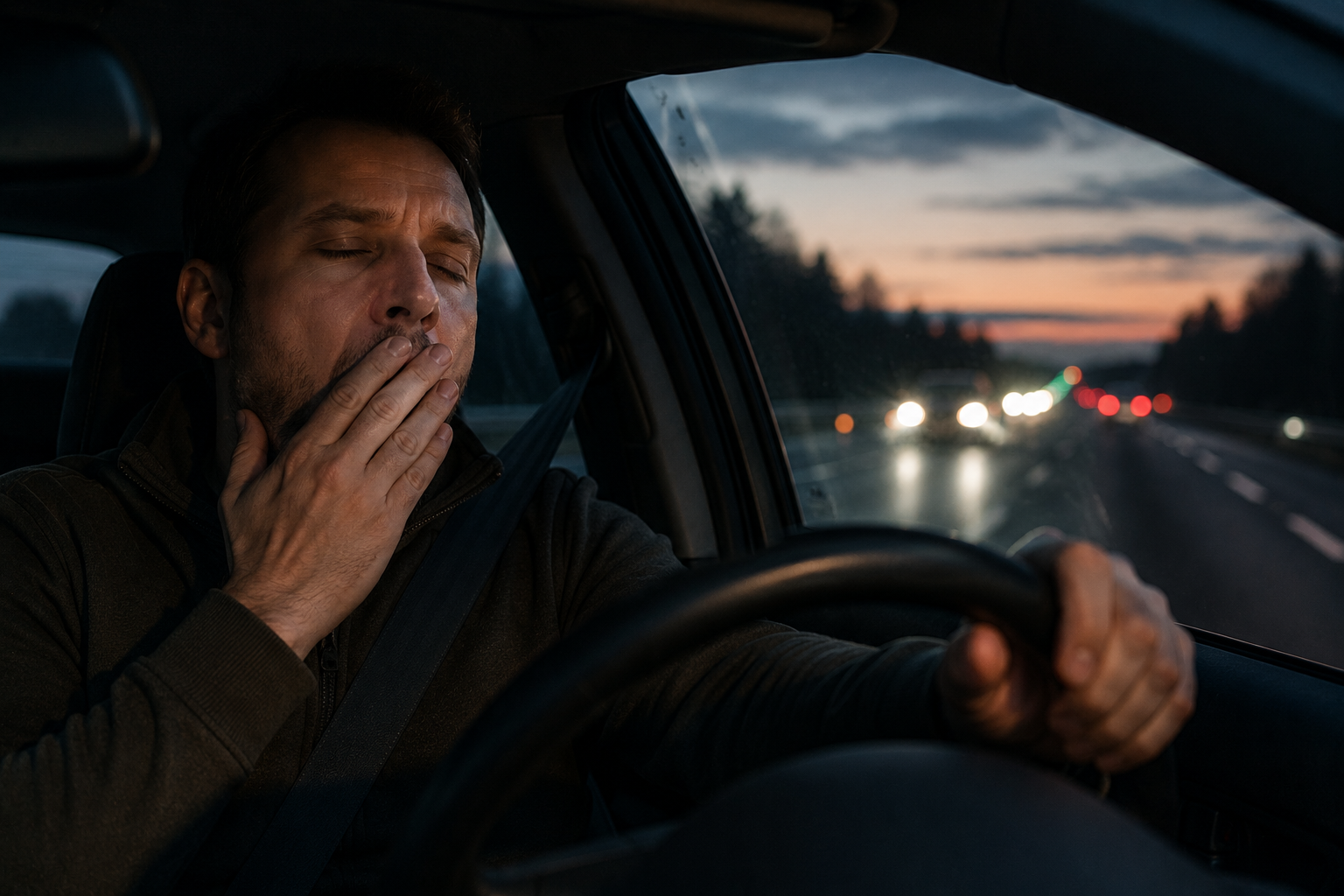
The clock shows 02:47. The road is almost empty, the lights of oncoming vehicles appear only every few minutes, and the navigation system says there are 54 kilometres left until home.
The driver feels tired, but the situation does not seem dramatic. He has not consumed alcohol, he is not speeding, his seat belt is fastened and the car is working perfectly. To feel more alert, he lowers the cabin temperature, turns up the music and drinks the final mouthful of an energy drink.
A few kilometres later, he realises that he cannot remember the previous junction.
A little later, a tyre touches the road-edge marking. The driver corrects the steering sharply, his heart begins beating faster, and for several minutes it feels as though the tiredness has disappeared.
In reality, it has not disappeared. The body has only reacted temporarily to the fright.
The next lapse in attention may begin without a yawn, without advance warning and without a conscious decision to close the eyes.
This is known as microsleep — a brief, uncontrollable sleep episode during which a person may outwardly remain upright, continue holding the steering wheel and even appear to be looking ahead, while the brain temporarily stops processing events properly.
At 90 km/h, four seconds represent 100 metres. The driver is still sitting in the seat, but the car effectively travels that distance without conscious control.
The driver’s brief conclusion: once you have begun fighting sleep, safe driving has already ended. From that moment, the goal is not to “hold on until home” but to find a safe place to stop the journey.
What exactly is microsleep?
Microsleep is not simply daydreaming. It is a brief sleep episode that may last from a fraction of a second to several seconds and, in cases of severe sleep deprivation, even longer.
Sometimes the driver’s eyes close completely. At other times, they may remain partly open while the brain temporarily stops processing visual information properly.
This means a person may appear to be looking straight at the road while failing to notice a bend, a braking vehicle, a pedestrian, a road sign or the edge of the lane approaching.
After a microsleep episode, the person may not realise that they fell asleep. They may believe that their vision merely became blurred for a moment or that they were deeply lost in thought.
Sometimes the only evidence is a sudden steering correction, the sound of tyres on the road edge, a passenger shouting unexpectedly or the realisation that the vehicle is positioned differently in the lane than it was moments earlier.
Fatigue, sleepiness and “autopilot” are not the same thing
Fatigue is a broad condition. A person may be physically exhausted after work, emotionally drained after a stressful day or mentally tired after prolonged concentration.
Sleepiness is more specific — it is the body’s biological need to sleep.
So-called highway hypnosis, or driving without conscious attention, may also occur in monotonous conditions when the driver is not yet close to falling asleep. The person continues driving but later cannot remember several of the preceding kilometres.
These conditions can overlap. A monotonous road makes a tired driver even sleepier, while sleepiness increases the likelihood of slipping into automatic, less conscious driving.
Fatigue
Energy, motivation, patience and the ability to maintain precise attention for a long period all decline.
Sleepiness
The brain’s need for sleep increases; the eyelids become heavy, reactions slow down and brief lapses in attention begin.
Microsleep
A genuine sleep episode occurs for several seconds, during which conscious control is no longer fully present.
The most dangerous hours are determined by more than darkness
Sleepiness is not simply a fatigue counter that increases equally with every hour spent awake.
The human body has an internal daily rhythm. At certain times it promotes alertness, while at others it lowers body temperature, attention and readiness for activity.
The strongest period of sleepiness usually occurs during the second half of the night and early morning. An increased risk may also appear in the afternoon, when many people experience a natural decline in alertness.
A driver who says at 03:30, “I have not been driving for very long,” may therefore underestimate the main risk — they are driving at a time when the body biologically expects sleep.
A particularly dangerous combination is an early departure after a short night. For example, a driver may wake at 03:30 to travel to an airport or begin a long international journey.
They may have slept for only four or five hours, while the journey begins precisely when the body’s alertness is at its lowest.
The first warning signs that must not be ignored
Microsleep is rarely the first sign of fatigue. The body usually tries several times beforehand to indicate that its reserve of alertness is running out.
Heavy eyelids
Opening the eyes requires effort, and the driver repeatedly rubs or blinks them to restore clear vision.
Repeated yawning
One yawn proves little, but regular yawning during a journey is a serious warning.
The previous kilometres have “disappeared”
The driver cannot remember the most recent sign, settlement, junction or several of the preceding kilometres.
Poor lane control
The vehicle begins wandering within the lane, moving towards the edge or touching the road markings.
Delayed decisions
An exit, speed restriction, braking vehicle or traffic-light change is noticed too late.
Restlessness and irritability
It becomes difficult to find a comfortable position, while other drivers, music, passengers or the navigation voice begin to feel irritating.
When even one of these warning signs appears, it is not time to experiment with the window, radio or sweets. It is time to look for a safe place to stop.
When several signs appear at once, continuing the journey becomes a gamble in which the driver is risking both their own safety and the safety of everyone else.
Why does a tired driver often overestimate their abilities?
Fatigue damages more than reaction time. It also reduces the ability to judge that reaction time accurately.
At the exact moment when the driver’s performance begins to decline significantly, they may become less capable of understanding how poorly they are actually driving.
The driver tells themselves, “I am in control,” because the car remains within the lane. What they do not see are the countless smaller errors — slower eye movements, longer fixed glances, inconsistent speed, poorer distance control and delayed processing of information.
After touching the road-edge marking, adrenaline is released and the driver briefly feels more alert. This temporary effect is easily mistaken for restored safety.
Adrenaline does not repay sleep debt. As soon as the effect of the fright fades, sleepiness may return even more strongly.
“I will only drive as far as the next town”
One of the most dangerous thoughts is the desire to set another apparently achievable limit.
“There are only 30 kilometres left.” “I will be there in twenty minutes.” “I will stop at the next petrol station.”
The problem is that microsleep is under no obligation to wait until the next petrol station.
When your eyelids already feel heavy, the dangerous episode may begin in ten seconds rather than twenty kilometres.
Safety principle: when fatigue appears, the goal is not to find the perfect resting place. The goal is to leave active traffic as soon as possible in a safe and permitted location.
Who faces the greatest risk of microsleep?
Anyone can fall asleep behind the wheel. Certain situations, however, increase the risk particularly quickly.
Night and shift workers
A person may feel sufficiently alert at work because light, movement and responsibilities keep them stimulated. During the quiet journey home, that stimulation disappears and sleepiness rises sharply.
Young drivers
Late evenings, studies, work, social life and insufficient sleep often form a dangerous combination, made worse by less experience recognising the signs of fatigue.
New parents
Sleep may remain fragmented for weeks or months. Even when the total number of hours seems acceptable, repeated awakenings reduce sleep quality.
Professional drivers
Long working days, early starts, irregular schedules, deadline pressure and monotonous distances may create chronic fatigue even when formal break requirements are followed.
People using certain medicines
Some allergy medicines, painkillers, sedatives and other medications may cause sleepiness. A warning may be included in the instructions or printed on the packaging.
People with untreated sleep disorders
Loud snoring, pauses in breathing during sleep, morning headaches and severe daytime sleepiness may indicate sleep apnoea or another health problem.
Even a completely healthy person’s risk rises sharply after one very short night, several consecutive days of insufficient sleep or an exceptionally demanding working day.
Sleep debt does not disappear after one long Saturday morning
When a person needs eight hours of sleep but sleeps for only six hours on five consecutive nights, they accumulate approximately ten hours of sleep deficit during the week.
The body does not regard every morning as a fresh start. Insufficient sleep accumulates, and a person may become accustomed to feeling tired, mistakenly treating it as their normal condition.
That sense of familiarity is dangerous. The person may no longer feel exceptionally tired, while attention, reaction speed and decision quality remain impaired.
One long sleep may help, but it does not always fully restore sleep lost over an extended period or repair an unstable daily rhythm.
Extended wakefulness can affect driving in a way comparable to alcohol
Research has compared the decline in performance caused by prolonged wakefulness with the effects of alcohol.
After approximately 17 hours without sleep, the reduction in performance may be comparable to the effects associated with a blood alcohol concentration of around 0.5‰. After 24 hours awake, impairment may approach the effects associated with approximately 1.0‰.
This comparison does not mean that fatigue can be assigned an exact blood-alcohol figure or that every person responds in the same way.
It demonstrates the scale of the problem: someone who would never consider driving after drinking alcohol may nevertheless drive after being awake throughout the night without much hesitation.
Why are fatigue-related collisions often particularly serious?
An attentive driver will usually attempt to brake, avoid the hazard or at least reduce speed before a collision.
A sleeping driver may do nothing. The vehicle continues at its previous speed until it leaves the road or collides with an oncoming vehicle, tree, barrier or another obstacle.
Fatigue-related crashes therefore frequently occur on rural roads and main roads, involve a single vehicle and happen without clear evidence of heavy braking.
An empty road is not a safety advantage in this situation. It is monotonous, permits higher speeds and provides fewer external stimuli to maintain attention temporarily.
Myths that help only briefly — or do not help at all
“I will open the window and the sleepiness will disappear.”
Cool air may create a brief feeling of alertness, but it does not remove the brain’s biological need for sleep. Once the new stimulus becomes familiar, the sleepiness returns.
“I will play very loud music.”
Sound may provide temporary stimulation, but a tired brain can fall asleep even in a noisy environment. Excessively loud music may also prevent the driver from hearing sirens and vehicle warnings.
“An energy drink will save me.”
Caffeine may improve alertness temporarily, but the effect is not immediate and it does not replace sleep. Microsleep remains possible after caffeine when sleep deprivation is severe.
“I will drive faster to make the journey more interesting.”
Higher speed reduces the available reaction time and increases the severity of a collision. Alertness caused by adrenaline is temporary, while the danger becomes greater.
“I will call someone to keep me entertained.”
A conversation may briefly maintain activity, but it also occupies cognitive attention. The person on the other end of the call cannot see how poorly you are already controlling the vehicle.
“I have never fallen asleep behind the wheel.”
The fact that previous tired journeys ended successfully does not make the next journey safe. The first microsleep episode may happen today.
What genuinely works?
Sufficient sleep before a journey is the only reliable way to prevent the risk created by severe fatigue.
When sleepiness has already begun during the journey, the most effective response is to stop driving rather than trying to convince yourself that you can continue.
What to do when sleepiness begins:
1. Reduce speed gradually and increase the following distance.
2. Do not attempt a risky overtake simply to reach a stopping place faster.
3. Select the nearest safe and permitted place to stop.
4. Secure the vehicle against movement and switch off the engine when conditions allow.
5. Change places with a fully rested driver or sleep.
6. Do not continue the journey when sleepiness remains after resting.
Sometimes the safest decision is to book accommodation, wait for several hours, use a taxi or ask someone to collect you.
That may be inconvenient and expensive. Those costs are not comparable with the consequences of a collision.
Coffee and a 20-minute nap: an emergency method, not a journey plan
A so-called coffee nap is often recommended for temporarily restoring alertness.
The idea is simple: after stopping safely, the person drinks coffee or another moderate dose of caffeine and immediately attempts to sleep for approximately 15–20 minutes.
Caffeine needs time to begin working. At the end of the short nap, the recovery provided by sleep may combine with caffeine’s stimulating effect.
This method may help temporarily, but it has important limitations.
• Caffeine does not replace sufficient sleep.
• Its effect differs from person to person.
• The effect may be weaker in regular coffee drinkers.
• An energy drink may contain a large amount of sugar and may not be suitable for a particular health condition.
• When heavy eyelids, confusion or repeated yawning remain after the nap, the person must not drive.
A coffee nap is an emergency response once fatigue has already appeared. It is not permission to begin a 600-kilometre journey deliberately after only three hours of sleep.
Where should you stop when sleepiness begins?
A tired driver may struggle to make complicated decisions, so the principles for finding a safe stopping place should remain simple.
A suitable location may be a petrol station, official rest area, car park, 24-hour shop or another public and permitted place away from the active carriageway.
Do not stop on a narrow shoulder, within a bend, on a bridge, inside a tunnel, directly beyond the crest of a hill or anywhere the vehicle cannot be seen in sufficient time.
Hazard warning lights do not transform a dangerous stopping place into a safe rest area.
When travelling on a motorway or a road where stopping is restricted, continue to the nearest safe exit, but do so at a reduced speed, with an increased following distance and maximum caution.
Will the car itself notice that the driver is falling asleep?
Many newer vehicles analyse steering movements, lane position, journey duration or the driver’s face.
The system may display a coffee-cup symbol, produce an audible warning, tighten the seat belt or warn that the driver’s eyes have not been directed towards the road for too long.
Such assistance can be extremely valuable, but it is not a medical sleep detector.
A steering-movement system may fail to identify someone driving in a very straight line. A camera may be affected by sunglasses, poor lighting or head position. A warning may appear only after driving quality has already deteriorated.
The correct attitude: a driver-monitoring system is a final safety net. It is not a tool for testing how long you can drive without sleeping.
Three scenarios familiar to drivers in Latvia
1. An early-morning journey to the airport
Departure is scheduled for 03:45 after an evening spent packing bags and checking documents. The driver has slept for four hours but believes that a 40-minute journey is not long.
The risk is not caused only by the short sleep. The journey takes place during the biologically lowest period of alertness, in darkness and on a relatively empty road.
2. Returning from an event in another city
The driver has not consumed alcohol and therefore considers themselves completely safe. The event ended after midnight, however, the day began early, and a two-hour journey remains.
Avoiding alcohol is essential, but it does not automatically guarantee alertness.
3. A long summer journey across Europe
A family wants to cover as much distance as possible in one day. They depart very early, breaks are postponed, and the driver continues because the children are sleeping and traffic is calm.
The quiet cabin and monotonous road may increase sleepiness. By the end of the day, the driver may have been awake for 16 or 18 hours.
How should a long journey be prepared professionally?
The day before
• Do not plan a late evening before an early departure.
• Pack everything in good time.
• Sleep for as long as you normally require to feel fully rested.
Before departure
• Assess honestly how you feel.
• Check warnings supplied with any medication.
• Add the first planned rest locations to the navigation route.
During the journey
• Rest approximately every two hours.
• Change places with another rested driver.
• Do not postpone a break simply because you “do not feel extremely tired yet”.
During a break, leave the vehicle, move around a little, drink some water and reassess how you feel.
Walking alone does not replace sleep. When sleepiness is already pronounced, a nap, driver change or longer rest is required.
A 60-second self-check before driving
1. How many hours did I sleep last night?
2. Have I accumulated sleep debt during the past few days?
3. Is this a time when I would normally be asleep?
4. Do I already have heavy eyelids or repeated yawning before departure?
5. Have I taken medicine that may cause drowsiness?
6. Is another fully rested driver available?
7. Where are the first two safe rest locations?
8. Would I trust this driver with my family’s safety if the driver were someone other than me?
The final question often helps break through overconfidence. We sometimes permit ourselves to take risks that we would never accept from another person.
Seven-day experiment: discover your real sleep situation
For one week, record every morning when you went to bed, when you woke up and how many times your sleep was interrupted.
During the day, note the moments when you feel sleepy, find it difficult to concentrate or unintentionally fall asleep while watching television.
Record separately how you felt behind the wheel — particularly early in the morning, after lunch and in the evening.
The experiment may reveal that your fatigue is not random. It may occur regularly at a particular time, after a particular work schedule or following several short nights.
When severe daytime sleepiness remains despite sufficient sleep, or is accompanied by loud snoring and pauses in breathing, it is sensible to consult a doctor.
Mini test: can you recognise dangerous fatigue?
Answer before checking the correct responses:
1. How many metres does a car travel in four seconds at 90 km/h?
2. Must the eyes always be completely closed during microsleep?
3. Does loud music reliably prevent a driver from falling asleep?
4. Does coffee fully replace sleep?
5. Which periods of the day are normally the most dangerous?
6. What may an inability to remember the previous kilometres indicate?
7. Does a driver-fatigue warning system guarantee safety?
8. How often should a break be planned during a long journey?
9. What is the first correct decision when repeated yawning and poor lane control begin?
10. Does a person always understand accurately how tired they are?
Correct answers: 1 — 100 metres; 2 — no; 3 — no; 4 — no; 5 — the second half of the night and early morning, together with the afternoon decline in alertness; 6 — driving without conscious attention or a risk of microsleep; 7 — no; 8 — approximately every two hours or sooner when fatigue appears; 9 — stop driving safely; 10 — no.
What should a passenger do when the driver becomes sleepy?
A passenger should not wait until the vehicle touches the road edge.
When the driver yawns repeatedly, controls the lane inaccurately, misses signs or becomes unusually quiet, the passenger should say directly: “You look sleepy. We need to stop.”
The response “everything is fine” should not be treated as sufficient evidence. Fatigue itself reduces the ability to assess one’s own condition.
When the passenger has a driving licence and is fully rested, the drivers can change places. When both people are tired, both need to rest.
How long can microsleep last?
It may last from a very brief moment to several seconds. Longer short sleep episodes are also possible in cases of severe sleep deprivation. Even four seconds at 90 km/h represents 100 metres without full conscious control.
Does a person notice that they experienced microsleep?
Not always. A person may notice a gap in time, fail to remember the previous section of road or suddenly discover that the car has moved away from its previous position. In other cases, they may incorrectly believe that they were merely daydreaming.
Does a 15–20-minute nap genuinely help?
A brief nap may temporarily improve alertness and is considerably more effective than opening a window or playing loud music. It does not replace sufficient sleep, however, and after waking the person must assess whether the sleepiness has genuinely reduced.
May a person sleep inside a car?
A safe and permitted parking place must be selected in accordance with local rules. The vehicle must be secured against movement. A person must not sleep in a dangerous roadside location or in an enclosed space with an internal-combustion engine running.
Is an energy drink more effective than coffee?
The main stimulant is usually caffeine, although the dose, sugar content and individual response differ. Neither coffee nor an energy drink replaces sleep or makes a severely sleep-deprived driver safe.
Is one coffee enough after a night shift?
Coffee may increase alertness temporarily, but a night shift combines prolonged wakefulness with driving at a time when the body biologically wants to sleep. Resting, changing drivers or using alternative transport may be the safer option.
Does cruise control increase the risk of microsleep?
Cruise control does not itself cause sleep, but constant speed and reduced physical involvement on a monotonous road may reduce external stimulation. No assistance system is a reason for a tired driver to continue travelling.
Will lane-keeping assistance protect a driver who falls asleep?
It may warn the driver or correct the vehicle’s path briefly, but it does not always recognise lane markings and is not intended to control a vehicle for an extended period instead of a sleeping driver.
How can I tell whether I may have sleep apnoea?
Possible signs include loud snoring, pauses in breathing, choking sensations during sleep, morning headaches, a dry mouth and severe daytime sleepiness. A medical professional must make the diagnosis, so a doctor should be consulted when the condition is suspected.
Is a break every two hours sufficient?
Two hours is a practical planning guideline rather than a guarantee. When signs of fatigue appear after 40 minutes, the driver should stop after 40 minutes. A break also does not compensate for beginning a journey after very little sleep.
Conclusion: sleep cannot be defeated by willpower
A tired driver often believes that safety is a matter of determination.
They pull themselves together, straighten their back, grip the steering wheel more firmly and promise themselves not to close their eyes again.
Sleep is not a voluntary habit that can be cancelled through stronger determination. When the pressure to sleep becomes sufficiently strong, the transition into sleep may happen suddenly.
An open window, loud music, an energy drink or a phone conversation may change how the driver feels briefly, but none of them restores the biological processes that occur during sleep.
A safe driver is not the person who can fight sleep for the longest time. A safe driver is the person who recognises the limit and stops before the body makes that decision for them.
A missed meeting, a more expensive hotel or reaching the destination one hour later may cause inconvenience.
Four seconds of sleep at 90 km/h can change the rest of a person’s life.
The main conclusion for drivers: when you cannot remember the previous kilometres, touch the road markings, yawn repeatedly or struggle with heavy eyelids, the journey is no longer safe. Do not attempt to prove that you can endure it. Leave the road, stop in a safe place and sleep — the destination can wait.