
 LV
 EN
 RU
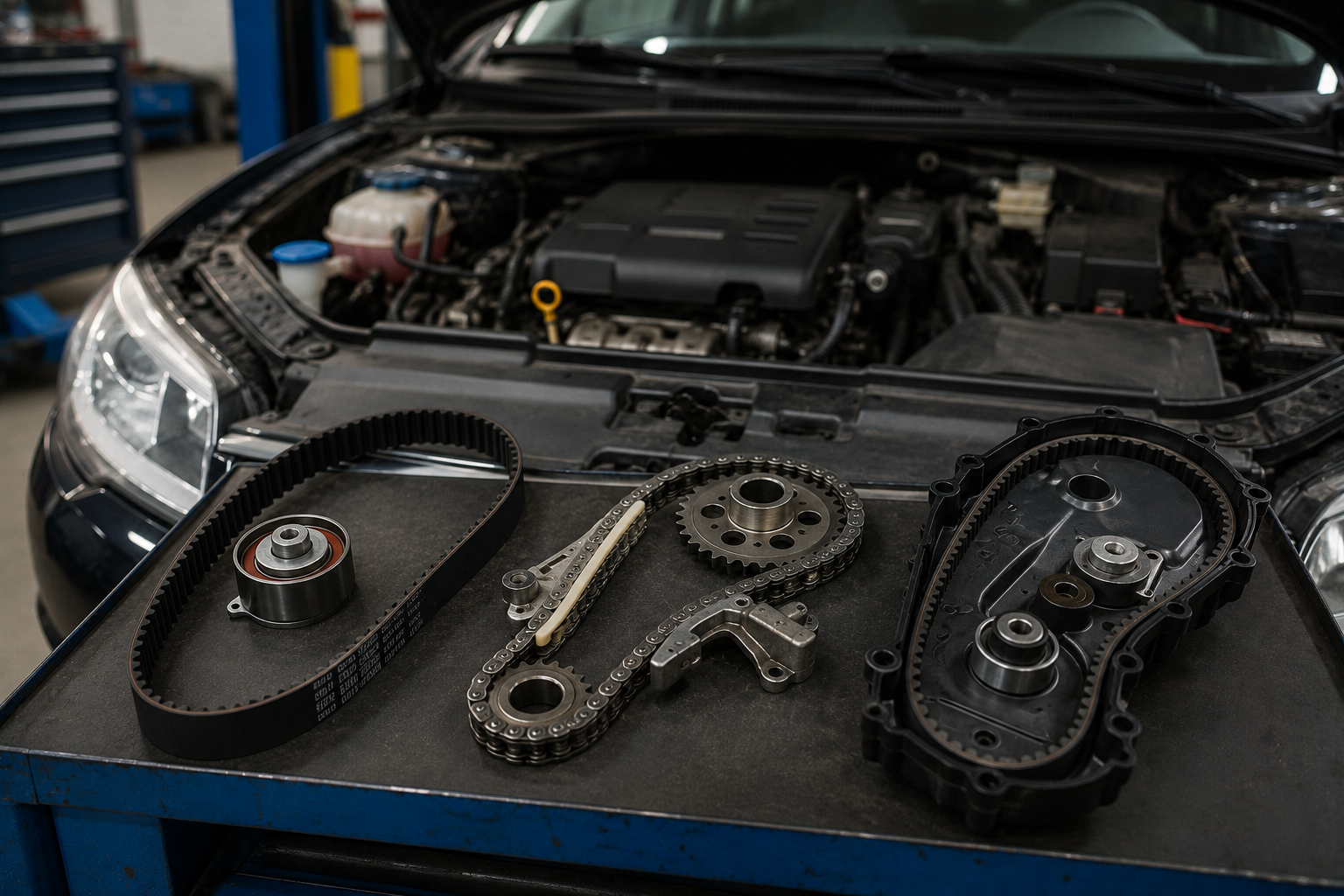
The seller of a used car confidently says: “It has a chain, so it never needs replacing.” The last entry in the service book was made six years ago, there are no invoices, and a brief metallic noise can be heard when the cold engine is started.
In another situation, nothing suspicious can be heard under the bonnet. The car runs well, there are no dashboard warnings, but the owner does not know when the timing belt was last replaced. They decide to wait another season because the belt will surely “start squeaking before it breaks”.
Both assumptions can become extremely expensive. A timing chain is not automatically permanent, while a timing belt often gives no clear warning through noise or a dashboard light. The timing drive may appear to consist of a single component, but it is actually a system that includes tensioners, guides, rollers, sprockets, seals and, in some engines, the water pump.
The most important question is not simply “belt or chain?”. You need to know the exact engine, the manufacturer’s specified interval, the age of the vehicle, its maintenance history, the oil that has been used and whether the previous repair really included the complete timing-drive kit.

The safest timing-drive interval is not the number mentioned most often online. It is the interval specified for the exact engine and supported by verifiable maintenance records.
What does the engine timing drive do?
The engine crankshaft moves the pistons, while the camshaft opens and closes the valves. Both shafts must operate in a precisely synchronised rhythm so that the valves open at the correct moment, allowing air to enter the cylinder, combustion to occur and exhaust gases to leave.
This synchronisation is maintained by a timing belt, timing chain or, less commonly, another type of mechanical drive. The belt teeth or chain links engage with the crankshaft and camshaft sprockets, preventing the shafts from changing their relative positions freely.
If the drive stretches, jumps by one or more teeth, loses tension or breaks, the valve timing no longer matches the movement of the pistons. The engine may lose power, run unevenly, fail to start or suffer mechanical damage.
The ribbed belt visible on the outside of the engine usually drives the alternator, air-conditioning compressor or other auxiliary components. The timing belt is generally located beneath a protective cover. Replacing one belt does not automatically mean that the other has also been replaced.
Timing belt, timing chain and wet belt: how are they different?
A toothed composite belt operates beneath a protective cover and is not designed for continuous contact with engine oil.
It is light and quiet, but it has a defined replacement interval based on mileage, time or both.
A metal chain operates in engine oil and runs along guides, using a mechanical or hydraulic tensioner.
It often has no simple periodic replacement interval, but the chain, guides, sprockets and tensioner can still wear out.
Some engines use a specially designed timing belt that operates inside the engine oil. It is commonly known as a wet belt.
Its durability is strongly affected by the correct oil specification, maintenance intervals, fuel dilution of the oil and the inspection requirements of the specific manufacturer.

How can you determine which system your car uses?
The make, model and production year alone are not enough. A single model may be offered with several petrol and diesel engines, and engines with the same displacement may use different timing drives in different production years.
The safest method is to check the VIN, exact engine code and manufacturer’s technical information. A workshop or parts catalogue can use these details to determine whether the engine has a belt, chain or wet belt and which components belong in the replacement kit.
The decorative engine cover does not provide the answer
In some engines, the timing drive is positioned close to the vehicle body or even on the transmission side. It cannot be identified reliably simply by looking into the engine bay or reading the engine displacement printed on a plastic cover.
When should a timing belt be replaced?
There is no universal interval. One engine may have a relatively short manufacturer-specified interval, while another may have a significantly longer one. The interval may also differ between normal and severe operating conditions.
Both mileage and time must be considered. If the manufacturer specifies replacement after a certain number of kilometres or years, whichever limit is reached first becomes the deadline. A low-mileage vehicle is not automatically protected, because the belt material is affected by age, temperature changes, moisture and prolonged storage in one position.
- the vehicle manufacturer’s maintenance schedule for the exact VIN and engine;
- manufacturer technical updates and service-campaign information;
- the previous repair invoice showing the date, mileage and installed components;
- a competent workshop that verifies the information using the engine code rather than only the model name.
What should you do if the replacement history is unknown?
A verbal claim that “the previous owner definitely replaced it” is not evidence. A sticker in the engine bay may also be incorrect, faded or refer to only one component.
If there is no invoice, service record or other verifiable document, it is safer to assume that the maintenance has not been proven. This is especially important in engines where timing-drive failure can cause contact between the valves and pistons.
The date, mileage, part numbers, kit contents and workshop name are shown. The next interval can be planned using this information.
Check whether the information can be confirmed by the workshop or previous owner. A sticker alone does not provide complete certainty about which parts were replaced.
Identify the correct kit and arrange preventive replacement instead of waiting for noise or visible damage.
Why is visually inspecting the timing belt not enough?
A visible section of the belt may look clean and free from cracks even though its internal tensile fibres, tooth base or material bonding have already weakened. In addition, only a small part of the belt can usually be seen.
A visual inspection is useful for identifying oil contamination, coolant leaks, belt misalignment, damaged edges, cracks or missing teeth. It does not replace the manufacturer’s specified replacement interval.
What should be replaced together with the timing belt?
Replacing only the belt while leaving the old tensioner and rollers in place is often false economy. If an old bearing seizes or the tensioner can no longer maintain the correct tension, the new belt may be damaged far earlier than the intended interval.
- the timing belt;
- the tensioner and idler rollers;
- the water pump, if it is driven by the timing belt or requires the same dismantling work for replacement;
- single-use bolts and fasteners;
- seals and coolant;
- additional belts, oil seals or other related components in certain engines.
Does the water pump always need to be replaced?
The water pump is not driven by the timing belt in every engine. If the pump uses another drive or is electric, the replacement logic may be different.
If the water pump forms part of the timing-belt drive, leaving the old pump in place creates two risks. It may later begin leaking, requiring the same part of the engine to be dismantled again, or its bearing may damage the timing drive. The repair procedure for the exact engine and the kit manufacturer’s instructions should therefore be followed.
The invoice should show the contents of the kit
An entry such as “engine belt materials replaced” is not precise enough. Keep an invoice showing the part numbers, list of work, vehicle mileage and replacement date.
Does a timing chain really last for the life of the car?
A timing chain usually does not have the same regular replacement schedule as a dry timing belt, but that does not mean it cannot wear out. The durability of the chain system depends on the chain itself, the guides, tensioner, sprockets, lubrication and engine design.
The commonly used phrase “stretched timing chain” does not necessarily mean that the metal has stretched like rubber. Wear develops at the chain joints, increasing its overall length and changing the valve timing.

Signs that may indicate a timing-chain problem
A single symptom is not a complete diagnosis. A brief noise may also be produced by the variable valve-timing mechanism, delayed oil pressure, auxiliary components or other parts. A targeted inspection is required.
Why is engine oil so important for a timing chain?
The chain and its guides are lubricated by engine oil, and many engines use an oil-pressure-operated hydraulic tensioner. Incorrect viscosity, an unsuitable specification, a low oil level, deposits or excessively extended oil-change intervals can impair the system’s operation.
This does not mean that every timing-chain problem is automatically caused by poor maintenance. Design, material and component defects also exist. However, using the correct oil and replacing it on time are among the few factors that an owner can control in everyday use.
Turning up the radio is not a repair
If a metallic noise repeatedly occurs during a cold start, record it and arrange diagnostics. A noise that disappears after the engine warms up does not mean that the cause has disappeared.
What should you know about an oil-immersed wet belt?
An oil-immersed timing belt is manufactured to operate inside the engine oil. It cannot be assessed according to exactly the same principles as a conventional dry belt, but it still has specific material and oil-compatibility requirements.
An incorrect oil specification, excessively long maintenance intervals, fuel dilution of the oil or other operating conditions can affect the belt material. In some cases, particles may separate from the belt and enter the lubrication system.
- which exact engine-oil specification is required for the engine;
- what the current replacement and inspection interval is for the VIN;
- whether the manufacturer has issued an updated maintenance or inspection procedure;
- whether the belt width and surface can be checked using the prescribed method;
- whether particles of belt material have been found in the oil pickup, filter or sump.
A universal approach is particularly dangerous here. What is correct for one engine may be wrong for another. When choosing engine oil, the viscosity printed on the container is not enough; the oil must also meet the manufacturer’s required specification.
What happens if the belt or chain jumps or breaks?
The consequences depend on the engine design, engine speed and the extent to which the valve timing changes. In some engines, the pistons and open valves occupy the same physical space at different moments in the operating cycle. Correct synchronisation prevents them from meeting.
If synchronisation is lost, a piston can bend the valves and damage their guides, the piston crowns or the cylinder head. In severe cases, the camshaft, connecting rods and other internal engine components may also be affected.
In other engines, no mechanical contact may occur and the vehicle may simply stop or fail to start. This should never be assumed without checking the technical information for the exact engine.
The work is planned, the parts list is known and the owner can choose a convenient service time before the vehicle becomes undriveable.
The engine may lose power, run unevenly, register timing-correlation faults or fail to start.
Internal engine damage, vehicle recovery, a lengthy repair and costs many times higher than preventive maintenance may follow.
What should you do if the engine suddenly stops?
If the engine suddenly stops while driving, the starter turns unusually easily or a mechanical noise is heard, do not repeatedly attempt to restart it. Every additional attempt may increase the extent of the damage.
Switch on the hazard lights, stop the vehicle safely and contact roadside assistance. The correct inspection should be carried out at a workshop rather than by repeatedly cranking the engine in a car park.
How much can delayed maintenance cost?
Actual costs vary considerably according to the engine, parts availability, labour complexity and extent of the damage. Access to the belt may be relatively simple in one vehicle, while another may require the removal of numerous components or partial removal of the engine.
It is therefore more useful to compare the cost of preventive maintenance with the possible total consequences than to search for one universal market price.
Assume that replacement of a complete preventive kit costs €650 for a particular vehicle. After a timing-drive failure, the engine repair, recovery and replacement transport cost a total of €3,100.
These figures are illustrative and are not a quotation from a specific workshop. The actual repair may be less expensive or considerably more expensive.
How should the timing drive be checked before buying a used car?
Look for documents rather than relying on the seller’s promises. A detailed invoice helps establish not only when the work was completed, but also whether the complete system was replaced.
- the exact engine code and timing-drive type;
- the manufacturer’s replacement or inspection interval;
- the date of the last maintenance and the vehicle mileage at that time;
- whether only the belt was changed or the rollers, tensioner and water pump were also replaced;
- which oil has been used in a timing-chain or wet-belt engine;
- whether a metallic noise is present during a cold start;
- whether timing-correlation faults are stored in the engine control unit.
What does “timing belt recently replaced” mean in an advertisement?
It can be a valuable benefit, but only if the repair can be verified. Find out who completed the work, which parts were used and why the belt was replaced immediately before the car was offered for sale.
If there is no invoice, no part numbers and no mileage record, the claimed repair should not automatically be valued as a complete professional service when negotiating the purchase price.
Common mistakes after timing-drive repairs
An old tensioner, roller or pump can damage the new belt and force the owner to pay again for the same dismantling work.
Paint marks do not always replace the crankshaft and camshaft locking tools specified by the manufacturer.
A loose drive can jump, while excessive tension overloads the belt, rollers, pump and shaft bearings.
If oil continues to enter the dry timing-belt area, the new component may also be damaged.
After several years, the owner no longer remembers the exact date or mileage and the uncertainty begins again.
Can you replace a timing belt or chain yourself?
Timing-drive replacement is not comparable with changing an air filter or light bulb. Incorrectly set valve timing can damage the engine during the first attempted start.
The work may require special locking tools, engine support, precise bolt-tightening sequences, specified angles, tensioner adjustment and, in some engines, diagnostic procedures after the repair.
An experienced mechanic with the technical documentation for the exact engine can carry out the work safely. For someone without the appropriate experience, the possible saving may be disproportionate to the risk of engine damage.
What should you ask the workshop before approving the work?
☐ What is the exact engine code?
☐ What is the manufacturer’s current interval?
☐ What is included in the proposed kit?
☐ Will all rollers and the tensioner be replaced?
☐ Is the water pump driven by the timing belt?
☐ Are new bolts and seals required?
☐ Will any oil or coolant leaks be repaired?
☐ Which brands of parts will be installed?
☐ What warranty applies to the parts and labour?
☐ Will I receive the part numbers after the repair?
☐ Will the invoice show the date and mileage?
☐ When is the next inspection or replacement due?
A short self-check
The vehicle covers only 5,000 kilometres per year. Can the age of the timing belt be ignored?
No. If the manufacturer also specifies a time limit, whichever condition is reached first must be followed: mileage or age.
The timing belt looks clean and has no visible cracks. Can replacement be delayed?
A visual inspection cannot reliably assess the belt’s internal fibres or the condition of all drive components. If the manufacturer’s interval has been reached, replacement should not be delayed simply because the belt looks good externally.
The engine has a chain and no scheduled replacement interval. Does it require no attention at all?
Correct oil maintenance must be followed, and attention should be paid to noises, fault codes and changes in engine operation. A timing-chain system can wear even without a fixed replacement interval.
Should the engine be repeatedly restarted after a timing-belt failure?
No. If timing-drive damage is suspected, repeated starting attempts can increase the mechanical damage.
Frequently asked questions
Does a timing belt always make a noise before it breaks?
No. Noise may be produced by the rollers, tensioner or water pump, but the belt itself may lose teeth or break without a clear warning.
Are motorway kilometres easier on a timing belt than city driving?
Operating conditions can affect various components, but they do not cancel the manufacturer’s interval. The replacement deadline should not be extended simply because most kilometres were covered outside the city.
Does timing-chain noise always mean that the complete kit must be replaced?
The source of the noise and the condition of the system must first be identified. If timing-chain wear is confirmed, the chain, guides, tensioner, sprockets, fasteners and seals are generally assessed as one system.
Can an oil change repair a stretched timing chain?
No. Correct oil may improve hydraulic-tensioner operation if the problem is related to lubrication, but it cannot restore a mechanically worn chain, guide or sprocket.
Is replacing the water pump with the timing belt unnecessary parts replacement?
It depends on the engine design. If the pump is driven by the timing belt or replacing it later would require almost all the same labour, installing a new pump can reduce the risk of a repeated repair or timing-drive failure.
Can a universal interval such as 100,000 kilometres be trusted?
No. Intervals differ significantly between engines, and the manufacturer may also specify a time limit or special inspection requirements.
Can any oil of the correct viscosity be used with a wet belt?
No. The oil must also meet the exact specification required by the vehicle manufacturer. The same viscosity grade does not guarantee the same additive package or material compatibility.
Will the Check Engine light always appear before a timing-chain failure?
No. The control unit may detect a timing-correlation error, but mechanical noise or a tensioner problem may develop before a clear dashboard warning appears.
Maintenance that should never be planned by guesswork
A timing belt, timing chain and oil-immersed wet belt all perform the same fundamental task: maintaining the engine’s precise mechanical rhythm. Their design, maintenance requirements and typical failure causes are different.
For a dry timing belt, the manufacturer’s mileage and time limits are important. For a chain, correct lubrication and timely diagnosis of noises and timing faults matter. A wet belt requires the exact oil specification and the inspection procedure prescribed for the specific engine.
When buying a used vehicle, an unproven maintenance history should not be replaced with hope. A preventive inspection or replacement may appear expensive only until it is compared with the cost of repairing an engine after timing-drive failure.
The driver’s main takeaway: identify the exact engine code, check the manufacturer’s interval and request documentary evidence. If timing-belt replacement cannot be proven or a chain produces a suspicious cold-start noise, do not postpone diagnostics until the next season.