
 LV
 EN
 RU
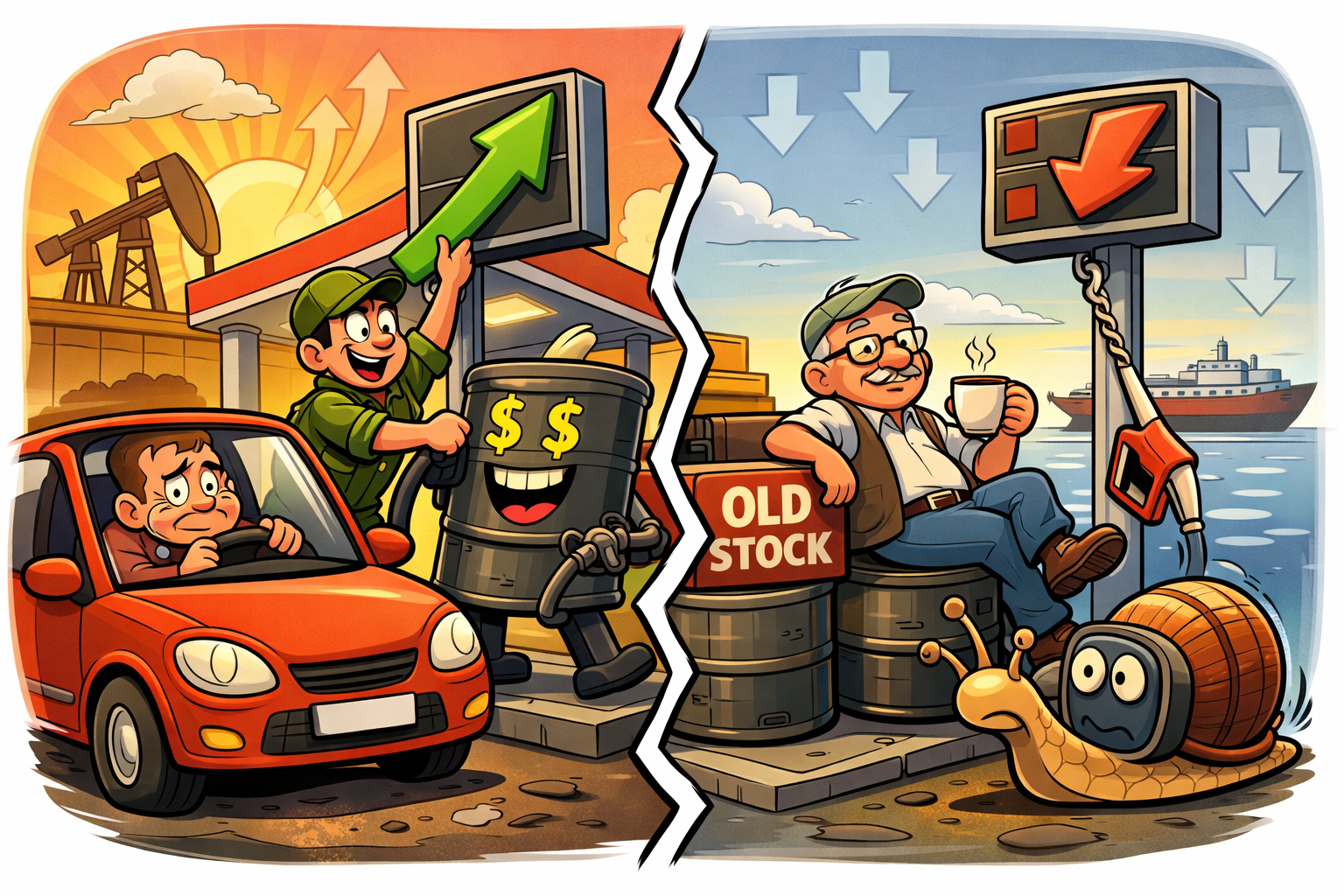
This is one of those questions drivers ask again and again. The moment global oil prices begin to rise or the news starts talking about market tension, fuel prices at filling stations seem to jump almost immediately. But when the situation becomes calmer and oil prices begin to fall, drivers often get a very different feeling — why does everything move so slowly now?
From the outside, it looks very simple. When fuel prices go up, everything happens fast. When they should be coming down, the process feels slow, stretched out, and frustrating. That is exactly why many people end up feeling that price increases are always “real,” while price decreases seem hesitant or somehow delayed on purpose.
In reality, there is a fairly logical explanation behind that feeling. The price on a fuel station sign is not just a direct reflection of one number from a global market. It is built from several layers, and some of those layers react faster on the way up than on the way down. That is where the answer to this very common and very irritating question begins.
Drivers do not see the market — they see the final price
Most people experience the fuel market in a very simple way: by arriving at a filling station. They do not see wholesale prices, supply contracts, currency changes, previously purchased stock, or the retailer’s cost structure. They see only one thing: the number on the station board.
And that number leaves a strong impression. If it was lower yesterday and higher today, the driver experiences it as an immediate market reaction. If global prices then begin to fall but the local price does not move as quickly, people naturally feel that something is unfair. That is a very human reaction.
But markets move in layers, not in one instant. And in fuel pricing, that layered structure matters a lot.
Price increases often trigger a fast defensive reaction
When the global market starts sending signals that fuel may become more expensive soon, retailers and other market participants naturally react quickly. That makes sense. If future deliveries are expected to cost more, nobody wants to stay stuck with a retail price that no longer matches the logic of the next incoming costs.
Put simply, rising prices often switch on defensive thinking. If the next purchase will be more expensive, prices at the retail level get adjusted faster. That is why drivers often see the increase almost immediately and conclude that fuel stations know very well how to react quickly when it suits them.
But this is not only about what is “convenient” for them. It is also about basic business self-protection. If a more expensive resource is coming next, companies start thinking ahead rather than looking only at today’s conditions.
Falling prices run into older stock
This is where the key difference begins. The fuel price at a station is not just a live mirror of today’s global market. A filling station or retailer is often selling fuel that was bought earlier — at earlier prices. If that stock was purchased at a higher cost, it is not possible to instantly switch to a new, lower retail price as if the previous cost never existed.
That is one of the main reasons why price reductions on station signs often appear with a delay. The driver thinks in terms of today: “oil is falling.” The retailer is still living partly with yesterday’s stock. This time-lag effect is one of the biggest reasons why prices seem much more reluctant to move downward.
From the outside, it feels unfair. From a cost perspective, it is fairly predictable. If a business bought expensive stock, it cannot instantly behave as though that stock had been purchased at today’s cheaper market rate.
Oil prices and fuel prices are not the same thing
Many people mix these two things together. They hear that oil has become cheaper on global markets and expect fuel at the filling station to become cheaper immediately too. But between crude oil and pump fuel there are several steps. Oil still has to be processed, transported, distributed, absorbed into cost structures, and only then does it reach the final consumer.
On top of that, wholesale fuel prices do not always move in exactly the same rhythm as crude oil itself. So even when someone sees a headline saying “oil is falling,” that does not automatically mean pump prices will be lower the next morning.
This is one of the most important points in the whole story: drivers live in the reality of the final price, while the market moves through a much more complex chain.
Taxes make the drop feel smaller
Another reason why falling prices feel slow is the role of taxes. A large share of the final fuel price consists of taxes, and that means even if the base fuel cost itself drops a bit, drivers do not always feel that change as strongly as they would like.
This matters psychologically. When the price rises by a few cents, people notice it sharply. When it falls, but the tax part remains the same, the final difference may look too small to feel satisfying. As a result, people end up with the impression that “yes, it is falling, but not really.”
That is not an illusion. It is simply a consequence of how the final price is structured. The larger the fixed tax share, the less dramatic the drop looks from the customer’s point of view.
Market psychology also moves faster in one direction than in the other
There is another factor that gets less attention, but is very real in practice — market psychology. Rising prices create urgency. They create the feeling that action must happen now. Falling prices, by contrast, are often treated more cautiously. Nobody wants to rush into reducing prices if there is still uncertainty about whether the market has truly settled at a lower level.
That means reactions to upward pressure are often faster, because everyone fears higher upcoming costs. Reactions to downward pressure are often slower, because there is always a risk that the market may turn upward again. So price reductions often come in smaller steps, with more waiting and less immediate movement.
From the driver’s point of view, that feels annoying. From the market participant’s point of view, it feels like caution.
What hurts drivers most is the uneven feeling
In reality, people are often not upset only about the price itself. They are upset by the feeling that everything moves quickly upward, but reluctantly downward. It is this asymmetry that creates mistrust. And that is why articles and discussions about this topic always become emotional so quickly.
Drivers do not think in terms of wholesale contracts, stock turnover, or tax structure. They think very simply: when I have to pay more, everything happens immediately; when I should be paying less, everything starts slowing down. That feeling is real, even if the mechanism behind it is more complex than it first appears.
That is exactly why it is worth understanding the process, not only reacting to the result.
Does this always mean something suspicious is happening?
No, not always. People naturally want to assume that this kind of uneven movement must mean someone is doing something unfair. Of course, market oversight matters, and authorities sometimes do need to pay close attention to how participants behave. But the simple fact that prices fall more slowly than they rise is not, by itself, proof of wrongdoing.
Very often, it is simply the normal result of different layers of cost, existing stock, taxes, and cautious pricing policy. That may not be a satisfying answer, but it is usually more realistic than assuming that every slower price drop automatically means collusion or manipulation.
What can a driver do in this situation?
The market mechanism itself is not in the driver’s hands, but their own running costs often are. In moments like this, it becomes especially important to monitor personal fuel consumption, compare filling stations, make use of loyalty programs, rethink routes, and check whether the car itself is using more fuel than it should.
When prices fall more slowly than you would like, the smartest move is not to wait for the perfect signboard, but to organise what is actually within your control. Sometimes you cannot influence a few cents per litre, but you can influence how many litres you burn in a week.
That approach usually brings a more real result than constant frustration about price movement.
Conclusion
Fuel prices often fall more slowly than they rise because price increases are driven by fast reactions to future cost risks, while price reductions run into older stock, the tax share of the final price, market caution, and a more complicated chain between crude oil and the final consumer.
To drivers, that feels unfair — and that feeling is understandable. But the better the mechanism is understood, the easier it becomes to make smarter decisions. Not every unpleasant answer is the wrong answer. Sometimes it is simply the reality of how the market works.
If you want to understand what your everyday driving really costs at different fuel price levels, use the calculator below.