
 LV
 EN
 RU
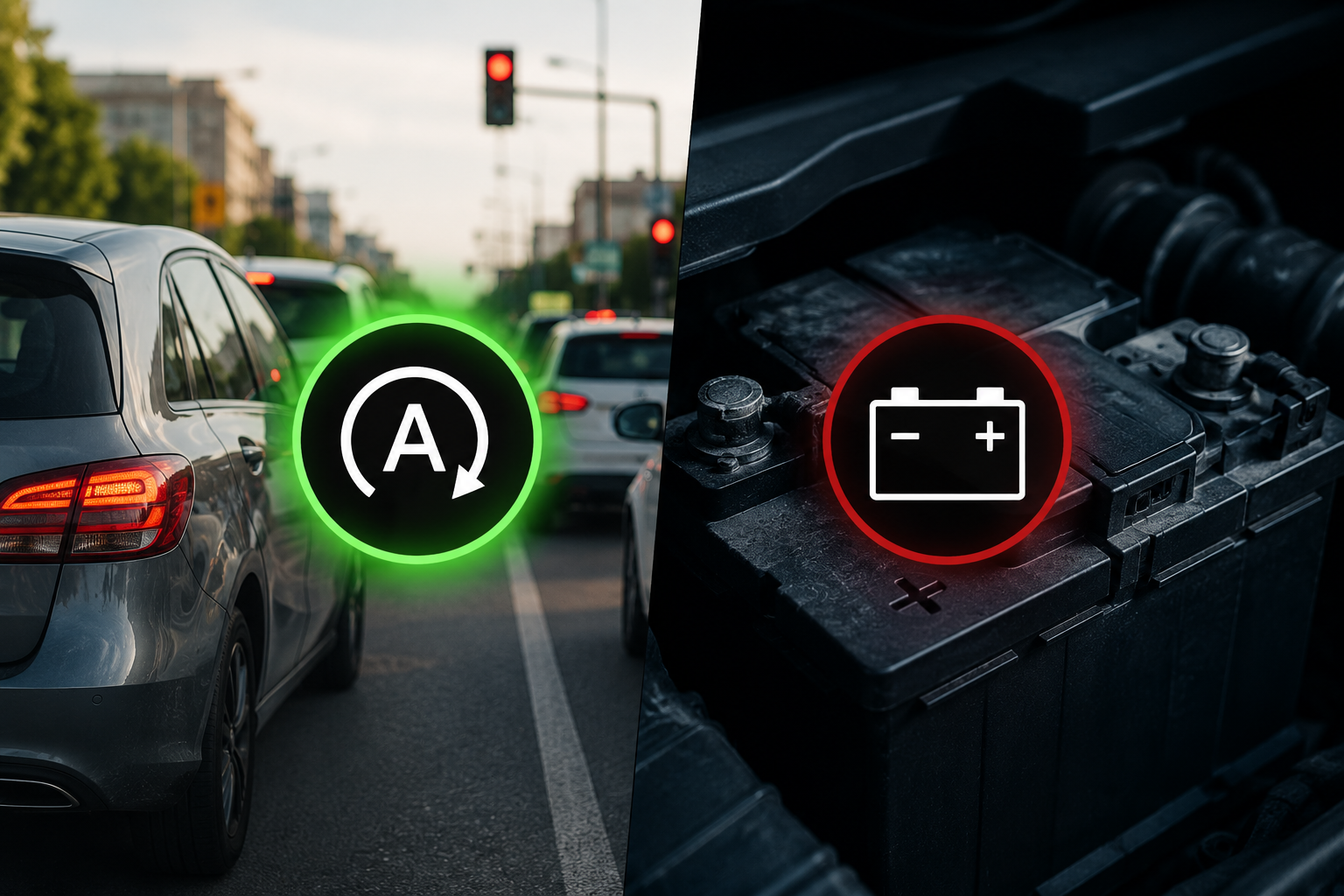
There are car features that drivers accept very quickly. Heated seats, parking sensors, a reversing camera or automatic lights are good examples. They simply make everyday driving easier, and after a while it becomes difficult to imagine the car without them. But there are also features that create much more discussion. One of them is the start-stop system.
For some drivers, start-stop feels like a logical and modern feature. The car stops at a traffic light, the engine switches off, fuel is not wasted at idle, emissions go down, and everything seems smart. For others, it is an annoying system that “shakes” the car at every stop, reduces comfort, creates the feeling that the engine is being stressed unnecessarily and raises concerns about future repairs.
That is exactly why the start-stop system is such an interesting topic. It is not simply a button on the dashboard. It is an entire system connected to the battery, starter, alternator, engine temperature, brake pedal, clutch, climate control, seat belt, doors, outside temperature and even how much electrical energy the car needs at that specific moment.
In this article, we will not take the easy route and simply say “start-stop is good” or “start-stop is bad”. That would be too superficial. We will look deeper: how the system works, where it really saves fuel, why it makes almost no difference on the highway, whether it damages the battery, why start-stop sometimes does not work, whether it should be switched off in traffic jams, how it differs in petrol, diesel, hybrid and newer cars, and what drivers should practically do in everyday use.
A typical driver thought: “Every time the engine switches off at a traffic light, I have two questions in my head — am I saving fuel, or am I slowly killing the battery?”
What is a start-stop system?
The basic idea of a start-stop system is very simple. If the car stops and the engine does not need to keep running at that moment, the system temporarily switches the engine off. When the driver wants to move again, the engine is quickly restarted. In cars with automatic transmission, this often happens when the brake pedal is released. In manual cars, it usually happens when the clutch is pressed or the driver prepares to move off.
The idea is to reduce idling time. An engine still consumes fuel at idle. The car is not moving, but the engine is running. In the city, where there are traffic lights, traffic jams, railway crossings and frequent stops, these moments can add up. If the engine does not burn fuel during some of those moments, in theory there is a saving.
However, a modern start-stop system is not a simple switch that blindly turns the engine off every time the car stops. It monitors many conditions. The car evaluates battery condition, engine temperature, cabin climate needs, outside temperature, brake pressure, steering position, safety systems and other parameters. If the conditions are not suitable, start-stop may not activate at all.
So if the start-stop system does not work on a particular day, it does not always mean there is a fault. Sometimes the car simply “decides” that switching the engine off would not be smart at that moment. For example, the battery may not be charged enough, the cabin may not yet have reached the required temperature, the engine may be cold, or the outside temperature may be very hot or very cold.
Why was the start-stop system introduced?
The start-stop system was not created just to give drivers another dashboard button. Its main purpose is to reduce fuel consumption and emissions in situations where the car spends a lot of time standing still. This is especially relevant in city driving, where cars regularly stop at traffic lights or in congestion.
From the manufacturer’s point of view, every small efficiency gain matters. If a technology helps reduce fuel consumption in official tests and in real urban driving, it helps make the car more efficient. Also, an idling engine produces emissions while the car is not going anywhere. In urban areas, this is an especially unpleasant scenario because many cars can be standing still and burning fuel at the same time.
For the driver, this means potential savings, but only under certain conditions. Start-stop is not a miracle technology that reduces consumption on every journey. If you drive 100 kilometres on the highway without stopping, this system does almost nothing. If you drive every day through a city where you spend half the time at traffic lights and in traffic jams, the effect can be much more noticeable.
A simple explanation: “Start-stop is not meant for the highway. It is meant for moments when the car is standing still and the engine would otherwise keep burning fuel at idle.”
When does start-stop actually help save fuel?
The start-stop system works best in the city, where there are many short stops. For example, driving through the centre with traffic lights, stopping at junctions, waiting at a railway crossing or moving slowly in a traffic jam. The longer the engine would otherwise have been idling, the greater the chance that start-stop provides a real benefit.
The length of the stop is important. If the car stops for one second and immediately has to move again, switching the engine off and back on may feel pointless. But if the stop lasts 20, 30 or 60 seconds, idling fuel consumption becomes more relevant. In many city situations, these moments repeat dozens of times.
The saving is usually not huge on a single trip. You should not expect start-stop to suddenly reduce fuel consumption by several litres per 100 km. But in city driving, it can provide a small but systematic saving. Especially for drivers who use the same routes every day and regularly wait at traffic lights.
A very good example is a morning drive through the city. The car stops every few hundred metres. Without start-stop, the engine would idle all that time. With start-stop, part of that time is spent with the engine switched off. If this kind of drive happens every working day, the saving over a year can become noticeable.
Simple principle:
The more time the car spends standing still with the engine running, the more sense start-stop makes. The more you drive at steady speed without stopping, the smaller the benefit.
When is the benefit of start-stop minimal?
The benefit of start-stop is very small if the journey takes place mainly outside the city or on the highway. If the car spends most of the time moving steadily and rarely stops, the engine simply does not have many opportunities to switch off. In that case, the start-stop system hardly contributes to fuel saving.
The benefit can also be small on very short trips. If the engine has not warmed up, the battery is not fully ready or the cabin climate requires active heating or cooling, the system may not activate at all. For example, during a short winter drive to the shop, start-stop may stay inactive because the car prioritises engine temperature, battery condition and cabin heating.
Start-stop is also not especially useful in situations where stops are extremely short and chaotic. For example, if a traffic jam moves forward by a metre every one or two seconds, constant switching off and restarting may feel annoying and may not provide much practical comfort benefit. In some of these situations, drivers choose to temporarily switch the system off.
A typical traffic jam comment: “If I am waiting at a traffic light, start-stop does not bother me. But if the car moves forward one metre every second, the system starts to get annoying.”
Does start-stop damage the battery?
This is one of the most important questions. Many drivers think that the start-stop system simply uses the starter more often and therefore kills the battery faster. There is some logic in this thought — the system really does mean more starting cycles than in a car without start-stop. But modern cars with start-stop do not use the same approach as older cars.
Cars with start-stop systems usually use specially designed batteries, such as AGM or EFB batteries. These are intended for a higher number of cycles, more frequent charging and discharging, and greater electrical load. The starter and charging system are also usually adapted for this type of operation.
This means that the start-stop system itself is not automatically a battery killer if the car is technically in good condition and the correct battery is used. Problems begin when an unsuitable cheaper standard battery is installed, warnings are ignored, the car is used only for very short trips, or the battery is already old and weak.
It is very important to understand this: start-stop often reveals battery condition. If the battery is no longer healthy, the system may start working less often or stop activating entirely. That does not necessarily mean the system itself has failed. Often it means the car’s electronics are protecting the vehicle and avoiding engine shutdown because there may not be enough energy for a safe restart.
A mechanic’s comment: “If start-stop suddenly stops working, do not immediately blame the button or the system. Very often the first suspect is the battery.”
Why does a start-stop car need a special battery?
A normal car without start-stop usually starts the engine once at the beginning of the journey, and then the engine keeps running. A start-stop car can restart the engine many times during a city drive. That means more load on the battery, more charging and discharging cycles, and a greater need to deliver energy quickly.
That is why a start-stop car usually needs a battery designed for these conditions. AGM and EFB batteries are created for much more active operation than a basic lead-acid battery. They cope better with frequent load and are usually more expensive. This is one reason why replacing the battery in a start-stop car can cost more than in an older car without such a system.
In some cars, after replacing the battery, it also needs to be registered in the car’s system. That means the electronics need to know that a new battery has been installed, what its capacity is and what type it is. If this is not done, the car may manage charging incorrectly, and the battery may not last as well as it should.
So the cheapest solution is not always the smartest one. If a start-stop car requires an AGM battery but an unsuitable cheaper option is installed, everything may seem fine at first. But over time, problems can appear: the system may work incorrectly, the battery may age faster, errors may appear or start-stop may simply stop activating.
Practical advice:
If your car has a start-stop system, choose the battery according to the manufacturer’s requirements, not only by price. The wrong battery can create more problems than the money saved.
Does start-stop damage the starter?
Another common question is about the starter. The logic seems simple: if the engine starts more often, the starter is used more often. So it should wear out faster. In an older car without start-stop, that concern would be very reasonable. But a start-stop car is usually not just an old starter with a new button added.
In many start-stop cars, the starter and related components are reinforced or adapted for more frequent operation. The system is not designed so that the starter fails after a few months. Manufacturers know that in city driving the engine may be restarted much more often than before, and the technology is designed with that in mind.
However, that does not mean wear does not exist. Any mechanical action creates wear. The difference is that a start-stop component is designed for a higher load. If the car is old, has high mileage, is poorly maintained or already has starter issues, frequent restarting can make those problems more noticeable.
So the honest answer is this: in a properly maintained car, the start-stop system should not quickly destroy the starter because the system is designed for that operation. But in an old or technically tired car, any additional load can reveal existing weak points sooner.
Can frequent engine shutdown harm the engine itself?
This question is especially popular among diesel owners and people who like mechanical topics. Many believe that the engine should be left running because frequent shutdowns and restarts may cause wear. Here it is important to distinguish a cold start from a warm restart.
A cold start in the morning, when the oil has not yet reached operating temperature, is very different from a short restart after stopping at a traffic light. Start-stop usually works when the engine is already warm enough and conditions are suitable. It is not intended to keep switching a cold engine off and on in unsuitable conditions.
A modern system also monitors many conditions. If the engine has not reached the required temperature, if the battery is not ready, if climate control needs high output or if there are other reasons, the system may not switch the engine off. So it is not as primitive as it may sometimes feel.
Still, the driver’s feelings are understandable. If the engine switches off at every very short stop and starts again one second later, it can create psychological discomfort. Not necessarily because the engine is being damaged, but because it feels as if the machine is being stressed. In this sense, start-stop is also a question of comfort and trust.
An honest driver comment: “I understand that the system is designed to work like this, but emotionally I do not like the engine switching off and on all the time.”
Why does start-stop sometimes not work?
A very common situation: the driver is used to start-stop working, but suddenly one day the system no longer switches the engine off. The first thought is that something has broken. But not always. A start-stop system has many conditions, and if even one of them is not met, the system may remain inactive.
The most common reasons why start-stop may not work include:
- the battery is not charged enough or has aged;
- the engine has not reached the required operating temperature;
- the outside temperature is very cold or very hot;
- cabin heating or air conditioning requires high output;
- many electrical consumers are switched on;
- the driver’s door is not fully closed or the seat belt is not fastened;
- the car is on a steep slope or the steering wheel is turned at a certain angle;
- there is a fault stored in the system and diagnostics are needed.
Different cars have different conditions, but the idea is the same — the start-stop system works only when the car considers it safe and useful. If the system does not activate for one day, it is not always a reason to panic. But if it does not work for a long time without a clear reason, it is worth checking the battery and running diagnostics.
In winter, start-stop can be much less active
In winter, many drivers notice that the start-stop system works less often or almost not at all. This is very logical. Cold weather makes life harder for the battery, the engine takes longer to warm up, cabin heating requires energy, heated windows use electricity, and the car’s priority is reliable operation rather than saving every possible drop of fuel.
On especially short winter trips, start-stop may not activate at all. The car simply does not reach conditions where switching the engine off would make sense. The driver may think the system is broken, but in reality it may be doing exactly what it is supposed to do — protecting the battery and maintaining cabin heating.
So in winter, there is no need to worry too much if start-stop works less often. It is much more important to monitor battery condition. If the car becomes harder to start, lights behave strangely, electronic errors appear or start-stop remains inactive even after longer drives, the battery may be tired.
In summer, air conditioning can affect the system
In summer, the behaviour of the start-stop system is often affected by air conditioning. If it is hot outside and the cabin has not yet cooled down, the car may not want to switch the engine off because the air conditioning system needs energy. If the engine stayed off too long, the cabin would start warming up faster and comfort would suffer.
In some cars, when start-stop switches the engine off, air conditioning output becomes weaker or changes. In other cars, the system is smarter and maintains comfort better. But the general principle remains: if climate control needs a lot of work, start-stop may be less active.
This is another reason why two similar journeys can give different results. On a cool spring day, start-stop may work perfectly. On a hot summer afternoon with an overheated cabin, it may barely activate. That is not necessarily a fault — those are different conditions.
Should you switch start-stop off?
This is a very practical question. Many drivers automatically press the start-stop off button every time they get into the car. Others never touch it. Which approach is correct? Once again, the answer is not black and white.
If you are driving in the city, stops are reasonably long and the system works smoothly, it can be left on. It may provide a small fuel saving and reduce idling time. If the car is in good technical condition, the battery is correct and the system does not cause discomfort, there is no mandatory reason to turn it off.
However, there are situations where temporary switching off can be sensible. For example, in a very slow traffic jam where the car moves only a few metres every second. When manoeuvring in a car park. In very hot weather if you want stable air conditioning. Or when the car’s technical condition makes you suspect the battery or starter is no longer in ideal shape.
Practical conclusion: “Start-stop does not need to be hated, but it also does not need to be worshipped blindly. It is a feature that can be used intelligently — leave it on in the city, but switch it off in specific situations.”
Can start-stop interfere with safety?
A properly working start-stop system should not interfere with safety. The car is designed so that the engine restarts quickly enough when the driver is ready to move. However, the driver’s feeling matters. If the system creates hesitation or the driver does not feel confident, it can become a comfort and trust issue.
For example, when pulling out from a side road into busy traffic, some drivers dislike the feeling that the engine was just switched off. Even if technically it restarts quickly, psychologically there may be a feeling that the car is not immediately ready. In such situations, the driver may choose to switch the system off temporarily.
That does not mean start-stop is dangerous. It means the driver should understand how their specific car behaves. If the system works smoothly, it quickly becomes almost invisible. If it works harshly, slowly or unpredictably, it is worth checking the vehicle’s technical condition or adjusting driving habits.
Start-stop with manual and automatic transmissions
In manual and automatic cars, the start-stop system feels noticeably different. In a manual car, the driver has more control over the process. The engine usually switches off when the car stops, the gearbox is in neutral and the clutch is released. When the driver presses the clutch, the engine restarts.
In an automatic car, the system is often linked to the brake pedal. You stop, hold the brake and the engine switches off. Release the brake and the engine restarts. This can be very convenient if it works smoothly. But if the restart is noticeable or the brake is being held during very short stops, it may feel more annoying.
In some newer cars, start-stop works together with auto hold, hybrid technology or mild-hybrid systems. Then the process can be much less noticeable. In older cars, the restart moment can be more obvious, and that often creates a negative attitude towards start-stop.
Diesel cars and start-stop: extra attention for short trips
Diesel owners often worry more about start-stop than petrol car owners. The reason is understandable: diesel cars already create more discussion around short trips, DPF filters, EGR systems, engine temperature and long-term maintenance costs.
Start-stop itself is usually not the main diesel problem. A much bigger issue is regular short trips where the engine does not warm up properly and the DPF system cannot operate in ideal conditions. If a diesel car is used only for a few kilometres around the city, start-stop is not the only thing to think about. The whole usage profile matters.
If a diesel regularly drives longer distances and the car is in good condition, start-stop can work normally in the city. But if the car is used almost only for short journeys, the battery is tired and the engine rarely reaches operating temperature, start-stop may be only one symptom of a broader unsuitable-use problem.
Hybrids and mild-hybrids: when start-stop becomes almost invisible
In hybrids and mild-hybrids, the start-stop idea is often taken to the next level. The engine can switch off much more smoothly, restarting can be softer, and the electric system can assist vehicle movement. In these cars, drivers often do not think about start-stop as a separate feature — it is simply part of how the car works.
In mild-hybrid systems, instead of or in addition to a conventional starter, there may be a more powerful starter-generator system that allows the engine to restart more gently and quickly. This can significantly improve the experience. In an older car, start-stop may feel like “the engine stopped and started again”. In a more modern system, it can be much smoother.
So when judging start-stop, it is important not to put all cars in the same basket. An older start-stop system, a modern mild-hybrid and a full hybrid can feel very different. Sometimes a person dislikes start-stop simply because their experience was with one particular car where the system worked unpleasantly.
Does start-stop really pay off?
This is one of the more complicated questions because the answer depends on the driving profile. If a person mostly drives on the highway, the economic benefit of start-stop will be very small. If a person drives daily in the city and regularly stops at traffic lights, the system can provide a small but real saving.
Maintenance costs must also be considered. A start-stop car usually needs a more expensive battery. If, after several years, an AGM or EFB battery needs to be replaced, it will cost more than a basic battery in an older car. This is why some drivers ask: does the fuel saving compensate for the more expensive battery?
There is no universal answer. If the car is used in the city and the system works often, the saving may be more meaningful. If the car is used little, mostly outside the city, or start-stop remains inactive most of the time, the economic effect will be smaller. However, start-stop is not only about an individual fuel bill. It also reduces idling emissions, especially in urban areas.
Honest conclusion:
Start-stop pays off most in city driving with many stops. If the car mostly drives on the highway, the practical fuel benefit of the system will be much smaller.
Simple calculation: how much can it save?
To understand the practical effect of start-stop, we can imagine a simple scenario. Suppose a driver spends several minutes every day standing at traffic lights and in congestion. Without start-stop, the engine runs at idle during all that time. With start-stop, part of that time is spent with the engine switched off.
On one trip, the saving may feel tiny. A few dozen millilitres of fuel or slightly more does not sound impressive. But in everyday use, small things add up. If the car is driven in the city every day, stops at traffic lights every day and the system works regularly, the saving over a year can become more noticeable.
Still, this system should not be seen as the main fuel-saving tool. Driving style, tyre pressure, speed, unnecessary weight, air conditioning use and the technical condition of the car often affect consumption much more. Start-stop is one small piece of the overall economy puzzle.
A very practical comparison: “Start-stop can save fuel at idle, but aggressive driving can use up that saving in the first three hard accelerations.”
How does start-stop affect comfort?
The judgement of a start-stop system is often not only technical. It is also emotional. If the system works smoothly, the driver quickly gets used to it. The engine switches off almost invisibly, restarts without shaking and the drive continues normally. In such a car, start-stop can feel like a completely natural feature.
But if the system works harshly, the engine shakes the car when restarting, hesitates or feels noisy, the driver can quickly get tired of it. Even if fuel is theoretically being saved, everyday comfort can suffer. And for a feature that has to be lived with every day, comfort is very important.
That is why two drivers can talk about start-stop in completely opposite ways. One says: “I do not understand why people complain, mine works perfectly.” Another says: “I switch it off every time because it annoys me.” Both can be right, because they drive different cars, with different systems, in different conditions.
What should you do if start-stop starts behaving strangely?
If the start-stop system suddenly begins to behave differently than before, it should not be ignored. For example, if the engine switches off but restart becomes slower, if warnings appear, if the system no longer activates at all, or if engine starting becomes heavy, it is worth checking the car.
The first step is usually a battery check. Not only voltage, but also real capacity and the ability to deliver current. The second step is to check whether there are faults stored in the control modules. The third is to confirm that the battery is the correct type and, if needed, properly registered in the car’s system.
Sometimes the problem is not in the start-stop system itself, but somewhere else. Climate control, the charging system, sensors, a seat belt switch, bonnet switch or even a door sensor can affect how the system works. That is why guessing by feel is not always helpful. Diagnostics are much smarter than randomly replacing parts.
Used car with start-stop: what should you check?
When buying a used car with start-stop, it is worth checking a few things. First, whether the system works at all. Second, whether it works smoothly. Third, what battery is installed. Fourth, whether there are any faults related to energy management or charging.
If the seller says: “I just do not like start-stop, so it does not work,” that is not a technical explanation. Maybe the system is simply switched off. But maybe the battery is weak. Maybe the wrong battery has been installed. Maybe there is a fault. In a used car, it is worth clarifying these things before purchase, not afterwards.
Be especially attentive if the car has a lot of electronics, an automatic gearbox, a diesel engine and a start-stop system. That does not mean the car is bad. It means the energy system needs to be healthy. A weak battery in a modern car can create many strange symptoms that initially seem unrelated.
A used-car buyer’s comment: “Before buying, I thought start-stop did not matter to me. Later it turned out to be a sign of a tired battery and poor charging behaviour.”
Common myths about the start-stop system
Myth No. 1: “Start-stop always damages the battery.”
Not exactly. Cars with start-stop usually use specially designed batteries and adapted charging systems. Problems more often appear when the battery is old, unsuitable or the car is used in very unfavourable conditions.
Myth No. 2: “Start-stop always saves a lot of fuel.”
Also wrong. The saving is most noticeable in city driving with many stops. On the highway or on journeys without stops, the benefit is minimal.
Myth No. 3: “If start-stop does not work, the system is broken.”
Not always. The system may stay inactive because of battery condition, temperature, climate control, engine condition or other requirements.
Myth No. 4: “It is always better to switch start-stop off.”
It depends on the situation. In the city with normal stops, the system can be useful. In very slow traffic or while manoeuvring, switching it off can be sensible.
Myth No. 5: “If the car is new, start-stop will definitely work perfectly.”
Not necessarily. The experience depends strongly on the specific car, engine, gearbox, battery condition and system design.
Practical tips for using start-stop
To make sure the start-stop system works as intended and does not create unnecessary problems, it is enough to follow a few practical principles:
- Keep the battery in good condition. A weak battery is one of the main reasons start-stop does not work correctly.
- Do not install an unsuitable battery. If the car requires AGM or EFB, choose the correct type.
- After battery replacement, check whether registration is needed. In many modern cars, this is important.
- Switch the system off when it gets in the way. For example, in very slow traffic or while parking.
- Do not worry if the system works less often in winter. In cold weather, this is often normal.
- If the system suddenly changes behaviour, run diagnostics. Do not replace parts by guessing.
- Do not expect a miracle in fuel consumption. Start-stop is a small helper, not the main fuel-saving tool.
Is the start-stop system a friend or an enemy?
In reality, the start-stop system is neither a friend nor an enemy. It is a tool. If the car is in good condition, the battery is correct, the system works smoothly and the driving happens in the city, start-stop can be a useful helper. It reduces idling time, saves a little fuel and reduces emissions when the car is standing still.
If the car is older, the battery is tired, journeys are very short, the system works harshly or the driver simply finds it uncomfortable, the attitude will be different. Then start-stop may feel more like an annoyance than a benefit. And that feeling should not be ignored, because an everyday car should be not only economical, but also pleasant and predictable.
The smartest approach is not to fight the system, but to understand it. When does it help? When does it get in the way? Why does it not work? Is the battery healthy? Does it make sense to leave it on during this specific journey? Once the driver understands these questions, start-stop is no longer a mysterious annoying button, but simply another vehicle efficiency tool.
Conclusion: start-stop saves fuel, but only in the right conditions
The start-stop system really can help save fuel, but mainly in city conditions where the car spends a lot of time idling. It is not a magical technology that makes the car economical on every journey. On the highway, its benefit is very small; on short winter trips, it may not activate at all; and in traffic jams with extremely short movements, it can sometimes be more annoying than helpful.
When it comes to the battery, the key point is that a start-stop car needs the correct battery and a healthy energy management system. The system itself is not automatically a battery killer, but an old, incorrect or unsuitable battery can quickly become a problem. The same applies to the starter and other components — they are usually adapted for more frequent operation, but in a worn car, extra load can reveal existing weak points.
So the best advice is simple: use start-stop consciously. In the city, where stops are normal and the system works smoothly, it can be left on. In very slow traffic, while manoeuvring or in situations where it gets in the way, it can be switched off. If the system does not work for a long time, check the battery and diagnostics instead of immediately assuming that the feature is useless.
The start-stop system works best when the driver understands its logic. It is not designed to annoy you. It is designed to reduce idling time. But like any car technology, it needs the right battery, good technical condition and sensible use.
Short driver conclusion: “Start-stop is neither a miracle nor a disaster. It saves fuel when the car spends a lot of time standing still, but it needs a good battery, proper technical condition and a driver who understands when to use it.”