
 LV
 EN
 RU
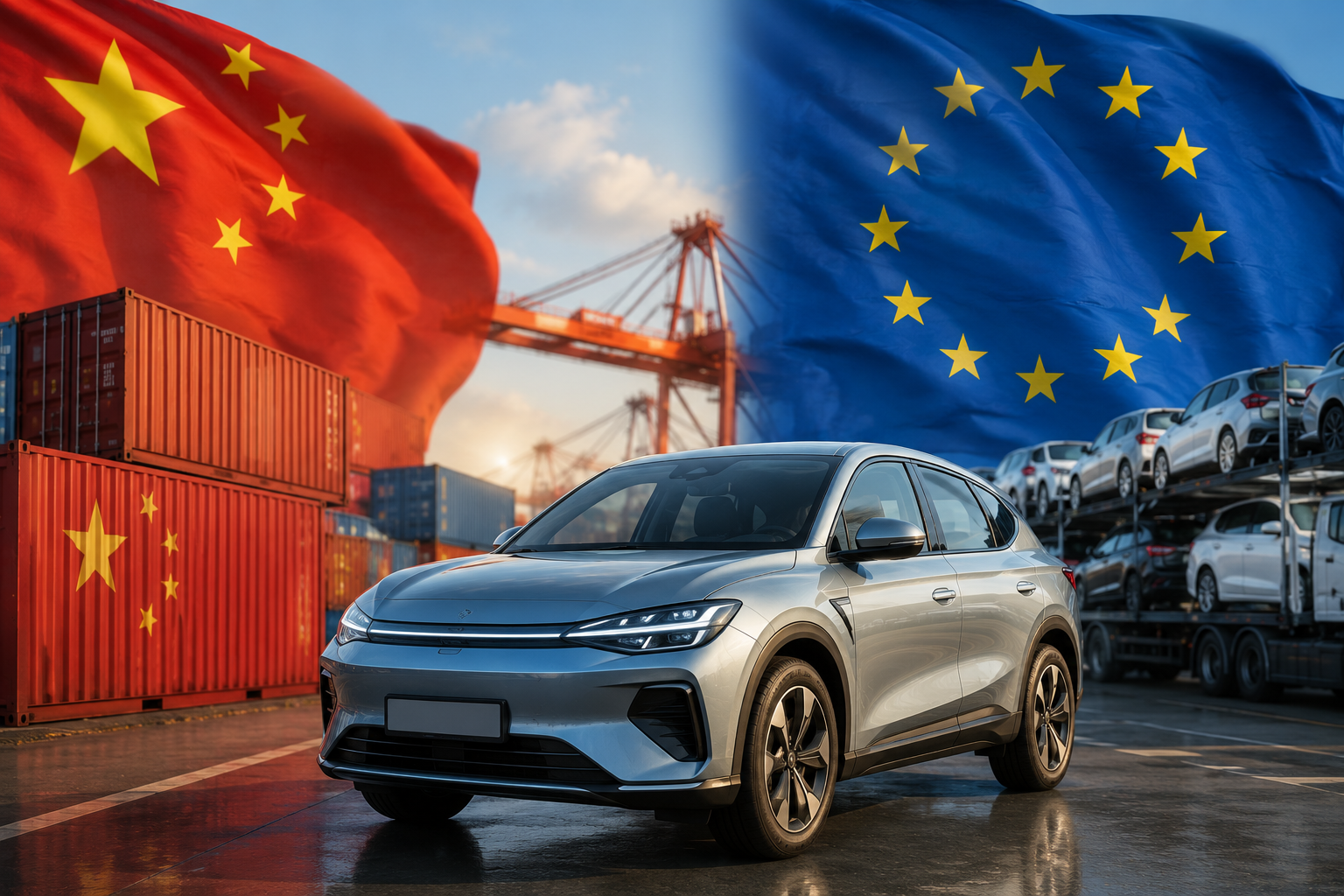
Information checked on 29 July 2026. EU countervailing duties on new battery-electric vehicles originating in China remain in force. Rates, individual exemptions and price-undertaking conditions may change in the future, so the specific manufacturer, factory, country of origin and current TARIC code should always be verified before directly importing or purchasing a vehicle.
“Chinese electric vehicle” appears to be a simple description, but in practice it may refer to at least three different situations.
It may be a Chinese-brand vehicle manufactured in China. It may be a European or American-brand vehicle assembled at a Chinese factory. It may also be a Chinese-brand model manufactured in the European Union.
From a customs perspective, these situations are not the same. The EU countervailing duty is not determined by the logo displayed on the vehicle. The decisive factors are the product’s origin, the specific exporting manufacturer and whether the vehicle falls within the scope of the regulation.
The dramatic statement that “all Chinese cars face a 35% tariff” is therefore incorrect. Some manufacturers face a rate of 17.0%, others 18.8% or 20.7%, Tesla’s Shanghai production has a 7.8% rate, while the SAIC group and certain other exporters face 35.3%.
A major first exemption also appeared in 2026. The China-built CUPRA Tavascan may be imported without the applicable countervailing duty when its manufacturer complies with the minimum import price, import-volume limits and investment commitments accepted by the European Commission.


The short conclusion: EU duties may make China-built electric vehicles more expensive, but the retail price does not automatically increase by the duty rate. Part of the cost may be absorbed by the manufacturer, part by the importer and part by the buyer. Some models may become more expensive, others may lose discounts, while others may be replaced by hybrids or European-built versions.
What has actually been imposed — a tariff, a penalty or a tax?
Officially, it is a countervailing duty. This is an EU trade-defence instrument intended to offset the price advantage created by foreign government subsidies.
The European Commission’s investigation concluded that China’s battery-electric vehicle value chain benefits from support that creates a threat of economic injury to EU electric-vehicle manufacturers.
It is not the same as an anti-dumping duty.
| Term | What does it address? | Situation for Chinese EVs |
|---|---|---|
| Standard customs duty | Application of the EU’s common customs tariff to imports from a non-EU country | Normally applies independently of the subsidy investigation |
| Countervailing duty | An advantage created by foreign subsidies | This is the duty imposed on new China-origin battery-electric vehicles |
| Anti-dumping duty | Selling a product in an export market at an unfairly low price | This is not the legal basis of the specific EV regulation |
| VAT | Consumption in the final market | Latvia’s standard import VAT rate is 21% |
In everyday conversation, all these charges are often described simply as “tariffs”, but the distinction matters. The countervailing duty is added on top of the standard customs tariff and is also included in the taxable base used to calculate import VAT.
What rates are currently in force?
| Exporting manufacturer or group | Countervailing duty | Important note |
|---|---|---|
| Tesla Shanghai | 7.8% | The rate applies to the specific Chinese factory, not to every Tesla worldwide |
| BYD group | 17.0% | Applies to the Chinese exporting companies listed in the regulation |
| Geely group | 18.8% | The factory and exporter of the specific model must be checked separately |
| Other cooperating companies | 20.7% | The correct additional TARIC code and supporting documents are required |
| SAIC group | 35.3% | The group also includes the production of MG vehicles |
| Other non-cooperating companies | 35.3% | The highest general rate |
Important: to apply an individual rate, customs must receive a valid commercial invoice containing the declaration required by the regulation and the correct additional company code. If the necessary documents are not submitted, the highest rate may be applied.
Which vehicles are covered?
The regulation applies to new battery-electric vehicles originating in China that are principally designed to carry no more than nine people, including the driver.
The vehicle must be powered solely by one or more electric motors. The scope also includes certain electric vehicles with an internal-combustion range extender or additional generator when the wheels are driven exclusively by the electric drivetrain.
| Vehicle | Does the current duty normally apply? | Why? |
|---|---|---|
| New battery-electric vehicle from China | Yes | This is the regulation’s main product scope |
| Electric vehicle with a combustion range extender that does not drive the wheels | Yes | The regulation specifically includes this type of supplementary energy generator |
| New plug-in hybrid | No | Hybrids were not included in the original investigation’s product scope |
| New conventional hybrid | No | It can also be driven by an internal-combustion engine and is not the BEV defined by the regulation |
| Petrol or diesel vehicle | No | The measure specifically concerns battery-electric vehicles |
| Used electric vehicle | Not under the regulation’s normal scope | The regulation covers new vehicles, although direct imports may still face other customs charges and VAT |
| Electric motorcycle or L-category vehicle | No | These are excluded from the specific regulation’s product scope |
The brand is not the same as the vehicle’s origin
This is the most important practical detail for a buyer.
The customs measure is not structured as “Chinese brands versus European brands”. It is a question of origin and the exporting manufacturer.
| Situation | Possible result | Example or explanation |
|---|---|---|
| Chinese brand, vehicle manufactured in China | The countervailing duty normally applies | The rate depends on the specific manufacturer group |
| European brand, vehicle manufactured in China | The duty may apply | The CUPRA Tavascan is manufactured by Volkswagen Anhui in China |
| American brand, vehicle manufactured in China | The duty may apply | Tesla’s Shanghai factory has an individual rate of 7.8% |
| Chinese brand, vehicle genuinely manufactured in the EU | The China-origin BEV duty normally does not apply | The origin of the product, rather than the origin of the shareholders or brand, is decisive |
| China-built vehicle transported through another country | The duty does not automatically disappear | Simple transshipment or sale through an intermediary does not change origin |
| Vehicle substantially manufactured or processed in a third country | Origin must be determined under customs rules | The factory’s location alone is not sufficient — the production process must be assessed |
The buyer’s practical question should not be limited to “which brand is it?” Ask which factory produced the specific VIN, what origin is declared and which company is the exporter.
Why does a 17% duty not mean a 17% increase in the showroom price?
The countervailing duty is calculated from the vehicle’s net customs value at the EU border, not from the final retail price displayed by a Latvian dealership.
The showroom price may already include:
• the manufacturer’s factory price;
• transport to the port and sea freight;
• insurance;
• the standard customs duty;
• the countervailing duty;
• VAT;
• type-approval and documentation costs;
• European logistics;
• importer and dealer expenses;
• warranty reserves;
• profit margins and discounts.
The manufacturer may reduce its export price or profit margin. The importer may give up part of its margin. The dealer may reduce a promotional discount. Alternatively, the entire additional cost may be passed on to the final buyer.
The possible outcomes are therefore very different:
| Action by the manufacturer or importer | What does the buyer see? |
|---|---|
| The company absorbs the duty completely | The price may remain unchanged, while the company’s profit falls |
| The cost is shared between the company and the buyer | The price rises by less than the duty percentage |
| The discount is reduced | The official price remains unchanged, but the real transaction price becomes higher |
| The entire additional cost is passed on to the buyer | The price rises by the duty and its VAT effect |
| The model is no longer imported | The buyer loses that particular option even if displayed prices do not rise |
| The BEV is replaced by a plug-in hybrid | A different powertrain appears in the range and is not covered by the current duty |
Calculation: what does the duty mean for a vehicle with a €30,000 customs value?
Assume an illustrative vehicle with a net customs value of €30,000 at the EU border.
The table calculates only the additional effect of the countervailing duty and Latvia’s 21% VAT arising from that duty. The standard customs tariff, transport, port charges, registration and dealer margin are not included.
| Manufacturer group | Rate | Countervailing duty | Additional VAT on the duty | Total additional effect |
|---|---|---|---|---|
| Tesla Shanghai | 7.8% | €2,340.00 | €491.40 | €2,831.40 |
| BYD | 17.0% | €5,100.00 | €1,071.00 | €6,171.00 |
| Geely | 18.8% | €5,640.00 | €1,184.40 | €6,824.40 |
| Other cooperating company | 20.7% | €6,210.00 | €1,304.10 | €7,514.10 |
| SAIC or another non-cooperating company | 35.3% | €10,590.00 | €2,223.90 | €12,813.90 |
The formula is straightforward:
Countervailing duty: customs value × duty rate.
Additional VAT: countervailing duty × 21%.
Total additional effect: countervailing duty × 1.21.
However, a €30,000 customs value is not the same as a €30,000 retail price. The results in this table should not simply be added to a vehicle’s advertised Latvian price.
Who actually pays — the manufacturer, importer or buyer?
The importer pays the duty to the customs authority, but the economic burden may be divided between several market participants.
The manufacturer may reduce the price charged to the European importer. The importer may reduce its margin. The dealer may withdraw a large promotion. The buyer may pay a higher final price.
A strong manufacturer with a substantial profit reserve and a strategic goal of gaining European market share may absorb part of the cost for a long period. A smaller company may simply stop importing a particular model.
Illustrative driver comment: “I expected the car’s price to rise by ten thousand euros immediately after the tariff, but the official list price stayed unchanged. Only later did I notice that the €4,500 promotional discount and free winter-tyre package had disappeared.”
The 2026 development: a minimum import price instead of the duty
EU law allows an exporter to offer a price undertaking.
In simplified terms, the manufacturer commits not to sell the vehicle into the EU below a specified minimum import price. If the European Commission concludes that the price adequately removes the injury caused by the subsidy and that the arrangement can be effectively monitored, the specific exports may be exempted from the countervailing duty.
However, this is not merely a promise that “we will not sell too cheaply”. The Commission assesses:
• the level of the minimum import price;
• sales channels;
• the risk that losses could be offset through other goods or payments;
• import volume;
• related companies in Europe;
• the ability to trace every vehicle sold;
• the manufacturer’s investment commitments in the European Union.
Why is the CUPRA Tavascan such an important example?
CUPRA is a Spanish brand within the Volkswagen Group, but the Tavascan is manufactured at the Volkswagen Anhui factory in China.
It clearly demonstrates that the countervailing duties are not merely a “Chinese-brand problem”. They may affect a well-known European brand when the particular model originates in China.
In February 2026, the European Commission accepted a price undertaking offered by Volkswagen Anhui and SEAT specifically for this model.
| Commitment | Practical meaning |
|---|---|
| Minimum import price | The model may not be imported below the approved price threshold |
| Import-volume limit | The exemption is not an unlimited right to import any number of vehicles |
| Investment in the EU | The company has committed to certain BEV-related projects in Europe |
| Monitoring | The Commission may monitor exports, sales and compliance with the commitments |
| Consequences of a breach | The exemption may be withdrawn and, in certain cases, the duty may be reinstated retroactively |
This exemption does not apply to every Volkswagen Group vehicle, every China-built car or every CUPRA model. It is a solution for a specific exporter and a specific model.
Can every Chinese manufacturer now simply choose a minimum price?
No. A manufacturer may submit an undertaking, but the European Commission is not required to accept it automatically.
Electric vehicles are complex products with many specification levels, battery versions, financing promotions, leasing offers, dealer discounts and related companies. It is therefore difficult to guarantee that a minimum import price will not be circumvented indirectly.
For example, a formally high price could potentially be offset through:
• unusually cheap financing;
• free optional equipment;
• payments to a related company;
• an excessively high trade-in valuation;
• a more favourable deal on another model;
• hidden compensation to the importer or dealer.
This is why the Commission evaluates not only the price itself but also the sales channels and the risk of cross-compensation.
Will hybrids become a way to avoid the duties?
The current countervailing duty does not apply to plug-in hybrids or conventional hybrids because they were not included in the product scope of the original investigation.
This creates a strong market incentive for Chinese manufacturers to offer more of the following in Europe:
• plug-in hybrids;
• conventional full hybrids;
• petrol models;
• models manufactured outside China that obtain a different country of origin.
A legally manufactured hybrid is not “circumventing” the duty merely because it falls outside this particular regulation. It is simply a different product that was not investigated.
By contrast, declaring an electric vehicle as another type of product, falsely stating its origin or merely routing it through a third country may violate customs rules.
Does manufacturing in Europe solve the problem?
One of the most logical long-term solutions for Chinese brands is to manufacture vehicles in the European Union.
When a vehicle genuinely obtains EU origin under customs rules, the countervailing duty on China-origin BEVs does not apply.
However, opening a European factory does not mean that the vehicle will become as inexpensive as it was when produced in China. Europe may involve higher:
• labour costs;
• energy costs;
• factory-construction and financing costs;
• local supplier prices;
• costs of meeting labour and environmental requirements;
• lower initial capacity utilisation.
Local production may nevertheless reduce sea transport, customs risk and delivery times while improving parts availability and political stability.
What could this mean for the Latvian market?
Latvia is a small market, so price changes do not always appear here in the same way as they do in Germany, France or the Netherlands.
An importer may use a common pricing policy for all Baltic countries. Latvia may receive fewer vehicles in stock, fewer specification levels and a more limited number of demonstrator cars.
Possible consequences for a Latvian buyer include:
| Market change | What may the buyer notice? |
|---|---|
| The manufacturer absorbs the duty | The list price remains unchanged, but promotions become less frequent |
| The importer passes on part of the cost | The price rises by several thousand euros rather than by the full duty percentage |
| The model becomes unprofitable | It disappears from the Latvian range or becomes available only by special order |
| Previously imported stock is cleared | A very good short-term price may still reflect the old import cost |
| The manufacturer moves towards hybrids | BEV choice decreases while plug-in and full hybrids appear |
| European production begins | After a transition period, models without the China-origin duty may appear |
| State support increases demand | The purchase subsidy may hide part of the tariff effect, although the unsubsidised vehicle may still have become more expensive |
Should you rush to buy a Chinese electric vehicle now?
Urgency is not a good basis for a vehicle purchase.
A stock vehicle offered at an attractive price may be a good deal, but the reason for the discount should be understood. It may be from a previous model year, use an older battery version, charge more slowly or be a vehicle the importer wants to clear before changing its product range.
Before completing the transaction, determine:
• whether the price is the final price including VAT;
• whether every customs formality has already been completed;
• whether the vehicle has EU type approval;
• who provides the warranty in Latvia;
• how long spare parts are expected to remain available;
• whether the manufacturer’s app and remote services function locally;
• which rapid-charging standard and power the vehicle supports;
• whether the navigation and software are intended for the European market;
• the vehicle’s expected value after three or five years.
Are Chinese electric vehicles lower quality?
The country of origin does not determine a vehicle’s quality by itself.
China manufactures both extremely simple, inexpensive cars and technically sophisticated premium models. European and American-brand vehicles are also manufactured there.
The particular model should be evaluated rather than relying on national stereotypes.
| Area | What should be checked? |
|---|---|
| Battery | Chemistry, usable capacity, warranty, thermal management and rapid-charging curve |
| Safety | Independent crash-test results and the operation of driver-assistance systems |
| Software | Languages, updates, app, navigation and system stability |
| Charging | AC power, maximum DC power, charging curve and battery preconditioning |
| Winter performance | Real cold-weather range, heat pump, charging speed and door-handle operation in freezing conditions |
| Servicing | Diagnostic availability, parts stock, body repairs and trained specialists |
| Resale | Brand reputation, dealer network, transferability of the warranty and used-vehicle demand |
The greatest risk may not be the duty but residual value
A buyer often focuses on a price difference of €2,000 or €4,000 while overlooking potential depreciation.
If the manufacturer substantially cuts the price of a new vehicle after two years, introduces a much better battery or withdraws the model from Europe, the used vehicle’s value may fall more quickly.
Illustrative example:
| Indicator | Vehicle A | Vehicle B |
|---|---|---|
| Purchase price | €29,000 | €33,000 |
| Value after 5 years | €11,000 | €18,000 |
| Depreciation | €18,000 | €15,000 |
Vehicle A was initially €4,000 cheaper but lost €3,000 more through depreciation over five years. Its genuine advantage was therefore only €1,000 before comparing any other costs.
These figures are illustrative only because future market values cannot be guaranteed precisely.
Will prices of used China-built EVs increase?
The countervailing duties do not directly increase the price of a vehicle that has already cleared customs, been registered and entered the EU market.
An indirect effect is nevertheless possible.
• when a new model becomes more expensive, used-vehicle prices may receive support;
• when the manufacturer cuts the new-car price, used-car values may fall;
• when a model disappears from the market, some buyers may worry about parts and servicing;
• when European production begins, the old China-built version may compete with a new locally manufactured model;
• when state support is available for a used electric vehicle, demand for eligible vehicles may increase.
What should be considered when importing a vehicle directly from China?
The price displayed in a Chinese advertisement is not the final price in Latvia.
A direct-import calculation should include:
• the vehicle’s purchase price;
• transport within China;
• export documents;
• sea freight and insurance;
• port and customs-broker charges;
• the standard customs duty;
• the possible countervailing duty;
• 21% import VAT;
• individual approval or homologation;
• conversion to a European charging standard when required;
• registration and technical inspection;
• warranty and repair risk.
A version intended for the domestic Chinese market may have a different charging connector, software, telematics module, navigation system, lighting, documentation and type approval.
Even when the vehicle can technically be charged using an adapter, this does not guarantee compatibility with every rapid-charging station, the manufacturer’s app or remote software updates.
Direct import may appear inexpensive only until every border, tax, homologation and warranty cost is placed in one calculation.
What should you ask a Latvian seller before buying?
1. In which country and factory was the specific vehicle manufactured?
2. Does the price include every customs charge and VAT?
3. Is the vehicle already in free circulation within the EU?
4. Does it have an EU Certificate of Conformity, or CoC?
5. Who provides the warranty — the factory, official importer or seller?
6. Where are warranty repairs carried out in Latvia?
7. How long does delivery of bodywork and high-voltage parts normally take?
8. Does the warranty remain valid if the importer ceases trading?
9. Do the app, eSIM and over-the-air updates work in Latvia?
10. What is the battery warranty by years, mileage and remaining capacity?
11. Does the vehicle qualify for Latvia’s electric-vehicle support programme?
12. What is the written final price without conditional financing, insurance or a trade-in?
Common myths about Chinese EV duties
| Myth | Reality |
|---|---|
| Every Chinese car has a 35.3% customs duty | The rates range from 7.8% to 35.3%, and the measure applies to specific new BEVs |
| The duty is determined by the brand’s country | The vehicle’s origin and the specific exporting manufacturer are decisive |
| European-brand vehicles are unaffected | A European-brand model may be affected when it is manufactured in China |
| Every Chinese-brand vehicle is affected | A Chinese-brand vehicle manufactured in Europe may not be a China-origin product |
| Plug-in hybrids face the same rate | The current investigation did not cover hybrids |
| A 17% duty automatically increases the showroom price by 17% | The duty is calculated from customs value, and part may be absorbed by the manufacturer or importer |
| The CUPRA Tavascan exemption cancels the entire duty system | It is an individual price-undertaking arrangement for a specific exporter and model |
| The vehicle can be routed through Turkey and the duty disappears | Simple transshipment or trading through another country does not change the product’s origin |
| The cheapest vehicle is always the best value | Warranty, servicing, battery, insurance and residual value must also be considered |
Mini test: is a particular China-built EV a safe purchase?
Answer these questions:
1. Do I know the specific vehicle’s factory and country of origin?
2. Does the written price include customs duty, countervailing duty and VAT?
3. Does the vehicle have EU type approval and a CoC?
4. Is there an official service centre in Latvia with high-voltage specialists?
5. Is the warranty provided by a financially stable company?
6. Have I checked comprehensive-insurance and spare-parts prices?
7. Do I know the real winter range and charging curve?
8. Do the app and remote services work in Latvia?
9. Are the five-year total costs lower than those of an alternative?
10. Would I still buy the vehicle without the large promotional discount?
When there is no clear answer to the first five questions, a large discount is not a sufficient reason to buy.
Do all BYD electric vehicles face the 17% duty?
The 17.0% rate applies to the BYD group’s Chinese exporting manufacturers listed in the regulation and to eligible new China-origin BEVs. The situation may be different for a vehicle manufactured in Europe or for another type of product.
Do MG vehicles always face a 35.3% duty?
The SAIC group faces a 35.3% rate on new China-origin BEVs within the scope of the regulation. This does not mean that the same rate automatically applies to every MG powertrain, used vehicle or future model manufactured in another country.
Is Tesla a Chinese electric vehicle?
Tesla is an American brand, but some vehicles are manufactured in Shanghai. Vehicles originating from that factory have an individual countervailing-duty rate of 7.8%. A Tesla manufactured in another country is not automatically treated in the same way.
Why does the CUPRA Tavascan not pay the countervailing duty?
The European Commission accepted an individual price undertaking from Volkswagen Anhui and SEAT. It includes a minimum import price, volume limits, monitoring and investment commitments in the EU. The exemption may be withdrawn if the conditions are not met.
Do the duties apply to plug-in hybrids?
No. The current countervailing-duty investigation concerned new battery-electric vehicles and did not cover hybrids. Introducing a comparable measure for hybrids would require an appropriate legal and investigative process.
Does the duty apply to a used electric vehicle bought in Germany?
When a vehicle has already been lawfully released into free circulation in the EU, registered in Germany and subsequently sold in Latvia, no new countervailing duty is calculated merely because it moves within the EU. The vehicle’s documents, VAT status and registration requirements should still be checked.
Can China have the duties cancelled through the WTO?
China has challenged the measures at the World Trade Organization. The process is continuing, and the panel’s final report is not expected before the second quarter of 2027. Until a legal change occurs, the current duties remain in force.
Should I buy now or wait for models manufactured in European factories?
That depends on the current price, warranty, charging options and whether the vehicle is needed now. Future European production may reduce customs risk, but it does not guarantee a lower price. State support, interest rates and the value of the buyer’s current vehicle may also change while waiting.
Does Latvia’s electric-vehicle subsidy offset the tariff-related increase?
The subsidy may reduce the buyer’s final price, but it does not change the vehicle’s import cost. The support programme also has its own vehicle-price, seller, mileage and usage conditions. The two calculations should be evaluated separately.
Five-year cost formula
True vehicle cost:
final purchase price including all taxes
− state support and a genuine dealer discount
+ financing interest and charges
+ charging infrastructure
+ electricity over five years
+ comprehensive insurance, compulsory insurance, tyres and servicing
+ possible repair costs and expenses caused by waiting for parts
− expected resale value after five years.
Only after completing this calculation can a buyer determine whether a less expensive China-built electric vehicle is genuinely better value than an alternative manufactured in Europe, Korea, Japan or another country.
Conclusion: the era of affordable EVs is not ending, but the rules are becoming more complicated
The EU countervailing duties are significant. In the highest 35.3% category, their effect on import costs can be very large, particularly because the duty also increases the import VAT base.
However, buyers should not automatically assume that a vehicle’s price in Latvia will rise by exactly 7.8%, 17.0% or 35.3%.
Manufacturers may absorb the cost, reduce discounts, change their model ranges, offer more hybrids, agree to a minimum import price or move production to Europe.
The CUPRA Tavascan case demonstrates that a price undertaking can become a genuine alternative to the duty, but such an exemption is closely controlled and is not automatically available to every manufacturer.
For a Latvian buyer, the most important task is to look beyond the brand name and advertised price. Origin, manufacturer, warranty provider, servicing, charging, software and expected residual value must all be checked.
A good China-built electric vehicle with an official importer, reliable warranty and competitive final price may be a highly sensible purchase. By contrast, an inexpensive direct-import vehicle without EU documentation or local servicing may ultimately cost more than a considerably more expensive officially distributed model.
The driver’s final takeaway: do not buy according to the flag above the factory, and do not reject a vehicle merely because of the brand’s origin. Buy according to the final price, documents, warranty, charging options and total five-year cost.