
 LV
 EN
 RU
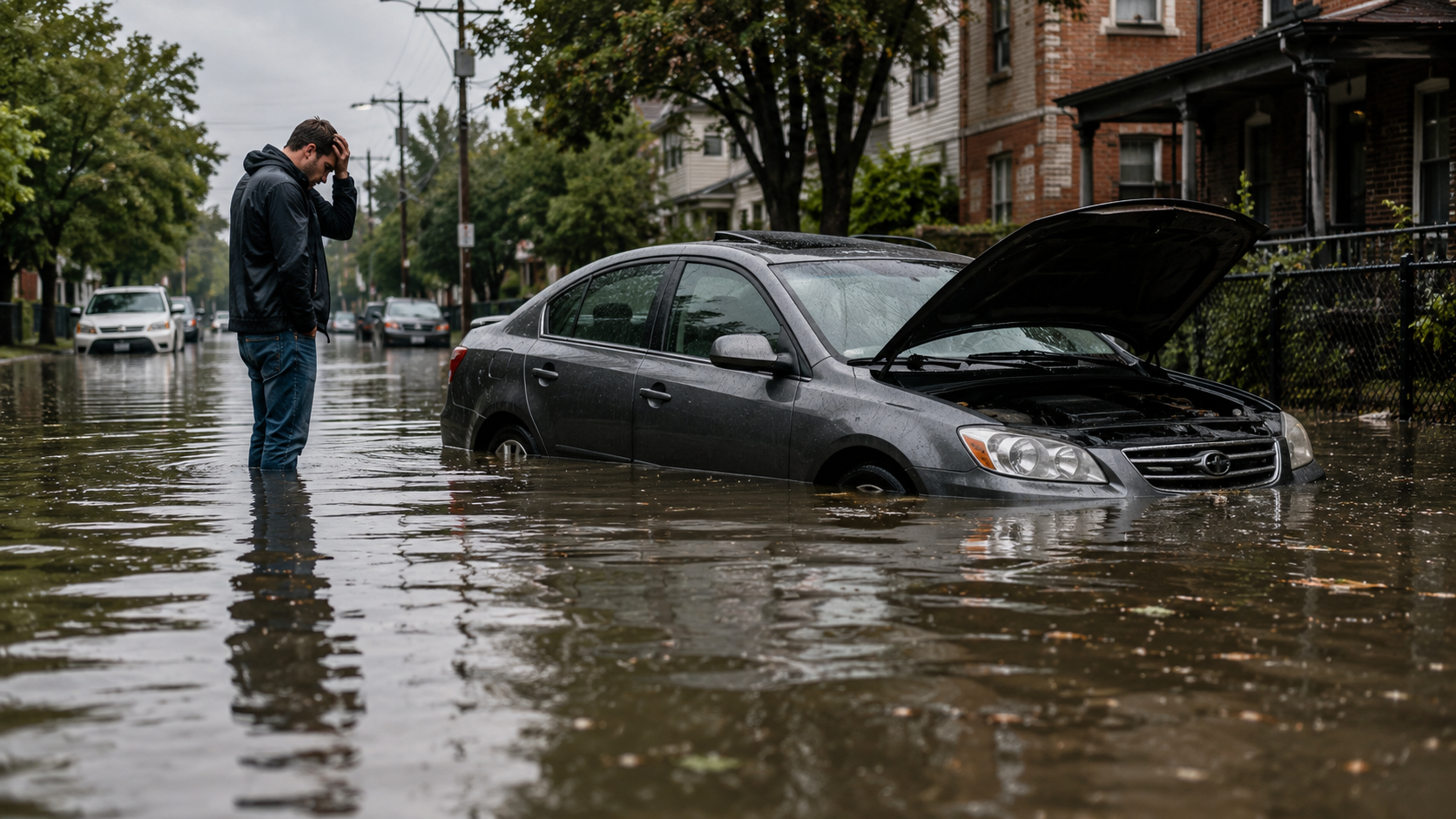
After heavy rain, a familiar road can suddenly look completely different. A large pool of water has formed beneath a bridge, the edges of the road are no longer clearly visible, and an SUV ahead drives through without stopping. It is tempting to follow because the water appears to be only slightly higher than the kerb.
A few metres later, the water is already reaching the lower edges of the doors. The car begins to feel heavy, a wave forms in front of it, warning lights appear on the dashboard and the engine suddenly stops. The driver’s first reaction is natural: press the start button again and try to drive out.
That second starting attempt can turn an unpleasant incident into a very expensive engine repair. If water has entered the cylinders, the starter may try to compress a liquid that is effectively incompressible. The result may be bent connecting rods, damaged pistons, valves, starter components or even a cracked engine block.
In another situation, the vehicle may not have been driven through floodwater at all. It may simply have been parked in an underground car park or outside while the water gradually rose to the sills, seats or dashboard. Once the water recedes, the exterior may appear almost normal, while damage beneath the carpets, inside connectors and within control modules is only beginning to develop.
The main principle: if the engine stops in deep water, do not attempt to restart it. If the vehicle has been flooded, it needs a professional inspection before anyone tries to find out whether it “still works”.
Driving through deep water and finding a parked car flooded are not the same situation
Several different scenarios should be distinguished when assessing the risk.
For a few seconds, the water reaches only the lower part of the tyres, the vehicle remains stable and the engine continues to run normally.
The risk of water entering the vehicle, brake problems, electronic faults and loss of control increases significantly.
In addition to depth, the force of the current acts on the vehicle. The car may lose grip, rotate or be swept off the road.
Water may remain for a long time inside the cabin, electrical connectors, control units, transmission and other components.
Even when two cars have been exposed to the same floodwater, the damage may be completely different. Water depth, exposure time, current, salt or mud contamination, air-intake position and vehicle design all matter.
Why is water depth difficult to judge from the driver’s seat?
The water’s surface does not reveal what lies beneath it. There may be a pothole, a washed-away road edge, an open drain, a displaced object or a sudden drop. What appears to be shallow water at first may become considerably deeper only a few metres ahead.
The fact that another vehicle has driven through successfully proves nothing. It may have greater ground clearance, a differently positioned air intake, larger wheels and a different overall weight. The first vehicle may also create a wave that increases the water level for the next one.
Comparing the water level with the kerb, wheel centre or number plate is only a rough visual estimate. A safe wading depth can be determined only from the manufacturer’s information for the specific vehicle and from genuinely verified conditions.
If the water depth or road condition is unknown, the safest choice is not to continue
Turning around and choosing another route may cost time. Engine hydrolock, a flooded cabin or a vehicle swept away by the current may cost the entire car and endanger lives.
Flowing water is more dangerous than standing water
In standing water, the main risks are depth and hidden obstacles. In flowing water, the vehicle is also subjected to sideways force. The tyres may lose contact with the road, while the body acts as a large surface against which the current pushes.
As the water rises, the effective weight pressing the tyres onto the road decreases. The vehicle may become unstable much earlier than the driver expects. A particularly dangerous situation exists when the road edges are no longer visible or the current crosses the carriageway.
Do not enter flowing water even in a four-wheel-drive vehicle. Four-wheel drive may improve traction on a road surface, but it does not protect against buoyancy, sideways current, a washed-away road or water entering the air intake.
What is engine hydrolock?
Engine hydrolock occurs when enough water enters a cylinder to replace the air that should normally be there. During normal operation, the piston compresses a mixture of air and fuel. Gas can be compressed, but liquid effectively cannot.
If the piston continues moving upwards, the mechanical load rises extremely quickly. The weakest component may bend, crack or break.
Possible damage caused by hydrolock
- a bent or broken connecting rod;
- a damaged piston or piston rings;
- damaged valves or cylinder head;
- damage to the crankshaft assembly;
- a cracked engine block;
- damage to the starter or starter drive;
- water mixing with engine oil and causing subsequent bearing damage.
The extent of the damage depends on engine speed, the amount of water that entered the cylinder and whether the engine stopped by itself or was turned again with the starter.
Why is the air intake more important than the exhaust pipe?
Drivers often look only at the height of the exhaust pipe. The risk of engine hydrolock, however, is mainly determined by the position of the air-intake opening and the route by which water can reach the air filter.
On some cars, the air intake is positioned relatively high. On others, it may be low behind a headlamp, bumper or wheel-arch area. Two vehicles with a similar overall height may therefore have very different safe wading capabilities.
While the engine is running, exhaust-gas pressure may under certain conditions help prevent water from moving deeply into the exhaust system. That does not make the crossing safe. If the engine stops, water may enter the exhaust, but the more serious risks remain the air intake, electronics and vehicle stability.
The safest response before a flooded section of road
- Reduce speed and stop in a safe place before the water.
- Check whether the edges of the road and the exit point are clearly visible.
- Determine whether the water is flowing and whether its level is rising.
- Do not treat another vehicle’s successful crossing as proof of the depth.
- Do not continue when the depth cannot be established safely.
- Leave enough room to turn around and avoid obstructing other vehicles.
- Choose another route whenever there is any reasonable doubt about safety.
A driver has no obligation to prove that the vehicle can cross a flooded road. Turning around is often the safest and most professional decision.
If you have already entered the water
If the water proves deeper than expected and a safe retreat is still possible, avoid sudden manoeuvres and panic. The main objective is to avoid creating a large bow wave and throwing more water into the engine compartment.
- drive slowly and steadily;
- avoid sudden acceleration;
- do not follow another vehicle closely;
- avoid sudden steering inputs;
- do not stop in the deepest area if safe movement remains possible;
- abandon the attempt immediately if the vehicle becomes unstable or the water continues to rise.
These points are not an invitation to cross deep water. They apply only when the driver has already entered it and is attempting to get out safely.
The engine stalled in the water: what should you do?
Do not turn the engine again with the starter
If the engine stopped in deep water, water may have entered the intake or cylinders. Every additional starting attempt can increase the damage.
Switch on the hazard lights if the electrical system still works, assess the safety of everyone inside and call roadside assistance. The vehicle should be recovered or transported using a method suitable for its design.
Before the engine is turned, a workshop should inspect the air filter, intake pipes, cylinders and fluids. In some cases, the spark plugs or glow plugs must be removed, the cylinders inspected with a camera and the engine’s condition assessed carefully before any attempt is made to rotate it.
If the car begins to float or is being moved by the current
At this point, saving the vehicle is no longer the priority. Protecting human life comes first. Call the emergency services as soon as possible and follow their instructions.
If the water is rising and it is still possible to leave safely, exit the vehicle as early as possible rather than waiting until it becomes unstable or the electrically operated windows stop working. Open a side window while you still can, release the seat belts and help children or passengers get out.
Do not return to the vehicle for a phone, bag or other possessions. Move towards higher and safer ground while avoiding fast-flowing water, drains and electrical infrastructure.
Every flood situation is different. If leaving the vehicle may itself be more dangerous than remaining inside, follow the instructions of the emergency services and do not step impulsively into a strong current.
After driving through shallower water
Even when the engine has not stopped, the journey should not simply continue as though nothing happened. Water may have affected the brakes, belts, electrical connectors and underbody components.
- Reduce speed in a safe location.
- Test the brakes gently.
- Check for pulling to one side or an unusual pedal feel.
- Listen for belt squeal, scraping or vibration.
- Monitor the engine temperature and dashboard warnings.
- Check whether the oil-pressure, charging or engine warning light is illuminated.
- Stop and call for assistance if any unusual symptom appears.
Braking performance may temporarily be reduced while the braking surfaces are wet. The brakes should be tested only at low speed, in a safe place and without endangering other road users.
What can water damage in a vehicle?
A wet filter, water in the intake pipes or water inside the cylinders may cause poor running and engine hydrolock.
Water may enter through breather openings or damaged seals and mix with the lubricating oil.
Muddy or salty water may damage seals, wash away grease and accelerate corrosion.
Faults may appear immediately or only weeks later as corrosion develops inside connectors.
Wiring, sensors, airbag modules and seat electronics may be located beneath the carpet.
Water, mud and sudden temperature changes may affect sensors, the catalytic converter, DPF and electrical connections.
Water inside the transmission, differential or reduction gearbox
The engine is not the only assembly that requires ventilation. Gearboxes, differentials and transfer cases may have breather openings that equalise internal pressure.
When a hot component is suddenly submerged in cold water, the air inside it cools and the internal pressure changes. If a breather or seal is below the waterline, moisture may be drawn into the assembly.
Oil contaminated with water may become cloudy or milky. It no longer provides the intended lubrication, and damage may develop gradually rather than immediately after the flood.
A flooded cabin is not merely a cleaning problem
The carpet may appear only slightly damp from above, while thick sound and heat insulation underneath has absorbed a large quantity of water. This material can take a very long time to dry.
Wiring looms, connectors, seat modules, airbag-system components, amplifiers and other electronics may be located beneath the floor covering. Simply vacuuming visible water from the cabin does not remove moisture trapped below the insulation.
Consequences of inadequate drying
- mould and bacterial growth;
- a persistent damp or sewage-like smell;
- windows repeatedly misting up;
- corrosion of electrical connections;
- airbag and seat-system faults;
- corrosion of the body from inside the cabin;
- recurring and difficult-to-explain electrical problems.
Professional restoration may require removal of the seats, carpet and insulation, washing and disinfecting the cabin, inspecting control modules and carrying out prolonged controlled drying.
Why can electrical faults appear later?
Pure water conducts electricity relatively poorly, but floodwater contains salts, mud, organic material and other contaminants. These remain inside connectors even after the visible water has dried.
At first, the vehicle may appear to work normally. Later, contacts oxidise, electrical resistance increases and intermittent faults develop. They may appear only in damp weather, during vibration or at a particular temperature.
A flooded vehicle therefore cannot be considered repaired merely because fault codes have been cleared. Connectors and modules located within the flooded area must be inspected physically.
Differences between petrol and diesel vehicles
Both petrol and diesel engines can suffer hydrolock. A diesel engine normally has a higher compression ratio and some stronger internal components, but that does not mean it can safely compress water.
On a diesel vehicle, the turbocharger and intercooler system should also be inspected. Water may remain inside the intercooler or boost pipes and enter the engine only after it has already been restarted.
On a petrol vehicle, water and moisture may affect ignition coils, spark-plug wells and high-voltage ignition components. The result may be hesitation, misfire faults and uneven engine operation.
A hybrid vehicle after flooding
A hybrid contains both an internal-combustion engine and a high-voltage electrical system. Engine-intake, fuel-system, 12-volt electronics and traction-battery risks may therefore exist at the same time.
The driver should not attempt to disconnect high-voltage components, remove orange cables or open the traction-battery casing. Such work must be carried out only by appropriately trained specialists.
Even when the petrol engine was not running during the flood, water may have reached floor-mounted modules, battery ventilation, charging electronics or safety systems.
A flooded electric vehicle: what must you not do?
Do not connect a flooded electric vehicle to a charger
Do not test whether charging works, and do not touch damaged high-voltage cables or the traction-battery casing. The vehicle must be assessed by a qualified specialist.
An electric vehicle’s high-voltage battery enclosure is designed to resist environmental exposure, but flooding, impact damage, corrosion or prolonged immersion may create faults that cannot be seen externally.
If the vehicle produces smoke, crackling noises, an unusual smell, vapour or significant heat, move away and call the emergency services. Do not store a suspicious flooded electric vehicle inside a closed garage before its safety has been assessed professionally.
The recovery operator must be told that the vehicle is a flooded electric car. Lifting, towing and storage methods should follow the rescue and transportation instructions for the specific manufacturer and model.
Salt water creates additional risks
Seawater or water heavily contaminated with road salt is particularly aggressive. Salts improve electrical conductivity and accelerate corrosion of metals and electrical connections.
Salt residue remains on surfaces even after they appear dry. Thorough cleaning, connector inspection and longer-term monitoring are therefore required.
When a traction battery has been exposed to salt water, it is especially important to inform the emergency services, insurer and recovery company about the type of flooding.
The vehicle was flooded while parked: the correct sequence of actions
- Confirm that the area is safe and that there is no electrical or structural danger.
- Do not force the doors open while the surrounding water remains high.
- Do not switch on the ignition or attempt to start the vehicle.
- Do not connect a charger or experiment with the battery.
- Photograph the waterline, cabin and external damage.
- Record the approximate time of the event and how long the vehicle remained in water.
- Contact the insurer and roadside-assistance provider.
- Tell the recovery operator if the vehicle is a hybrid or electric car.
- Have the vehicle transported for a professional inspection before any starting attempt.
Even switching on the ignition once may activate modules and cause current to flow through wet connectors. A quick attempt to test the windows, seats or infotainment system may therefore make the damage worse.
Should you disconnect the 12-volt battery yourself?
In a dry and safe environment, disconnecting the battery may sometimes reduce further electrical damage. In a flood situation, however, access to the battery may be dangerous, and on some vehicles it is located beneath a seat, in the boot or within the flooded area.
If water remains around the vehicle, damaged wiring is visible, there is a burning smell or the vehicle is a hybrid or electric car, do not disconnect anything yourself. Wait for professional instructions.
Disconnecting a high-voltage system is not the same as removing the terminals from a conventional battery. It must not be attempted without training and the manufacturer’s prescribed procedure.
What should the workshop inspect?
- inspection of the air filter and intake system;
- checking the cylinders for water;
- assessment of the engine oil and oil filter;
- a compression or cylinder-leakage test when mechanical damage is suspected;
- inspection of the turbocharger, boost pipes and intercooler;
- inspection of gearbox, differential and reduction-gear oils;
- assessment of the brakes and wheel bearings;
- inspection of wiring, connectors and control modules;
- removal and complete drying of cabin materials when water entered the interior;
- diagnosis of the airbag and seat systems;
- inspection of the 12-volt and high-voltage systems;
- a controlled test drive only after the vehicle has been declared safe.
Why may an oil change alone be insufficient?
If water is visible in the engine oil, replacing the oil and filter is necessary, but it does not prove that the engine has escaped mechanical damage. A bent connecting rod or damaged bearing may not produce obvious symptoms immediately.
Water may also remain inside the intercooler, intake pipes, exhaust system, transmission and electrical connectors. Replacing one fluid does not address the entire flooding event.
The repair plan should be based on the actual water level and the components exposed, not merely on whether the engine starts after drying.
When may an inspection be enough, and when may repairs be uneconomical?
The vehicle briefly crossed shallow water, the engine did not stop, no water entered the cabin and no symptoms appeared afterwards.
The engine stopped, the air filter is wet, the water reached the sills or the cabin is damp and electrical faults have appeared.
The water reached the seats or dashboard, the vehicle remained submerged for a long time, salt water was involved or the high-voltage battery was affected.
The economic viability of a repair depends on the vehicle’s value, the type of water, the flood level, the amount of electronics and the availability of replacement parts. A technically possible repair is not always financially sensible.
Illustrative cost example
Assume the engine stops in deep water. In the first scenario, the driver does not restart it, calls a recovery truck and the workshop cleans the intake, replaces contaminated fluids and performs an inspection. In the second scenario, the engine is repeatedly turned with the starter and suffers mechanical damage.
The amounts are illustrative and are not a quotation from a specific workshop. Costs depend on the vehicle, engine, flood exposure and extent of the damage.
Documenting the incident for an insurance claim
Before cleaning or moving the vehicle, photograph the overall scene, the waterline on the body, the cabin, engine compartment and visible damage whenever it is safe to do so.
Record the location, time, approximate water height and whether the engine continued running or stopped. Keep all recovery, rescue, diagnostic and repair documents.
Contact the insurer before repairs begin and follow its claim-reporting and inspection procedure. Cover and requirements depend on the individual insurance policy.
How can you identify a previously flooded used car?
After professional or superficial cleaning, external signs of flooding may be difficult to see. Moisture and sediment, however, often remain in areas that are not normally reached during routine interior cleaning.
- a strong damp, mouldy or air-freshener smell;
- new carpets or seats in an older car without a clear explanation;
- mud beneath the seat rails or boot trim;
- rust on interior screws and metal brackets;
- waterlines or sediment inside the doors;
- oxidised fuses and electrical connectors;
- multiple unrelated electrical faults;
- mist inside lamps or moisture within control modules;
- several recently replaced interior electronic modules;
- an incomplete or contradictory vehicle history.
No single sign proves that the vehicle was flooded. A combination of several signs, however, is a strong reason to arrange an independent inspection and investigate the vehicle’s history carefully.
What should you ask the workshop after flooding?
☐ Was water found in the air filter or intake?
☐ Were the cylinders checked before the engine was turned?
☐ Was the intercooler checked for trapped water?
☐ Was water contamination found in the engine oil?
☐ Were the gearbox and final-drive oils inspected?
☐ Were the wheel bearings and brakes checked?
☐ Which control modules were below the waterline?
☐ Were the carpet and insulation removed from the cabin?
☐ How were the airbag systems checked?
☐ Was a high-voltage insulation test performed?
☐ Which faults could still appear later?
☐ Which repairs and parts are covered by a warranty?
Driver’s checklist
☐ The water depth and road edges are clearly known
☐ The water is not flowing across the road
☐ There is a safe exit and turning opportunity
☐ I am not relying only on the vehicle ahead
☐ A stalled engine is not restarted
☐ A flooded electric vehicle is not connected to a charger
☐ Human safety is more important than the vehicle
☐ Emergency services have been called when necessary
☐ The incident has been photographed and documented
☐ The insurer has been contacted before repairs
☐ The recovery operator has been informed about a hybrid or electric vehicle
☐ A professional inspection has been completed before driving
A short self-check
The engine stopped in deep water, but the starter still turns it. Should I try again?
No. The fact that the starter can turn does not mean the cylinders contain no water. Another attempt may bend connecting rods or cause other mechanical damage.
The water reached only the door sills, and nothing is visible inside. Is an inspection still necessary?
Yes, especially when the water was deep or the vehicle remained in it for a longer period. The underbody, transmission breathers, electrical connections and the area beneath the carpet should be inspected.
The electric vehicle was in floodwater, but the dashboard works normally. Can it be charged?
No, not until the vehicle has been inspected by a qualified specialist. A normal dashboard display does not confirm that the high-voltage battery and insulation are safe.
The brakes were briefly weak after leaving the water but then recovered. Is everything all right?
Wet brakes may temporarily perform less effectively, but vibration, pulling to one side, unusual noises and warning lights should still be monitored. After deeper water, an inspection of the brakes and wheel components is sensible.
Frequently asked questions
Can a taller SUV safely drive through any depth of water?
No. Greater ground clearance may help, but safety also depends on the air-intake position, breather openings, electrical components, current and road surface.
Does four-wheel drive protect a vehicle from flooding?
Four-wheel drive improves traction on the road, but it does not protect against hydrolock, flowing water, buoyancy, a washed-away road or flooded electronics.
Does water inside the exhaust pipe damage the engine?
Water in the exhaust system may cause problems, but engine hydrolock is normally associated with water entering the air intake and cylinders. The entire incident must be assessed, not only the height of the exhaust pipe.
Does a wet air filter mean the engine is already damaged?
Not necessarily, but it is a serious warning that water reached the intake system. The engine should not be turned until the intake pipes and cylinders have been checked.
Can a flooded cabin be dried with a heater and open windows?
That is often insufficient. The insulation beneath the carpet may retain water, while dirt and salts remain inside electrical connectors. Interior disassembly and professional drying may be necessary.
If the car starts after flooding, does that mean there is no damage?
No. Corrosion, contaminated transmission oil, safety-system faults and bearing damage may appear later.
Must every oil in the vehicle be replaced after flooding?
That depends on the water level, breather positions and vehicle design. Fluids should first be inspected, and replacement should be carried out in assemblies where water may have entered.
Can a flooded vehicle always be restored completely?
Many components can technically be repaired, but deep flooding or salt-water exposure may create such extensive and unpredictable long-term damage that restoration is not economically sensible.
A few minutes of caution can save the engine and protect lives
A flooded road creates pressure to make a quick decision. Other vehicles may be waiting behind, someone ahead may already have crossed and turning around may feel inconvenient. None of those factors changes the water depth, the height of the air intake or the force of the current.
When the conditions are unknown, refusing to continue is a professional decision, not a fearful one. If the engine stops in water, another starting attempt is not a diagnostic test. If the cabin or electronics have been submerged, superficial drying is not a complete repair.
Protect people first, prevent additional damage second and only then assess whether the vehicle should be restored.
The main takeaway: do not enter water when you cannot safely determine its depth or the condition of the road beneath it. If the engine stalls, do not restart it. Do not connect a flooded hybrid or electric vehicle to a charger or touch high-voltage components. Document the incident, call for assistance and arrange a professional inspection before the next starting attempt.